
Table of Contents
At its core, DeFi risk management is the practice of finding, evaluating, and softening potential financial losses inside decentralized finance protocols and investments. It means digging into everything from the smart contract code itself to the wild swings of market volatility to keep assets safe in a very high-stakes game. This isn't something you set and forget; it's a constant, active process vital for survival and success.
Why DeFi Risk Management Is Your Most Important Skill

Welcome to the fast-paced, often chaotic world of decentralized finance. Jumping into DeFi isn't like playing slots at a casino. A better analogy? It's like building a skyscraper in the middle of an earthquake zone. The potential rewards can be towering, but the structural risks are just as massive and all tangled together.
Without a solid foundation of DeFi risk management, even the most promising projects can crumble under unexpected stress. This is exactly why getting a handle on these principles is the single most important skill for any investor, developer, or user in this space. It's what separates those who build lasting value from those who become another cautionary tale.
Moving Beyond Simple Definitions
It's a common mistake to think of risk management as just a checklist to tick off. It's not. You have to see it as a living, breathing discipline. The threats in DeFi don't stand still—they morph and evolve as new protocols launch, market sentiment shifts, and hackers cook up new ways to attack.
A proactive risk management approach transforms you from a passive participant into a strategic operator. It’s about anticipating potential failures before they happen and building layers of defense to protect your capital and your project’s integrity.
This guide will take you far beyond simple definitions. We're going to give you a practical framework for spotting and neutralizing these threats. We'll explore the main types of risk that everyone needs to understand to move through this ecosystem with real confidence.
The Core Pillars of DeFi Risk
A well-rounded DeFi risk management strategy has to cover several connected areas. Each one is a potential weak point that, if ignored, could set off a chain reaction of negative events. We’re going to cover a few key areas:
- Smart Contract Risk: Hidden flaws or bugs in a protocol's code that hackers can exploit.
- Market Risk: The unpredictable price swings that can lead to sudden liquidations and impermanent loss.
- Liquidity Risk: Not being able to get out of a position without crashing the price because there aren't enough buyers or sellers.
- Regulatory Risk: The ever-present uncertainty around government rules and new laws that could suddenly change the game.
Understanding these pillars is the first step toward building a strong defense. This mindset applies even to assets that seem safe on the surface. For instance, knowing the fundamentals of stablecoin security is critical, as these are not entirely risk-free. By treating risk management as an essential survival skill, you can start your DeFi journey on the right foot, ready for what comes next.
Understanding the DeFi Risk Landscape
Jumping into decentralized finance is a lot like exploring a new frontier. There are incredible opportunities, but you have to know the lay of the land—and all its hidden dangers. The first step in managing DeFi risk is simply knowing what you’re up against, because the threats here don't have perfect parallels in the old financial world. And don't make the classic mistake of looking at each risk in a vacuum; they’re often tangled together, where one problem can easily set off a chain reaction.
Think of a smart contract as the architectural blueprint for a skyscraper. If there's even a tiny flaw in that blueprint—a single line of bad code—the whole structure becomes vulnerable. That’s smart contract risk. It’s the ever-present danger that a bug or exploit in a protocol’s code could let a bad actor waltz in and drain its vaults. We’ve seen this happen time and again, costing users billions.
For anyone just getting their feet wet, it’s a good idea to have a solid understanding of the broader cryptocurrency landscape first. Getting a feel for how value moves and is secured in crypto makes the specific DeFi risks we’re about to cover much easier to wrap your head around.
Data Feeds and Digital Bank Runs
Next up is oracle risk. Oracles are the bridges that feed real-world data, like the price of ETH, into DeFi protocols. Imagine an oracle is the live stock ticker for a trading floor. If someone hacks that ticker and flashes a fake price, every trade based on that bad information is going to be a disaster. In DeFi, a manipulated oracle can trick a lending protocol into thinking collateral is worthless or priceless, opening the door for catastrophic exploits.
Then you have liquidity risk, which is basically the DeFi version of a bank run. This happens when a protocol simply doesn't have enough cash on hand to pay out everyone who wants to withdraw their funds. If a wave of users all try to pull their money out of a liquidity pool at once—maybe sparked by bad news or just plain market panic—the pool can run dry, trapping everyone else's capital inside.
The real danger in DeFi isn't just one thing going wrong, but how fast one failure can infect the next. A smart contract bug could crater a token's price, sparking massive market volatility and triggering a liquidity crisis as everyone rushes for the exits.
Market Volatility and Governance Failures
Even with perfect code, the market itself is a minefield. Market risk is all about the wild price swings that are just part of the crypto experience. This covers everything from impermanent loss when you’re providing liquidity to the nightmare scenario of getting liquidated on a lending platform because your collateral’s value suddenly tanked. Even stablecoins, which are built for stability, aren’t immune. A quick look into specific stablecoin risks shows how things like de-pegging can send shockwaves through the market.
Finally, there are two big-picture threats that hang over the entire ecosystem:
- Governance Risk: This is what happens when the voting process for a Decentralized Autonomous Organization (DAO) gets hijacked. If someone gets their hands on enough governance tokens, they could push through a malicious vote to, say, empty the entire treasury into their own wallet.
- Regulatory Risk: This is the constant "what if" of government intervention. A sudden ban, new tax rules, or heavy-handed regulations could completely change the game overnight, crushing a protocol’s viability and the value of its assets.
To help keep these threats straight, it's useful to see them side-by-side.
The Pillars of DeFi Risk A Quick Guide
Here’s a simple breakdown of the main risks you'll encounter in the DeFi space, what causes them, and what they look like in the real world.
| Risk Category | Primary Cause | Common Example |
|---|---|---|
| Smart Contract | Bugs or flaws in the protocol's code. | An exploit allowing an attacker to drain funds from a lending pool. |
| Oracle | Inaccurate or manipulated external data. | A flash loan attack that manipulates a price feed to borrow uncollateralized funds. |
| Liquidity | Insufficient assets to meet user withdrawals. | A "digital bank run" where users cannot withdraw their funds from a protocol. |
| Market | High price volatility of crypto assets. | A user's collateral being liquidated during a sudden market crash. |
| Governance | Manipulation of a protocol's voting process. | A bad actor acquiring enough tokens to vote to steal treasury funds. |
| Regulatory | Unpredictable government action or new laws. | A country banning a specific protocol, causing its token value to collapse. |
Keeping these pillars in mind is the first step toward building a smarter, safer strategy for navigating the exciting, but often treacherous, world of decentralized finance.
How to Assess and Quantify Protocol Risk
Knowing the different types of DeFi risks is a great start, but the real work begins when you learn how to measure them in a live protocol. Without a solid way to evaluate a project, you're basically flying blind. A practical framework is what helps you slice through the hype and make decisions based on what’s actually there, not just what the community is buzzing about.
The idea is to build a repeatable process you can use on any protocol, whether it's a brand-new decentralized exchange or a lending market that’s been around for years. A simple but powerful approach boils down to three steps: Identify, Score, and Prioritize. This turns a pretty complex job into something manageable, helping you spot the red flags before you put any capital on the line.
This diagram breaks down three of the most critical risk areas—smart contracts, oracles, and liquidity—which really form the bedrock of any serious protocol assessment.
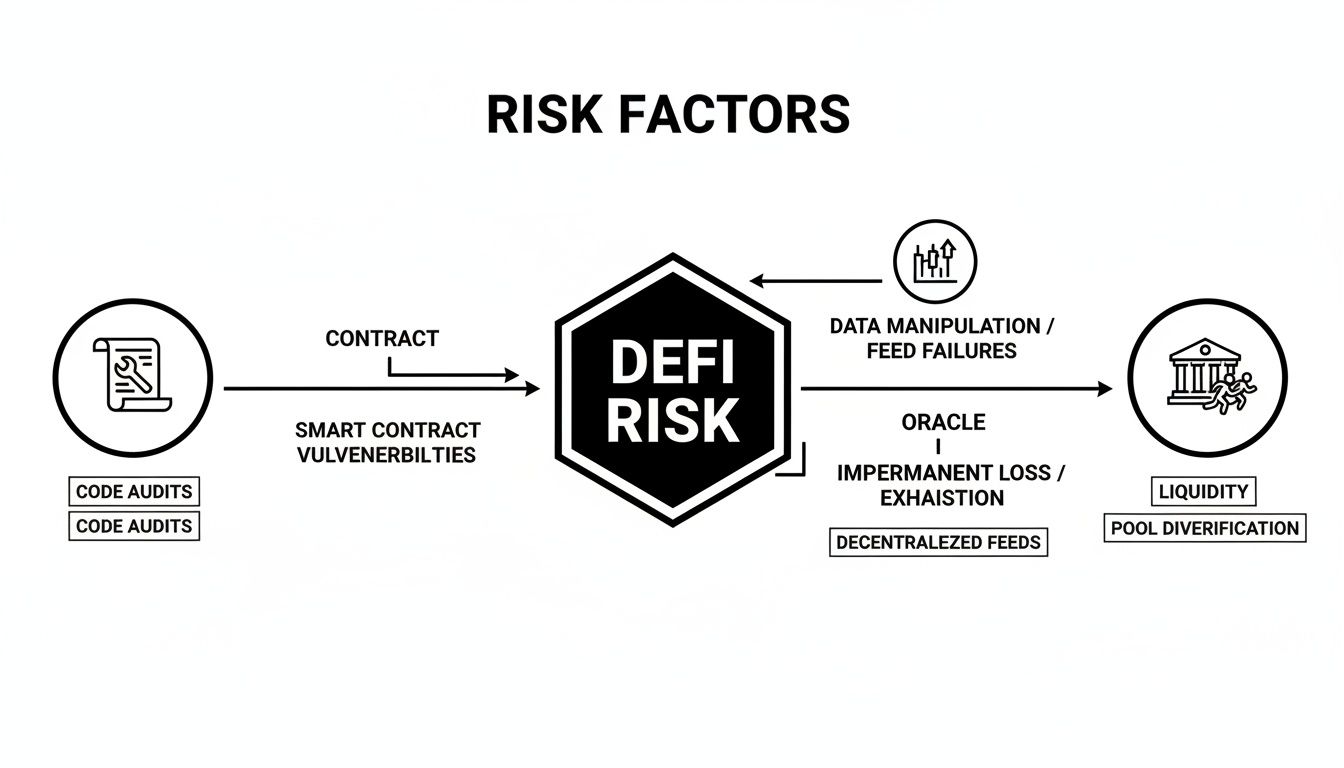
As you can see, these pieces are all tangled together. A weak link in one area can easily cause a domino effect across the others, which is why you have to look at the whole picture.
Creating Your Own Risk Matrix
A risk matrix is just a simple grid that helps you score protocols in a structured way. It’s a tool for putting a number on fuzzy, qualitative factors, giving you a much clearer view of a project's overall risk profile. You can build your own by picking a few key categories and scoring each one on a scale—say, 1 to 5, where 5 is the highest risk.
Here are a few essential factors you’ll want to include in your assessment:
- Code Audits: Has the protocol actually been audited? You should be looking for multiple audits from well-known security firms. A single audit, or worse, a self-audit, is a huge red flag.
- Team Anonymity: Do you know who the developers are? Anonymous teams dramatically increase the risk of a rug pull because there's zero accountability if things go south.
- TVL Concentration: Is the Total Value Locked (TVL) spread out, or is most of it coming from just a handful of wallets? When a few "whales" control the liquidity, one of them pulling out can destabilize the entire protocol.
- Oracle Dependencies: Does the protocol get its price data from a single, centralized oracle? That’s a massive single point of failure just waiting to be exploited. It's worth getting familiar with the common stablecoin oracle manipulation vectors to understand what can go wrong here.
By scoring each of these, you graduate from a gut feeling of "this seems risky" to a hard number you can work with. A protocol with an anonymous team and no audits? That might score a 5 in both categories, instantly telling you it's in the high-risk zone.
Key Metrics to Monitor
Your initial assessment is just the beginning. To really manage risk in DeFi, you have to keep monitoring things constantly. Protocols and markets can change in a flash, and a project that looks solid today could be on shaky ground tomorrow. Keep a close watch on these key performance indicators (KPIs) to stay ahead of trouble.
1. Collateralization Ratios
For any lending protocol, this is the metric that matters most. It's the ratio of the value of assets locked up as collateral versus the value of assets being borrowed. A healthy, overcollateralized system (think 150% or more) gives you a solid cushion against market swings. If that ratio starts to drop, it’s a warning sign that liquidation risk is climbing.
2. Insurance Fund Size
Some protocols have an insurance fund set aside to cover user losses from hacks or other disasters. A growing, well-funded treasury shows a real commitment to security and resilience. On the flip side, a tiny or shrinking fund is a major cause for concern.
3. Governance Activity
An active and engaged governance community is often a sign of a healthy project. Keep an eye on proposal turnout, how people are voting, and the quality of the discussions. If the governance forum is a ghost town, it could mean the project is either abandoned or so centralized that the community has no real power. This kind of ongoing vigilance is what separates reactive panic from proactive risk management.
Proactive Strategies for Mitigating DeFi Risks
Spotting and understanding risk is only half the battle. The other, far more critical half, is building a solid defense. Real DeFi risk management isn't about trying to sidestep every possible danger—that's impossible. Instead, it’s about layering proactive strategies to defuse threats before they turn into full-blown disasters.
This means shifting from a reactive mindset to a tactical one, using the right tools and techniques to secure everything from the code itself to the way you hold your keys.
A strong defense has to start at the very foundation: the smart contract. Think of it like checking the blueprints of a skyscraper before you build. A bug in the code is the most direct route to losing money, so this is one area where you simply can't cut corners.
Fortifying Smart Contracts and Oracles
The undisputed gold standard for securing code is the independent security audit. One audit is a good start, but getting multiple, independent reviews from reputable firms is far better. Each firm brings a different set of eyes and a unique methodology, which dramatically increases the odds of catching those subtle, hard-to-find bugs that a single team might overlook.
For protocols handling serious value, there's an even higher level of assurance: formal verification. This is a deep, mathematical process that rigorously proves the code will behave exactly as intended, effectively wiping out entire categories of potential exploits. It’s complex and expensive, but it's an incredibly powerful safeguard.
Of course, the code is only as good as the data it relies on. When it comes to oracle risk, the answer is decentralization.
- Decentralized Oracle Networks: Protocols like Chainlink avoid putting all their eggs in one basket. They aggregate price feeds from a wide network of independent, pre-vetted nodes, making it much harder for bad data to slip through.
- Reputation and Staking: These networks have skin in the game. Nodes are required to stake the network's token (like LINK) as collateral. If they feed the network bad data, their stake gets slashed.
This system makes it incredibly expensive and difficult for any one person to manipulate the price feeds that so many DeFi applications depend on.
Taming Market and Liquidity Risks
Even with perfect code and trustworthy oracles, the crypto market's wild volatility can still cause chaos. The best protocols anticipate this and build in automated safeguards to protect users from sudden price crashes and cascading liquidations.
One of the most powerful tools for this is the circuit breaker. Just like in the stock market, these mechanisms can automatically pause certain actions—like new borrowing or liquidations—if an asset's price moves too violently in a short window. That brief pause can give the market a moment to breathe and prevent a panic-fueled death spiral.
Protocols also manage risk by using dynamic parameters. For instance, a lending platform might automatically tighten borrowing limits or raise collateral requirements for volatile assets when the market gets choppy. This adaptive approach helps keep the platform solvent precisely when it's under the most stress.
A well-designed protocol doesn't just hope for the best; it prepares for the worst. Built-in safeguards like circuit breakers and dynamic borrowing limits are the digital equivalent of emergency brakes, designed to prevent a bad situation from becoming a total catastrophe.
Mastering Your Personal Operational Security
All the protocol-level defenses in the world won't matter if your personal security is weak. The hard truth is that attacks targeting individual users have become the biggest threat in the space. Recent analysis shows that compromised private keys were behind a staggering 47% of all stolen funds, a clear sign that hackers are shifting from complex code exploits to much simpler attacks on users. You can explore the full findings on DeFi hacks from Halborn for a deeper look.
This is where your own personal risk management becomes the most important line of defense. There are two tools that are non-negotiable for anyone serious about security.
- Hardware Wallets: Often called "cold storage," these are physical devices that keep your private keys completely offline and isolated from the internet. This makes it practically impossible for malware or a remote hacker to get to them.
- Multi-Signature (Multi-Sig) Wallets: A multi-sig setup requires more than one private key to approve a transaction. This simple change removes a single point of failure. Even if a hacker steals one key, your funds are still safe.
Making these tools part of your routine is a massive step up in security. For more on this, check out our guide on digital asset custody solutions. By pairing rock-solid protocol defenses with your own disciplined personal security, you can build a truly resilient strategy for navigating DeFi safely.
Navigating Regulatory and Illicit Finance Threats
While it's easy to get bogged down in the technical weeds of smart contracts and market swings, some of the most serious threats to DeFi come from the outside world. Regulatory uncertainty and illicit finance are two powerful forces that can shake even the most well-built protocols. To truly manage risk in DeFi, you have to zoom out and see how these big-picture issues affect the entire ecosystem.
The very things that make DeFi so exciting—permissionless access, user privacy, and cutting out the middleman—also make it a tempting playground for bad actors. When you mix cybersecurity gaps with a lack of serious Anti-Money Laundering (AML) and Countering the Financing of Terrorism (CFT) controls, you get a perfect storm. This environment unfortunately draws in sophisticated criminal groups, leading to massive exploits that wreck user trust and bring down the hammer of regulatory scrutiny.
The Scale of Illicit Finance
The numbers here don't lie, and they paint a pretty grim picture. Illicit activity is a constant drag on the ecosystem, with state-sponsored hackers and cybercriminals draining billions of dollars. What's surprising is that a huge chunk of this isn't from some genius on-chain exploit, but from basic failures in operational security.
Private key compromises are a massive problem, causing 43.8% of the billions in stolen funds—a figure that’s up a staggering 21% year-over-year. In fact, a shocking 80.5% of all money stolen from DeFi hacks happened through off-chain attacks. The data shows that only 20% of the targeted protocols were audited, and even fewer used multi-sig wallets (19%) or cold storage (2.4%). The U.S. Treasury has directly called out DeFi's lack of AML compliance as a major enabler for ransomware, fraud, and terrorist financing. You can dig into more of these trends in the 2025 Crypto Crime Report from Chainalysis.
The lesson here is crystal clear: real DeFi risk management has to combine on-chain audits with tough off-chain security. Protecting private keys is every bit as critical as writing secure code.
The Challenge of Regulatory Uncertainty
On the other side of this macro risk coin is regulation. Governments and financial authorities across the globe are scratching their heads, trying to apply rules designed for centralized banks to a decentralized, borderless system. This fundamental mismatch creates a fog of uncertainty for developers, investors, and users.
The core challenge for regulators is fitting a square peg into a round hole. Traditional finance is built on intermediaries—banks, brokers, and clearinghouses—that can be regulated. DeFi removes them, leaving authorities unsure of who to hold accountable when something goes wrong.
This regulatory ambiguity creates a few distinct risks that can't be ignored:
- Jurisdictional Risk: A protocol might be perfectly legal in one country but considered illegal in another. This creates huge operational headaches and can split the user base.
- Compliance Burden: The sheer cost and complexity of trying to follow unclear or conflicting rules can crush innovation, especially for smaller teams without a big legal budget.
- Enforcement Actions: A sudden crackdown or a regulator reclassifying a token as an unregistered security can wipe out a project's value almost overnight.
Building for a Compliant Future
If DeFi is ever going to hit the mainstream, it has to tackle these threats head-on. Proactively working with regulators and adopting industry-wide security standards aren't just nice-to-haves; they are essential for long-term survival and legitimacy.
Developers can start building compliance-ready protocols right now. This could mean integrating optional identity verification layers for institutional players or using analytics tools to screen for illicit funds—finding a middle ground between decentralization and regulatory needs. For investors, this means adding jurisdictional risk to your due diligence. You need to look closely at a protocol's legal structure and the regulatory climate where its core team operates. Understanding these approaches is key, and you can learn more by exploring the principles of digital asset compliance.
Ultimately, managing these external risks is a team sport. By embracing transparency, tightening up security hygiene, and working constructively with policymakers, the DeFi community can build a more resilient and trustworthy financial system for everyone.
Building a Resilient DeFi Future
Let's be clear: navigating DeFi isn't a one-and-done task. It's a constant practice of being vigilant and ready to adapt. Proper risk management in this space isn't about ticking off a checklist; it's a living, breathing process of spotting threats, understanding weaknesses, and building multiple layers of defense. This mindset is what separates those who survive and thrive from those who don't in an ecosystem that's always changing and deeply intertwined.
One of the biggest elephants in the room is systemic risk, largely driven by value concentration. Think about it: the top 20 protocols currently rake in nearly 80% of all fees. If just one of those giants stumbles, the shockwave could ripple through the entire market. This stark reality means diversification isn't a luxury—it's a necessity, alongside smart treasury strategies designed to protect against any single point of failure. If you want to dig deeper into this concentration and other key trends, you can explore detailed insights on the state of DeFi.
So, what’s next? The path forward lies in more mature governance models and DAOs that operate with real professionalism, acting as the sophisticated risk managers the ecosystem needs. To truly build a stronger DeFi, you have to create a resilient risk management strategy. By being proactive, educated, and constantly watchful, we all can shift from just being users to becoming the architects of a much more stable and secure financial future.
Your DeFi Risk Questions, Answered
Jumping into DeFi often raises more questions than answers. It's one thing to read about risk in theory, but it's another to face it in practice. Let's tackle some of the most common questions I hear from users trying to navigate this space safely.
As a Beginner, What's the First Thing I Should Focus On?
If you're new to DeFi, your number one priority is personal operational security. It’s easy to get fixated on the big, flashy smart contract hacks you see in the news, but a huge chunk of losses actually comes from simple user mistakes. Your entire focus should be on one thing: protecting your private keys. They are the only thing that stands between you and losing everything.
The best way to start is with a hardware wallet. Think of it as a small, specialized vault. These physical devices keep your keys totally offline, which means they're out of reach for hackers, malware, and the phishing attacks that constantly target browser-based wallets.
Right alongside that, you have to get good at spotting phishing scams. They’re everywhere—fake emails, malicious links, pop-ups that look just like the real thing. Get into the habit of obsessively checking URLs and never, ever type your seed phrase into a website or app. If you can master just these two things, you’ve already built a formidable defense against the most common ways people lose their crypto.
How Do I Know if a DeFi Protocol's Audit Is Any Good?
A security audit is a must-have, but just having one doesn't mean a protocol is safe. A good audit is a sign of transparency and a team that takes security seriously, but you have to know what to look for.
When you're looking at an audit report, here's what actually matters:
- Who Did the Audit? Is the firm a well-known name in the space with a solid reputation? An audit from a top-tier security firm carries a lot more weight.
- What Did They Audit? Check the scope. A useful audit covers all the critical smart contracts and thinks about potential economic attacks, not just a tiny piece of the code.
- What Did They Find? Look for any "critical" or "high-severity" vulnerabilities. These are the time bombs that hackers are looking for.
- Did the Team Fix It? This is the most important part. The report should show that the developers actually fixed the problems the auditors found. An audit that finds a dozen critical flaws is only useful if the team proves they've patched them.
A good audit report isn't one with zero findings. It's one where a thorough search was done, and the development team responsibly fixed every single serious issue that was brought to their attention.
Is DeFi Insurance Actually Worth Buying?
DeFi insurance can be a great safety net, but you have to be crystal clear on what it covers—and what it doesn't. It's not a magic shield against all risk, but it can be a smart move for protecting yourself against specific disasters. Whether it's right for you comes down to your own risk tolerance.
Services like Nexus Mutual let you buy coverage against specific protocol failures. The most common type of coverage is for smart contract failure—basically, a bug or an exploit that directly causes you to lose funds. For example, if a lending protocol you're using gets hacked and your deposited assets are drained, your insurance policy should pay out.
But there are big blind spots. DeFi insurance generally will not cover:
- Market Risk: If you get wiped out by impermanent loss in a liquidity pool or liquidated in a market crash, that's on you.
- User Error: Lost your private keys? Got tricked by a phishing scam? Insurance won't help.
- Oracle Failures: Losses that happen because a price oracle was manipulated are almost always excluded from policies.
Think of DeFi insurance as a specialized tool. It's a solid investment if you're worried about a catastrophic protocol hack, but it does nothing to protect you from bad market moves or a lapse in your personal security.
Ready to deepen your understanding of the digital asset economy? At Stablecoin Insider, we provide the essential news and analysis you need to stay ahead. Explore our insights today at https://stablecoininsider.com.