

Table of Contents
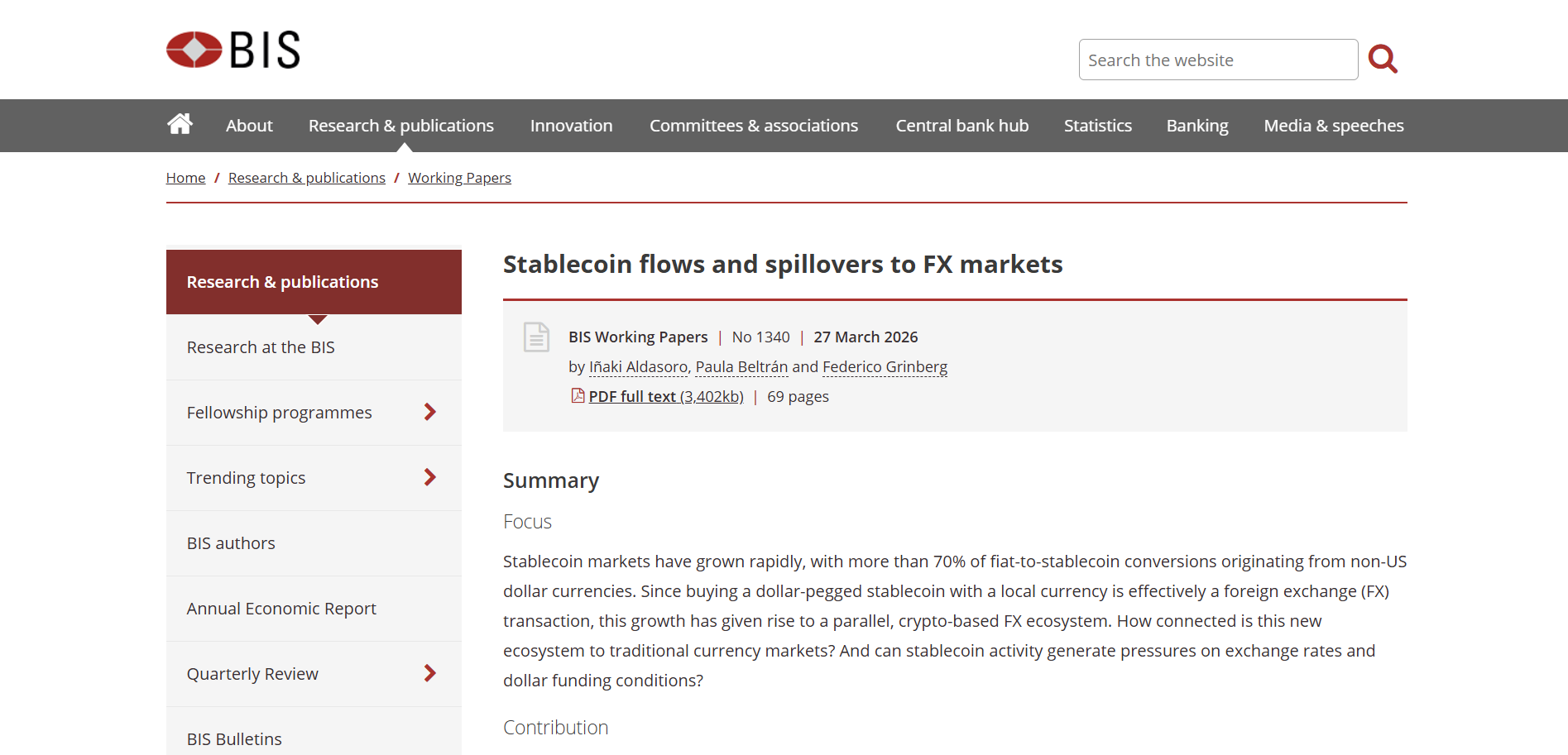
Co-authored with IMF researchers, the BIS Working Paper No. 1340 reveals how stablecoin demand drives parity deviations, local currency depreciation, and higher dollar funding costs in traditional FX markets.
Basel, Switzerland - March, 2026 - The Bank for International Settlements (BIS) today published a major new working paper that for the first time documents causal spillovers from the crypto-based stablecoin market into conventional foreign exchange (FX) markets.
Titled Stablecoin Flows and Spillovers to FX Markets, the study, co-authored by BIS economist Iñaki Aldasoro and IMF researchers Paula Beltran and Federico Grinberg, uses high-frequency data on four major USD-pegged stablecoins traded against 27 fiat currencies to show that stablecoin inflows create measurable pressure on spot exchange rates, covered interest parity (CIP) deviations, and dollar funding conditions.
Key Takeaways
- Causal spillovers confirmed: A 1% exogenous net stablecoin inflow shock widens stablecoin–fiat parity deviations by ~40 bps, depreciates the local currency by ~5 bps, and raises synthetic dollar funding costs by 5–10 bps.
- Spillover ratio of 0.15: Roughly one-sixth of stablecoin price pressure transmits to traditional dollar funding markets, affecting banks, corporates, and sovereigns that never touch crypto.
- Cross-market frictions drive transmission: Counterfactuals show that doubling intermediaries’ balance-sheet costs nearly doubles CIP spillovers; removing frictions eliminates local-currency depreciation effects.
- Emerging markets most exposed: Effects are amplified in EMs with macroeconomic stress or capital controls, where stablecoins already serve as an alternative cross-border channel.
- Policy relevance grows with scale: As stablecoin markets expand, so does their potential to undermine monetary sovereignty and the effectiveness of capital-flow management tools.
The findings come as global stablecoin market capitalization exceeds $200 billion and usage in emerging markets surges for remittances, hedging, and capital flight.
“Stablecoin activity does not stay confined to the crypto ecosystem,” the authors note. An exogenous 1% increase in net stablecoin inflows raises parity deviations by approximately 40 basis points, depreciates the local currency by about 5–6 basis points, and widens the short-term dollar premium in synthetic funding markets by 5–10 basis points.
How Stablecoins Create a Parallel FX Market
Buying a stablecoin with local currency is effectively an FX transaction. On centralized exchanges, traders can swap fiat directly for USDT, USDC, or other major stablecoins, creating a parallel FX venue that often operates outside traditional banking rails and regulatory oversight.
When arbitrage between this crypto FX channel and the onshore spot market is constrained, due to balance-sheet limits, capital controls, or counterparty risks, price pressures transmit across venues.
The paper’s theoretical model of constrained arbitrage explains the mechanism. Intermediaries linking the two markets face capacity limits. A surge in stablecoin demand forces them to shrink positions in traditional FX swaps, pushing up CIP deviations (the dollar premium) and weakening the local currency in spot markets.
Empirical results, identified via a granular instrumental-variable strategy that exploits idiosyncratic shocks to stablecoin flows in unrelated currencies, confirm causality.
Parity deviations are especially large and volatile in economies facing high inflation, FX volatility, or capital-flow management measures, precisely where stablecoins are most actively used as a dollar substitute.
Policy Implications for Regulators
The authors highlight two clear directions for policymakers.
- First, prudential requirements on stablecoin intermediaries: capital buffers, liquidity mandates, and limits on concentrated currency exposures, would shrink the spillover channel at its source.
- Second, central banks and macroprudential authorities, especially in emerging markets, should incorporate stablecoin market monitoring into routine surveillance.
Tracking the evolving “spillover ratio” could serve as an early-warning indicator of rising crypto–traditional finance interconnectedness.
The paper also flags future risks: depleted intermediary capital or simultaneous redemption frictions could multiply spillover effects several times over.

Conclusion
Stablecoins have evolved from a crypto-niche tool into a structurally important segment of global currency markets.
This BIS–IMF analysis provides the first systematic evidence of causal links between stablecoin flows and traditional FX pricing and funding conditions.
While stablecoins can enhance payment efficiency and financial inclusion, their growth also creates new transmission channels for shocks.
Regulators now have robust empirical grounds to design frameworks that preserve innovation while safeguarding financial stability and monetary sovereignty.
Read Next:
- Coinbase Rejects Latest CLARITY Act Draft
- USDC Officially Launches in Japan via SBI VC Trade
- Tether's First Full Independent Audit of USDT Reserves
FAQs:
1. What is the BIS stablecoin report about?
The BIS Working Paper No. 1340, co-authored with IMF researchers, examines how demand for USD-pegged stablecoins spills over into traditional FX markets, affecting exchange rates, dollar funding costs, and local currency values.
2. How do stablecoin flows affect FX markets?
A 1% rise in net stablecoin inflows raises parity deviations by ~40 basis points, depreciates the local currency by ~5 bps, and widens CIP deviations (dollar premium) by 5–10 bps through constrained arbitrage by intermediaries.
3. What are parity deviations in stablecoin markets?
They measure the price gap between buying a stablecoin directly with local currency versus routing through the dollar spot market. Large deviations signal frictions between crypto and traditional FX venues.
4. Why does the report matter for emerging markets?
EM currencies with high inflation or capital controls already show the largest parity gaps and spillovers; stablecoin growth can amplify currency depreciation and reduce the effectiveness of monetary and capital-flow policies.
5. What policy recommendations does the BIS–IMF paper offer?
Strengthen prudential rules for stablecoin issuers (capital and liquidity buffers) and integrate stablecoin monitoring into macroprudential frameworks to limit cross-market spillovers.
Disclaimer:
This content is provided for informational and educational purposes only and does not constitute financial, investment, legal, or tax advice; no material herein should be interpreted as a recommendation, endorsement, or solicitation to buy or sell any financial instrument, and readers should conduct their own independent research or consult a qualified professional.