
Table of Contents
As of 2026 the global circulating stablecoin supply is over $272B, and adjusted stablecoin transaction volume over the last 12 months is about $10.2T, which signals both scale and real-world usage beyond pure speculation.
At the same time, the “risk-free baseline” matters: the U.S. 3-month Treasury yield was ~3.67% on January 29, 2026.
Any stablecoin yield meaningfully above that level is usually being financed by borrow demand, incentives, leverage, or strategy complexity, so the best platforms in 2026 are the ones that pair competitive net APY with clear yield drivers, reliable liquidity, and risk controls (not just the highest headline rate).
Key Takeaways
- The best stablecoin yield platforms in 2026 fall into six buckets: DeFi lending, DeFi peer-to-peer lending, fixed-rate yield markets, yield vaults, RWA/treasury yield tokens, and custodial earn programs.
- Borrow demand and T-bill-linked cashflows tend to be more repeatable than incentive-heavy APYs.
- “Best yield” should be evaluated as net APY after fees + liquidity + exit reliability + risk controls, not headline rates.
- A practical allocation is core + satellite: keep most funds in lower-complexity yield, allocate a smaller portion to higher-yield strategies.
- Always confirm: stablecoin exposure, platform risk, chain risk, and redemption/withdrawal rules before sizing a position.

The Best Platforms for Earning Stablecoin Yield In 2026
1) Aave

A leading DeFi money market used across multiple chains, known for deep stablecoin liquidity and broad integrations. It is commonly used by traders, market makers, and DeFi treasuries because positions are transparent and typically easy to rebalance.
Rates are market-driven, so returns move with borrowing demand.
How it generates yield:
Lenders earn variable interest paid by borrowers who post collateral to borrow stablecoins for leverage, arbitrage, and liquidity.
Pros
- Deep liquidity and strong adoption across chains
- Transparent on-chain positions and utilization metrics
- Generally straightforward to enter and exit (when liquidity is available)
Cons
- APY is variable and can compress quickly
- Smart contract/oracle/liquidation-design risk
- High utilization can reduce withdrawal liquidity
2) Morpho
A DeFi lending layer focused on improving rate efficiency versus standard pooled lending by matching lenders and borrowers more directly. It is often used by allocators who care about net yield and want a more optimized lending experience without running a bespoke strategy.
Product complexity is slightly higher than basic pooled lending, but still transparent.
How it generates yield:
Earns yield from borrowing demand, often improving pricing through more efficient matching and routing mechanics.
Pros
- Often more capital-efficient than pooled-only lending
- Transparent positions and market-level rate discovery
- Strong fit for rate-sensitive stablecoin lenders
Cons
- Still exposed to protocol/market risks in the stack
- Rate advantages can shrink in competitive markets
- Requires more understanding than a basic pool deposit
3) Compound
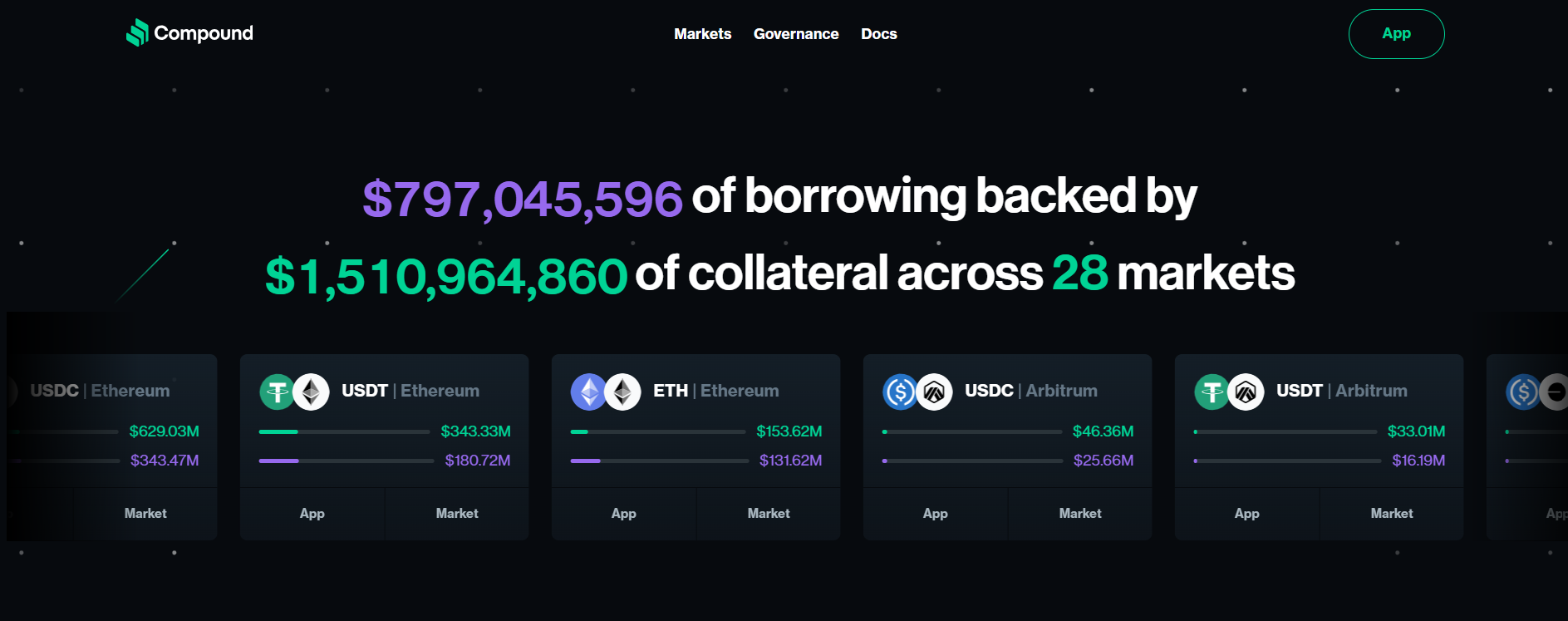
One of the original DeFi lending protocols, widely integrated and conceptually simple: supply assets, earn a variable rate, and withdraw subject to liquidity. It is often used as a baseline venue for DeFi lending exposure because the mechanics are familiar and easy to audit.
Yields generally track market borrow demand and can be less “spiky” than incentive-heavy venues.
How it generates yield:
Lenders earn variable interest paid by overcollateralized borrowers.
Pros
- Simple, widely understood lending model
- Strong ecosystem integrations and composability
- Useful as a conservative DeFi lending building block
Cons
- Rates can be lower than more optimized venues at times
- Variable APY can drop fast in low-demand regimes
- Smart contract and liquidation-structure risk remains
4) Spark Protocol
A DeFi lending venue built with a strong emphasis on stablecoin liquidity and treasury-style usage. It is often used by allocators who want stablecoin-first lending exposure rather than multi-asset complexity.
Like other lending markets, returns are driven by utilization and borrowing demand.
How it generates yield:
Lenders earn interest paid by borrowers, with rates primarily reflecting stablecoin borrow utilization.
Pros
- Stablecoin-centric design and market focus
- Clear yield driver (borrow interest) with onchain transparency
- Can be a solid “core sleeve” venue for stable allocations
Cons
- Variable APY and utilization-driven liquidity constraints
- Protocol/governance risks still apply
- Market conditions can shift quickly during stress
5) Pendle Finance
A term-yield marketplace that lets users separate and trade yield components to target or lock returns over a defined period. It is commonly used when allocators want more predictability than pure variable lending, or when they want to position around expected rate moves.
It is powerful, but requires understanding of maturity, pricing, and exit mechanics.
How it generates yield:
Users gain yield exposure through term-based pricing and yield component trading that can lock or target rates for a maturity window.
Pros
- Better predictability versus purely variable-rate lending
- Useful for planning, budgeting, and term-based positioning
- Can be attractive when you expect variable rates to fall
Cons
- Higher complexity than lending markets
- Secondary liquidity and pricing vary by market/maturity
- Exit before maturity can introduce pricing slippage
6) Yearn Finance

A vault and strategy layer designed to automate stablecoin allocation across onchain opportunities. It is often used by users who prefer delegation and systematic rebalancing rather than manual routing between markets.
Returns depend heavily on the specific vault strategy, fees, and current incentive environment.
How it generates yield:
Vault strategies allocate across lending, liquidity, and incentive opportunities and rebalance to optimize net returns.
Pros
- Hands-off management and automated rebalancing
- Can improve net APY by routing across venues
- Strategy abstraction reduces day-to-day operational burden
Cons
- Adds strategy-layer risk on top of protocol risk
- Strategy performance can change as incentives rotate
- Requires trust in vault design, parameters, and execution
7) Ondo Finance

An RWA-focused platform offering tokenized exposures commonly linked to short-duration traditional yield sources. It is often used by allocators seeking yield that behaves more like rates-driven cash management than DeFi borrowing cycles.
Product availability, redemption terms, and eligibility can vary depending on structure and jurisdiction.
How it generates yield:
Yield is derived from off-chain cashflows (often treasury-like) and reflected through token structure, accrual, and redemption mechanics.
Pros
- Yield source is typically easier to explain (rates/cashflows)
- Often less correlated to DeFi leverage cycles
- Can fit treasury-style stablecoin allocation frameworks
Cons
- Issuer/legal/custody structure risk is central
- Redemption terms and eligibility can be restrictive
- Onchain liquidity varies by venue and market conditions
8) Mountain Protocol
A yield-bearing stablecoin-style product designed to simplify access to rate-linked returns without actively managing multiple DeFi venues. It is often positioned for users who want a cleaner, cash-management-like experience with yield accrual mechanics.
As with all structured products, the key diligence points are custody, legal structure, and redemption behavior.
How it generates yield:
Yield is driven by off-chain cashflow sources and passed through via the token’s accrual/redemption design.
Pros
- Simplifies yield capture versus multi-protocol strategies
- Clearer yield narrative than incentive-only products
- Can reduce rebalancing overhead for some allocators
Cons
- Counterparty and structure risks matter significantly
- Redemption rules can be more constrained than DeFi lending
- Not “risk-free” even if the underlying yield source is conservative
9) Ethena
A higher-complexity stablecoin-adjacent yield approach built around hedged carry dynamics that can produce strong returns in certain market regimes. It is typically used by sophisticated allocators who understand funding/basis sensitivity and who size positions conservatively.
Returns can change quickly when market structure shifts.
How it generates yield:
Yield is primarily sourced from strategy mechanics such as funding rates and hedged basis/carry dynamics (regime-dependent).
Pros
- Potential for top-tier yields in favorable regimes
- Diversifies away from pure borrowing-demand yield
- Fits well as a satellite sleeve for experienced allocators
Cons
- Tail risk and regime shifts can be material
- Requires deeper understanding of dependencies and mechanics
- Not ideal for set-and-forget users with low risk tolerance
10) Coinbase

A large custodial venue where yield products are delivered through an exchange-native experience, often appealing to users who prioritize simplicity and reporting. It is typically chosen for operational convenience rather than maximum onchain transparency.
Yield terms, eligibility, and rates can vary by product and region.
How it generates yield:
Yield is produced through platform-managed lending/financing/investment routing (platform-dependent).
Pros
- Simple onboarding and custody + earn in one place
- Operational convenience and familiar UX
- Often easier portfolio tracking for custodial users
Cons
- Counterparty risk is the main risk driver
- Less transparency into exact yield engine than DeFi
- Rates/terms can change based on policy and market conditions
11) Kraken

A custodial platform offering yield access integrated with trading and account management. It is often used by users who want stablecoin yield without managing wallets, gas, bridges, or onchain monitoring.
Product availability and yield levels can differ by jurisdiction and account type.
How it generates yield:
Yield comes from platform-run lending/financing arrangements and product structures.
Pros
- Simple UX and exchange-integrated operations
- Low on-chain operational overhead
- Convenient for users already trading on-platform
Cons
- Counterparty/platform risk dominates
- Product terms and availability can be region-dependent
- Less granular transparency versus on-chain venues
12) Binance
A large custodial platform with multiple yield formats (often including flexible and locked options) and frequent rate promotions. It is typically selected for breadth of product choices and ease of execution.
Because product menus can be extensive, diligence on terms and lockups matters.
How it generates yield:
Yield is delivered through platform-managed lending/financing and structured earn products.
Pros
- Broad range of stablecoin yield options and terms
- Often competitive headline rates during promotions
- Fast execution for users already operating on the exchange
Cons
- Counterparty risk remains the core tradeoff
- Terms, lockups, and eligibility can change quickly
- Complexity increases with many product variants
13) Nexo

A custodial yield and lending platform that often combines earn features with a credit-style product ecosystem. It is typically used by users who want a unified custodial experience and do not want to manage on-chain positions.
Rate tiers and conditions can materially affect realized yield.
How it generates yield:
Yield is derived from platform-managed lending/financing and product-specific allocation policies.
Pros
- Streamlined custodial UX for earn and related products
- Can offer boosted rates depending on program terms
- Convenient for users who prefer an all-in-one platform
Cons
- Counterparty and operational risk dominate
- Boosted yields may require lockups or conditions
- Transparency depends on platform disclosures and product design
14) Ledn
A custodial lender typically framed around a lending-first yield model rather than complex strategy stacking. It is often chosen by users who want fewer moving parts and a clearer narrative for how returns are generated.
As with all custodial lenders, platform risk and product terms are decisive.
How it generates yield:
Yield is primarily driven by lending activity and borrower demand under the platform’s risk framework.
Pros
- Lending-based yield model is easy to understand
- Generally simpler product framing than strategy-heavy offerings
- Can suit users who want a more conservative custodial approach
Cons
- Counterparty/platform risk remains significant
- Rates can lag aggressive DeFi incentive cycles
- Availability and terms can vary by jurisdiction
Comparison Table
| Platform | Category | Yield Driver | Liquidity | Primary Risks | Best For |
|---|---|---|---|---|---|
| Aave | DeFi pooled lending | Borrow interest | High (utilization-dependent) | Smart contract, liquidation dynamics | Liquid onchain yield |
| Morpho | DeFi P2P optimization | Rate efficiency + borrow demand | High (market-dependent) | Protocol + underlying market risks | Rate-sensitive lenders |
| Compound | DeFi pooled lending | Borrow interest | High (utilization-dependent) | Smart contract risk | Simple DeFi lending |
| Spark Protocol | DeFi lending (stablecoin focus) | Borrow interest | Medium–High | Protocol/governance, liquidity shifts | Core stable allocations |
| Pendle | Fixed/term markets | Term yield pricing | Medium (market-dependent) | Complexity, exit pricing | Predictable yield planning |
| Yearn Finance | Vault strategies | Routing + incentives | Medium (strategy-dependent) | Strategy + protocol stack | Delegated management |
| Ondo Finance | RWA/treasury tokens | Offchain cashflows | Medium (redemption rules) | Issuer/legal, liquidity | Rate-linked core sleeve |
| Mountain Protocol | Yield-bearing stable structure | Offchain cashflows | Medium | Counterparty/legal, redemption | Simplified rate-linked yield |
| Ethena | Synthetic/carry | Funding/basis mechanics | Medium | Regime shifts, tail risk | Higher-yield satellite |
| Coinbase | Custodial earn | Platform-managed | High (product-dependent) | Counterparty, policy changes | Convenience + reporting |
| Kraken | Custodial earn | Platform-managed | High (product-dependent) | Counterparty, eligibility limits | Exchange-native earn |
| Binance | Custodial earn | Platform-managed | High (product-dependent) | Counterparty, terms risk | Product variety seekers |
| Nexo | Custodial yield | Platform-managed | Medium–High | Counterparty, conditional boosts | Custodial yield users |
| Ledn | Custodial lending yield | Lending-based | Medium–High | Counterparty, jurisdiction | Simpler CeFi lending |
Risk Management
1) Start with stablecoin risk, not platform APY
- Prefer stablecoins with clear reserve narratives and deep liquidity.
- Avoid concentrating in a single issuer if the position is material.
2) Match the yield engine to your risk tolerance
- Borrow-interest yield is usually easier to reason about.
- Incentive-heavy yield is usually temporary.
- Carry-based yield can be strong, but breaks hardest in bad regimes.
3) Treat liquidity as a risk control
If you cannot exit quickly, you do not have a yield position, you have a term bet.
4) Use a baseline rate to sanity-check APY
Short-term U.S. Treasury yields provide a useful baseline for what “low-volatility” yield looks like in traditional markets.
For example, the 3-month constant maturity Treasury rate was around 3.67% in late January 2026.
If a product is paying far above baseline, demand a clear explanation of the extra risk being taken.
5) Operational controls (simple, effective)
- Set max exposure per platform and per chain.
- Use separate wallets for long-term and active strategies.
- Track utilization, withdrawal conditions, and strategy changes monthly.
How To Choose the Best Platform for Stablecoin Yields in 2026
Step 1: Choose your primary objective
- Liquidity-first → pick DeFi lending or flexible custodial earn
- Predictability → pick term/fixed-rate markets
- Compliance-first → pick reputable custodial earn or structured RWA products (where eligible)
- Max yield → pick higher-complexity strategies, but size smaller
Step 2: Pick a core platform set (2–3) before adding satellites
A practical default:
- Core (70–90%): Aave / Compound / Spark + a rate-linked RWA sleeve (if eligible)
- Satellite (10–30%): Pendle, Yearn strategies, or Ethena-style carry exposure (only if you understand the mechanics)
Step 3: Decide based on your “non-negotiables”
- Must be able to withdraw within X hours/days
- Must have transparent yield source
- Must fit your jurisdiction and compliance posture
- Must have acceptable counterparty or smart contract risk
Conclusion
The best stablecoin yield platforms in 2026 are the ones that combine credible yield sources, reliable exits, and risk controls.
For most users, the strongest default is a core allocation in transparent lending markets, optionally complemented by term yield or rate-linked RWA structures, with higher-yield strategies kept as a smaller satellite sleeve.
Read Next:
- 55 Comparison Stats: Stablecoins vs. CBDCs in 2026
- 50 Fintech Statistics That Matter in 2026
- 2025 Stablecoin Year-End Report
FAQs:
1. What Platforms Offer The Best Stablecoin Yields In 2026?
Platforms that offer the best stablecoin yields in 2026 are typically top DeFi lending markets, term yield venues, RWA yield-token issuers, and reputable custodial earn providers, depending on your risk and liquidity needs.
2. How Do DeFi Lending Platforms Generate Stablecoin Yield In 2026?
DeFi lending platforms generate stablecoin yield in 2026 by paying lenders interest funded by borrowers who post collateral and borrow stablecoins for leverage, arbitrage, and liquidity.
3. How Do Fixed-Rate Stablecoin Yield Platforms Work In 2026?
Fixed-rate stablecoin yield platforms work in 2026 by letting users lock or target yield for a defined term through maturity-based pricing and yield component trading, which improves predictability but can reduce flexibility.
4. How Do RWA And Treasury Yield Tokens Produce Stablecoin-Like Yield In 2026?
RWA and treasury yield tokens produce stablecoin-like yield in 2026 by passing through short-duration offchain cashflows, where the return is driven more by traditional rates than crypto incentives.
5. How Should I Compare CeFi Earn Vs DeFi Stablecoin Yields In 2026?
CeFi earn vs DeFi stablecoin yields in 2026 should be compared by focusing on the primary risk: CeFi concentrates counterparty risk in the platform, while DeFi concentrates smart contract and market-structure risk onchain.
6. How Can I Reduce Risk While Earning Stablecoin Yield In 2026?
You can reduce risk while earning stablecoin yield in 2026 by diversifying across platforms and yield engines, prioritizing liquidity, avoiding incentive-only APYs, and sizing higher-complexity strategies as smaller satellite allocations.
Disclaimer:
This content is provided for informational and educational purposes only and does not constitute financial, investment, legal, or tax advice; no material herein should be interpreted as a recommendation, endorsement, or solicitation to buy or sell any financial instrument, and readers should conduct their own independent research or consult a qualified professional.