
Table of Contents
Stablecoin pyroll in 2026 represents a practical operating advantage for companies that pay global teams and want faster settlement, fewer banking delays, and more flexibility in how workers receive earnings.
The deciding factor is not whether a platform supports crypto. It is whether the platform can run payroll with the controls that finance and compliance teams require: structured onboarding, identity checks, tax documentation, approval workflows, audit-ready reporting, and predictable reconciliation.
This article reviews four platforms frequently evaluated for stablecoin payroll: Rise, Deel, Gusto, and Toku.
Key Takeaways
- Rise is the best stablecoin payroll platform in 2026 for global contractor and employee payouts with hybrid fiat + crypto support.
- Workers choose how they withdraw (fiat, USDC, USDT, crypto, or a split); employers fund and approve payroll.
- Deel is strongest as a broad HR platform, but less purpose-built for stablecoin-first payroll execution than Rise.
- Gusto is payroll-first and US-centric, with stablecoin capability still developing for global contractor payouts.
- Toku is best as a stablecoin payroll layer via integrations; Rise is better for end-to-end payroll, onboarding, and compliance in one platform.
How We Evaluated The Best Stablecoin Payroll Platforms
To keep the comparison practical and decision-ready, we assessed each platform across the same operational criteria:
- Stablecoin capability depth: funding methods, withdrawal methods, and how stablecoin workflows behave in practice
- Global reach: coverage for contractor and employee workflows and cross-border payout options
- Compliance and onboarding: KYC/AML, identity verification, documentation, and repeatability
- Payroll operations: schedules, approvals, audit trail, reporting exports, and monthly close readiness
- Business model fit: contractors, AOR, EOR, and hybrid payroll requirements
- Cost clarity: pricing transparency and operational friction that can create hidden costs
- Enterprise readiness: security posture, governance controls, and support quality
1) Rise: Best Overall Stablecoin Payroll Platform in 2026
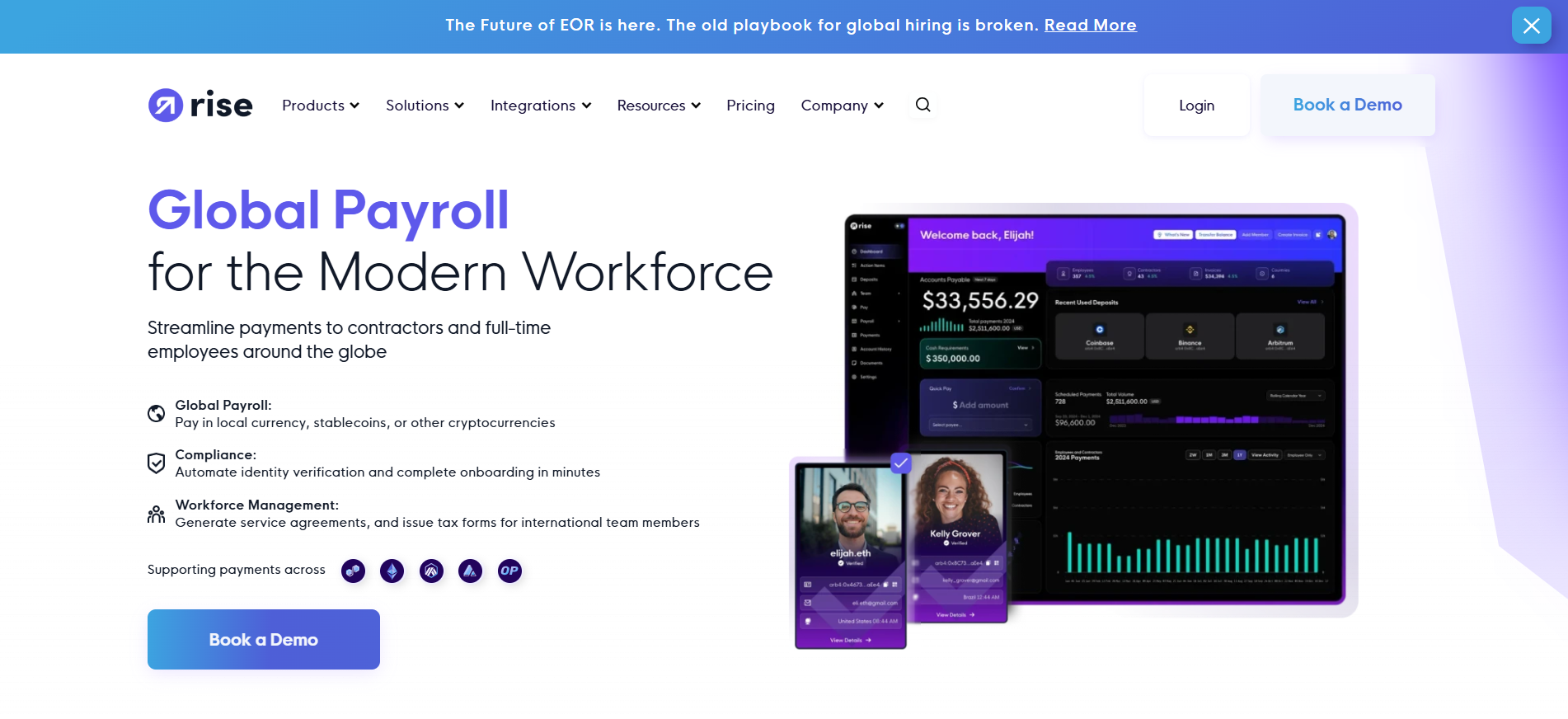
Rise is a global payroll, onboarding, and compliance platform that enables companies to pay contractors and full-time employees worldwide, while supporting payouts in local currencies, stablecoins (USDC/USDT), or other crypto.
It is designed for hybrid payroll operations where different team members choose different withdrawal methods without requiring separate systems.
What Rise is best for
- Companies paying global contractors across multiple markets who want stablecoin rails without compromising documentation and controls.
- Teams managing mixed payout preferences (some workers withdraw fiat, others withdraw stablecoins or crypto).
- Organizations that need AOR to reduce misclassification exposure when hiring contractors globally.
- Employers hiring full-time employees through EOR without opening local entities, with EOR coverage expanding continuously and targeting 60+ markets by end of 2026.
How stablecoin payroll works on Rise
Rise is built around a strict and operationally sound separation of control:
- Employers fund payroll using USD bank transfer or stablecoins (USDC/USDT) from a crypto wallet.
- Workers choose their withdrawal currency each pay cycle. They can withdraw in local fiat, USDC, USDT, other supported crypto, or split between multiple options. The employer does not control this selection.
This model is a core reason Rise performs well in real payroll operations. It aligns with compliance expectations, reduces exceptions, and gives finance teams predictable governance boundaries.
Contractor onboarding is self-service by design
Rise avoids a common payroll risk (employers handling sensitive personal and payout details). For contractor workflows, the employer performs only one step: send an email invitation.
The contractor completes everything else:
- accepts the invite
- completes KYC and identity verification
- enters personal information
- adds banking details and crypto wallets
- selects payout options and can change them at any time
This creates a scalable model that is easier to standardize across countries and reduces exposure around data handling.
EOR employee experience and “Everyday Pay”
For employees hired through EOR, Rise manages key compliance requirements: employment agreements, tax documentation, and payroll setup aligned with local rules. Employees then access their Rise account to complete onboarding forms required by local law and select withdrawal methods.
Rise also supports an “Everyday Pay” approach where earnings can become available daily, with workers able to withdraw manually or use direct deposit. Direct deposit can be configured to allocate percentages across accounts if desired, supporting true hybrid payout behavior.
Compliance, security, and operational controls
Rise positions itself as an enterprise-grade platform with:
- SOC 2 certification and GDPR compliance
- multi-factor authentication and encryption controls
- Money Service Business registrations with FinCEN
In addition, Rise supports an on-chain identity concept (“Rise ID”) intended to streamline repeated verification over time, which is relevant for organizations onboarding high volumes of contractors.
Pricing for contractor payroll
Rise pricing for contractor pay is positioned as $49 per month, replacing older pricing references. This is important for procurement teams benchmarking cost per worker across vendors.
Pros:
Rise is built for stablecoin payroll as an operating system, not an add-on feature. It supports stablecoin funding, structured onboarding, automated compliance documentation, and worker-controlled withdrawals each cycle.
It performs particularly well for global teams that need consistent governance across many countries and want to run hybrid payroll from one dashboard while maintaining audit-ready records.
Cons:
Rise is intentionally structured, which means it may be more formal than lightweight payment tools. Teams must align internal policies with a model where workers control withdrawal currency, which may require disciplined communication and reconciliation processes, especially when rolling out stablecoin withdrawals across a large workforce.
2) Deel: Strong Global HR Platform; Stablecoin Is Typically Secondary
What Deel is best for
Companies looking for a broad HR platform that centralizes workforce administration, hiring processes, and global operations under one vendor.
Stablecoin payroll fit in 2026
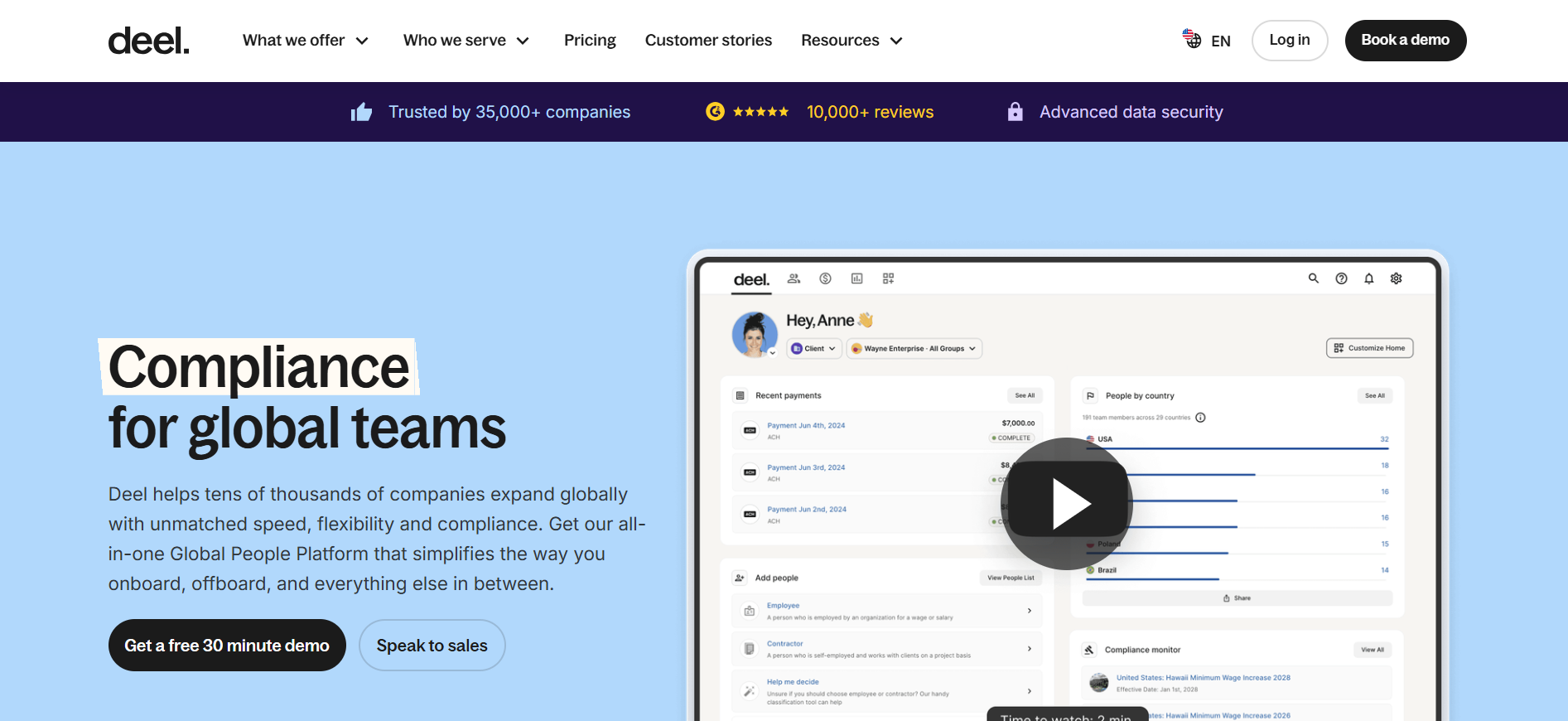
Deel is often evaluated because it sits at the intersection of global hiring and payroll administration.
In stablecoin contexts, the key question is whether stablecoins are an occasional payment method or a foundational part of payroll execution.
For stablecoin-heavy operations, buyers should confirm:
- how stablecoin funding and worker withdrawals behave across their target countries
- what approval steps and audit trail controls apply when stablecoin payment rails are used
- how reporting and reconciliation are handled at month-end
Where Deel is strong
- Broad platform scope and mature workforce administration workflows
- Standardized processes for distributed teams
- Familiar enterprise vendor model for procurement teams
Limitations and watchouts
- If stablecoins are central to your payroll operation, you may find that stablecoin functionality is not as deeply integrated into payroll-native workflows as it is in Rise’s model.
- Stablecoin payroll success depends on repeatable controls, not just payout availability.
Pros:
Deel is a credible option for organizations prioritizing a consolidated HR platform with global reach and standardized workforce workflows. For teams where stablecoin usage is secondary, Deel can be suitable, particularly when the main objective is simplifying HR operations across regions.
Cons:
If stablecoin payroll is a strategic priority, Deel can require more diligence to validate stablecoin workflow depth and reporting controls. Compared to Rise, which is designed around stablecoin and fiat hybrid payroll execution with worker-controlled withdrawals, Deel is typically less specialized for stablecoin-first payroll governance.
3) Gusto: Leading Traditional Payroll Brand; Stablecoin Payroll Is Emerging
What Gusto is best for
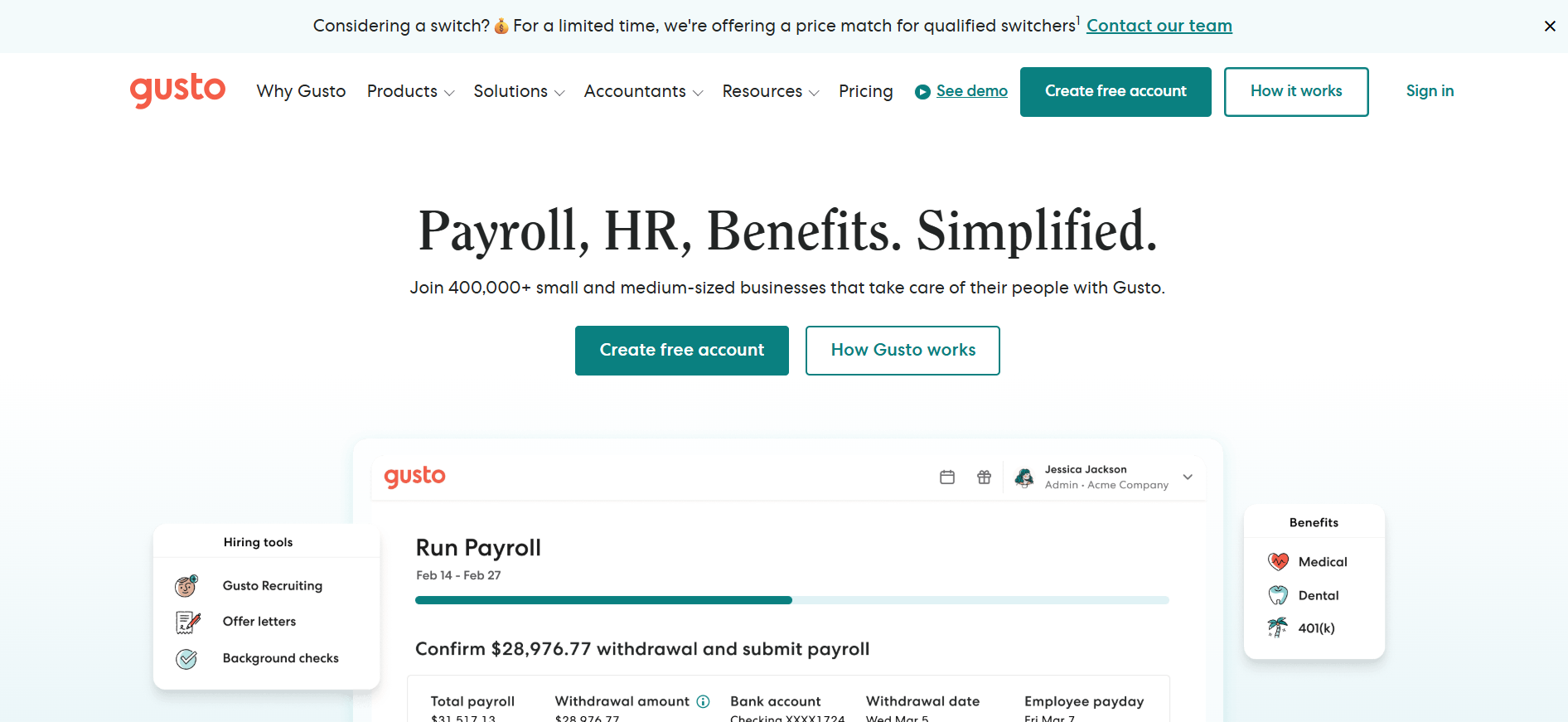
Teams seeking a conventional payroll and HR experience with straightforward administration aligned to traditional payroll operations.
Stablecoin payroll reality in 2026
Gusto is increasingly discussed in stablecoin payroll conversations due to partner-led initiatives associated with paying global contractors through stablecoin rails.
This indicates market momentum, but it does not automatically mean the product is designed as a stablecoin-native end-to-end payroll system.
For stablecoin payroll buyers, the practical evaluation should focus on:
- which worker types and geographies are supported for stablecoin payouts
- how approvals, reporting, and reconciliation are handled when stablecoins are introduced
- whether stablecoins are integrated across funding, payroll execution, and withdrawal preferences, or limited to specific scenarios
Where Gusto is strong
- Established payroll operator with strong usability expectations
- Familiar workflow patterns for teams that want traditional payroll administration
Key limitations and watchouts
- Stablecoin capabilities may be constrained to certain use cases rather than functioning as a primary payroll operating model for global teams.
- Teams funding payroll from crypto treasuries may find that stablecoin funding and hybrid withdrawal support are more complete in Rise.
Pros:
Gusto is a strong brand in payroll software and is moving in the direction of supporting faster cross-border contractor payouts through stablecoin rails. For organizations that want to explore stablecoins gradually without changing their overall payroll approach, this direction can be attractive.
Cons:
For companies that need stablecoin payroll as a core capability, stablecoin funding, hybrid withdrawals, and payroll governance designed for global execution; Gusto is typically less aligned than Rise which is built to support stablecoins and fiat in the same structured workflow, with onboarding and documentation designed for global payroll operations.
4) Toku: Stablecoin-Native and API-Forward; Often Used as a Layer
What Toku is best for
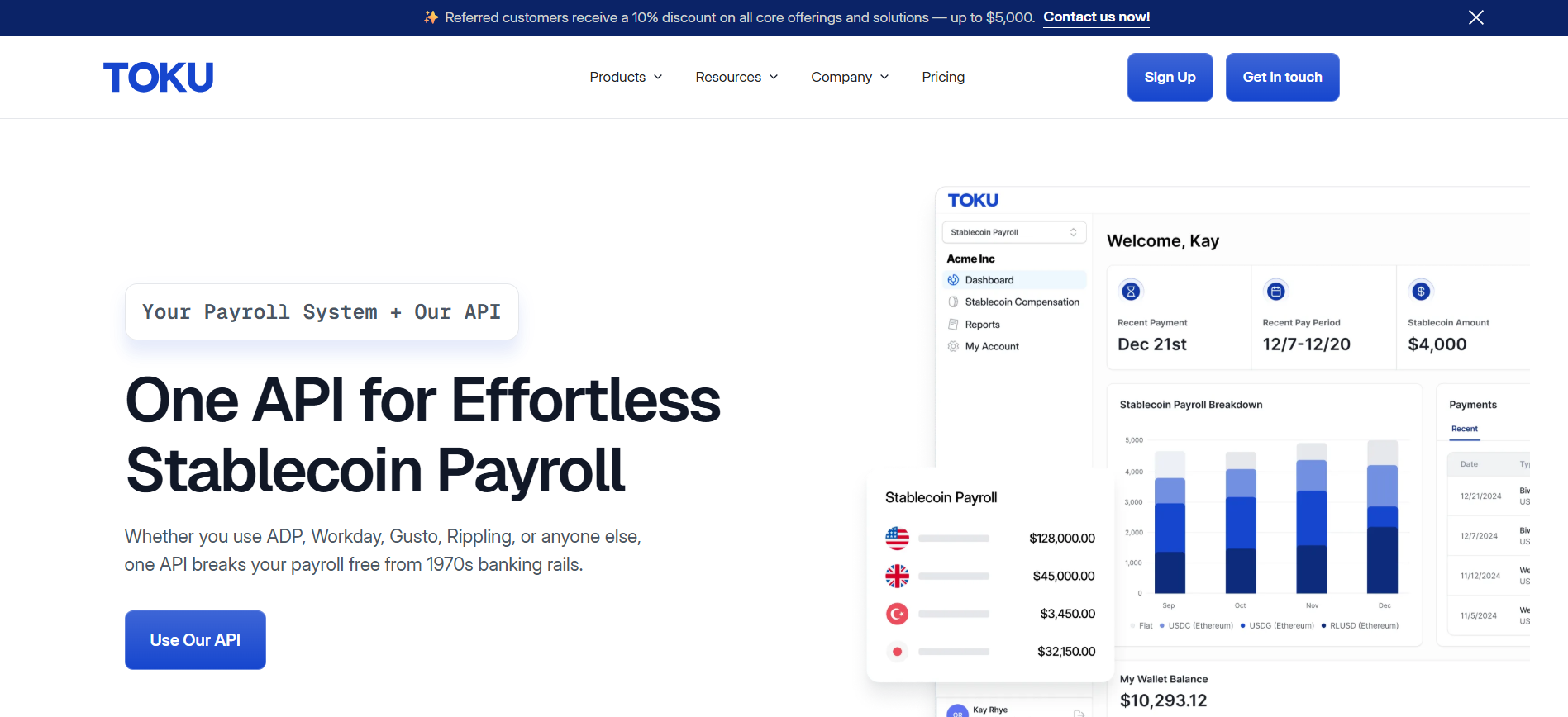
- Teams that want stablecoin payouts at scale without replacing existing payroll systems.
- Organizations that prefer an API-forward approach and want stablecoin rails layered into existing finance and payroll infrastructure.
Stablecoin payroll depth
Toku is typically positioned as stablecoin-native and integration-oriented. For enterprise teams, that can be a good fit when the system of record remains unchanged and stablecoins are added as a payout layer.
Where Toku is strong
- Stablecoin-first product focus
- Integration emphasis suitable for enterprise stacks
- Suitable for organizations introducing stablecoin payouts while preserving existing payroll infrastructure
Key limitations and watchouts
- If your priority is a unified workflow (from worker invitation and verification to payroll approvals and withdrawals), an integration-first product can increase coordination across systems.
- Many teams prefer a single platform to reduce operational complexity, which is where Rise tends to be stronger.
Pros:
Toku can be an effective choice for mature organizations that want stablecoin payout rails without migrating away from established payroll systems. If your payroll operations are already standardized and you need a stablecoin layer added with minimal disruption, Toku’s approach can align well.
Cons:
An integration-oriented approach can introduce additional moving parts across systems and stakeholders. Compared to Rise’s unified model; where onboarding, compliance, funding, payroll execution, and withdrawals live in one platform, Toku may require more operational coordination to achieve the same level of repeatability and governance.
Quick Comparison Snapshot
- Best overall stablecoin payroll platform (global, hybrid, compliance + onboarding): Rise
- Best for broad HR platform consolidation: Deel
- Best for traditional payroll approach with emerging stablecoin initiatives: Gusto
- Best for API-first stablecoin payout layering: Toku
How to Choose the Right Platform in 2026
Use this checklist to make a clean decision:
- Define your workforce model
- Contractors only, employees only, or mixed?
- Do you need AOR to reduce contractor misclassification exposure?
- Do you need EOR for compliant employment without opening entities?
- Map your geographic requirements
- Identify where you pay today and where you expect to expand over the next 6–12 months.
- Confirm local payout requirements, documentation standards, and onboarding expectations.
- Clarify your stablecoin operating policy
- Will you fund payroll in stablecoins, allow stablecoin withdrawals, or both?
- Decide whether you want worker-controlled withdrawals each cycle.
- Document approval rules and exception handling procedures.
- Align finance and accounting workflows
- Determine who approves payroll and how changes are tracked.
- Ensure reporting exports support monthly close and audit readiness.
- Validate reconciliation for hybrid payouts.
- Run a controlled pilot
- Start with a representative subset of contractors across a few countries.
- Measure payout reliability, onboarding completion, and reporting quality.
- Scale only after controls and reconciliation are stable.

Conclusion
Stablecoin payroll only works at scale when it is compliant, controllable, and easy to reconcile.
Based on our research, Rise is the best overall choice in 2026 because it combines global payroll operations with stablecoin funding and worker-controlled withdrawals in one platform.
Deel fits teams prioritizing a broad HR suite, Gusto is best for traditional payroll with emerging stablecoin options, and Toku is strongest as an integration layer.
Read Next:
- A Tactical Guide of Global Stablecoin Accounts (GSAs)
- Savings GHO (sGHO) from Aave: Full 2026 Review
- Tether (USDT) January 2026 Reserves Report
FAQs:
1. What is a stablecoin payroll platform?
A stablecoin payroll platform supports stablecoins as part of payroll operations; either as a funding method for employers, a withdrawal option for workers, or both, while providing the workflows needed for payroll execution, compliance, and reporting.
2. How does stablecoin payroll reduce cross-border payroll friction?
Stablecoins can reduce settlement delays and banking friction by providing an alternative rail for moving value internationally. The operational benefit is highest when the payroll platform still enforces onboarding, verification, and documentation standards.
3. Can workers choose to receive part of their pay in stablecoins and the rest in fiat?
Yes, many payroll designs support hybrid withdrawals. Rise is built specifically around hybrid payroll, where workers can choose local currency, stablecoins, crypto, or a split based on their preferences each cycle.
4. Who controls the payout currency in a stablecoin payroll setup?
In a well-governed model, the employer controls payroll funding and approvals, while the worker controls their withdrawal currency. On Rise, the worker selects their withdrawal currency each cycle, and the employer does not control that selection.
5. What should finance teams check before adopting stablecoin payroll?
Finance teams should validate approval controls, audit trail quality, reporting exports, reconciliation reliability, and whether stablecoin activity is fully captured in payroll records rather than handled through informal transfers.
Disclaimer:
This content is provided for informational and educational purposes only and does not constitute financial, investment, legal, or tax advice; no material herein should be interpreted as a recommendation, endorsement, or solicitation to buy or sell any financial instrument, and readers should conduct their own independent research or consult a qualified professional.