

Table of Contents
Think of it this way: what if you could blend the instant, borderless power of crypto with the everyday reliability of the U.S. dollar? That’s exactly what stablecoins do. They act as a vital bridge, connecting the often-wild world of digital assets with the traditional money we use every day.
Why Stablecoins Are Changing Modern Finance
Stablecoins represent a huge leap forward. They take the best parts of cryptocurrency—like speed and global access—and pair them with the stability of fiat currencies. We've all seen the rollercoaster price charts of assets like Bitcoin. Stablecoins are the antidote to that chaos.
Most are designed to hold a steady value, usually pegged 1-to-1 with a major currency like the U.S. dollar. This isn't just wishful thinking; it's backed by real-world reserve assets, giving them tangible value.
This simple concept unlocks a ton of practical benefits. By creating a trustworthy digital version of cash, stablecoins solve real problems for people and businesses, acting as a dependable way to transact and a safe place to hold value in the digital economy.
Bridging Two Financial Worlds
At their heart, stablecoins are powerful because they seamlessly link two very different financial systems. You get the innovative perks of crypto without the gut-wrenching volatility, which opens the door to a more efficient and accessible global economy.
Here’s a quick rundown of the main advantages they bring to the table:
- Speed and Efficiency: Transactions are settled in minutes, not days. The network is always on, 24/7, so you’re not stuck waiting for banking hours.
- Reduced Volatility: Pegging their value to stable assets makes them a safe harbor when the crypto markets get choppy.
- Lower Transaction Costs: They slash fees, especially for sending money internationally, by cutting out all the middlemen that normally take a cut.
- Enhanced Accessibility: Anyone with an internet connection can tap into financial services built on stablecoins, which is a massive step for financial inclusion.
To really get why this is all possible, you have to understand the basics of blockchain development. That’s the underlying technology that powers programmable money and the decentralized apps that are rewriting the rules of finance.
By functioning as a blockchain-based money equivalent that is liquid, globally transferable, and perceived as a stable store of value, stablecoins bridge the gap between volatile digital assets and traditional monetary systems.
To make these benefits even clearer, here’s a quick comparison.
Stablecoin Benefits at a Glance
This table offers a snapshot of how stablecoins stack up against both traditional finance (TradFi) and other cryptocurrencies.
| Benefit Category | Key Advantage | Real-World Impact |
|---|---|---|
| Payments & Speed | Near-instant settlement, 24/7/365 | A merchant receives payment in minutes, not days. Cross-border remittances arrive without banking delays. |
| Volatility | Stable value pegged to fiat | Traders can exit volatile crypto positions into a stable asset without converting back to cash. |
| Cost | Minimal transaction fees | An immigrant sending $200 home saves $10-15 in fees compared to traditional wire services. |
| Accessibility | Open to anyone with an internet connection | An unbanked individual in a developing country can access savings and lending services via a mobile wallet. |
| Programmability | Can be integrated into smart contracts | Automated payroll systems that pay employees by the second, or insurance contracts that pay out instantly. |
As you can see, stablecoins don't just offer marginal improvements; they create entirely new possibilities.
The Foundation for a New Economy
This stability isn't just a nice-to-have feature—it’s the bedrock of the entire Decentralized Finance (DeFi) ecosystem. DeFi apps for lending, borrowing, and trading couldn't function without stablecoins. They need a reliable unit of account and a steady form of collateral to work.
It doesn’t stop there. Stablecoins are steadily making their way into the mainstream. Big payment companies and online merchants are already looking at how they can use them to make transactions cheaper and faster.
The list of stablecoin use cases is growing every day, from simple P2P payments to complex, automated financial agreements. As we'll see, these benefits are paving the way for a much more connected and efficient financial future for everyone.
How Stablecoins Actually Stay Stable
Before we jump into all the ways stablecoins are changing the game, we need to answer a fundamental question: what keeps them stable? After all, aren’t cryptocurrencies supposed to be volatile?
The secret isn’t magic—it’s just good design. Think of a stablecoin as a digital receipt that’s always redeemable for a specific, fixed value, like one U.S. dollar. The real value comes from what’s backing that receipt.
It’s a bit like a casino chip. When you exchange $100 for chips, those plastic tokens have value because you know the casino holds the actual cash in its vault. Stablecoins apply a similar logic, but they use a few different methods to hold their "peg" to an asset like the dollar.
There are really three main ways this is done, each with its own pros and cons.
Fiat-Collateralized: The Old-School Approach
This is by far the most common and easiest-to-understand model. For every digital token issued, the company behind it holds one real-world dollar (or an equivalent, super-safe asset like a U.S. Treasury bond) in a bank.
Companies like Circle (USDC) and Tether (USDT) built their empires on this simple promise: one token, one dollar in the bank. This direct 1-to-1 backing means you can, in theory, always cash out your digital dollar for a real one.
To keep everyone honest, these issuers have independent firms audit their reserves regularly. This transparency is crucial for building trust and is a big reason why this model dominates the market, making up around 99% of all stablecoins.
Crypto-Collateralized: The Decentralized Alternative
The second method ditches traditional banks entirely and uses other cryptocurrencies as collateral instead. But since crypto prices (like Ethereum) can swing wildly, there’s a built-in safety measure: over-collateralization.
Here’s how it works. To get $100 of a stablecoin like DAI, you might have to lock up $150 worth of Ethereum in a smart contract. That extra $50 serves as a cushion. If the price of Ethereum dips, the stablecoin's value remains protected.
This approach is the backbone of Decentralized Finance (DeFi). It creates a stable asset that lives entirely on the blockchain, with no need for banks or corporations.
Algorithmic: The Experimental Frontier
Finally, we have algorithmic stablecoins. These are the most ambitious and, frankly, the riskiest. Instead of relying on collateral, they use smart contracts and code to automatically manage the token supply to hold the price steady.
If the price creeps above $1, the algorithm mints new tokens to increase supply and push the price back down. If it drops below $1, the algorithm "burns" or buys back tokens to reduce supply and drive the price up.
While brilliant in concept, this model has proven fragile under pressure, leading to some spectacular collapses. If you want to go deeper into the weeds on these mechanics, our guide on how stablecoins work is a great next step.
The infographic below really brings it all together, showing how these designs create the stability needed for everything that follows.
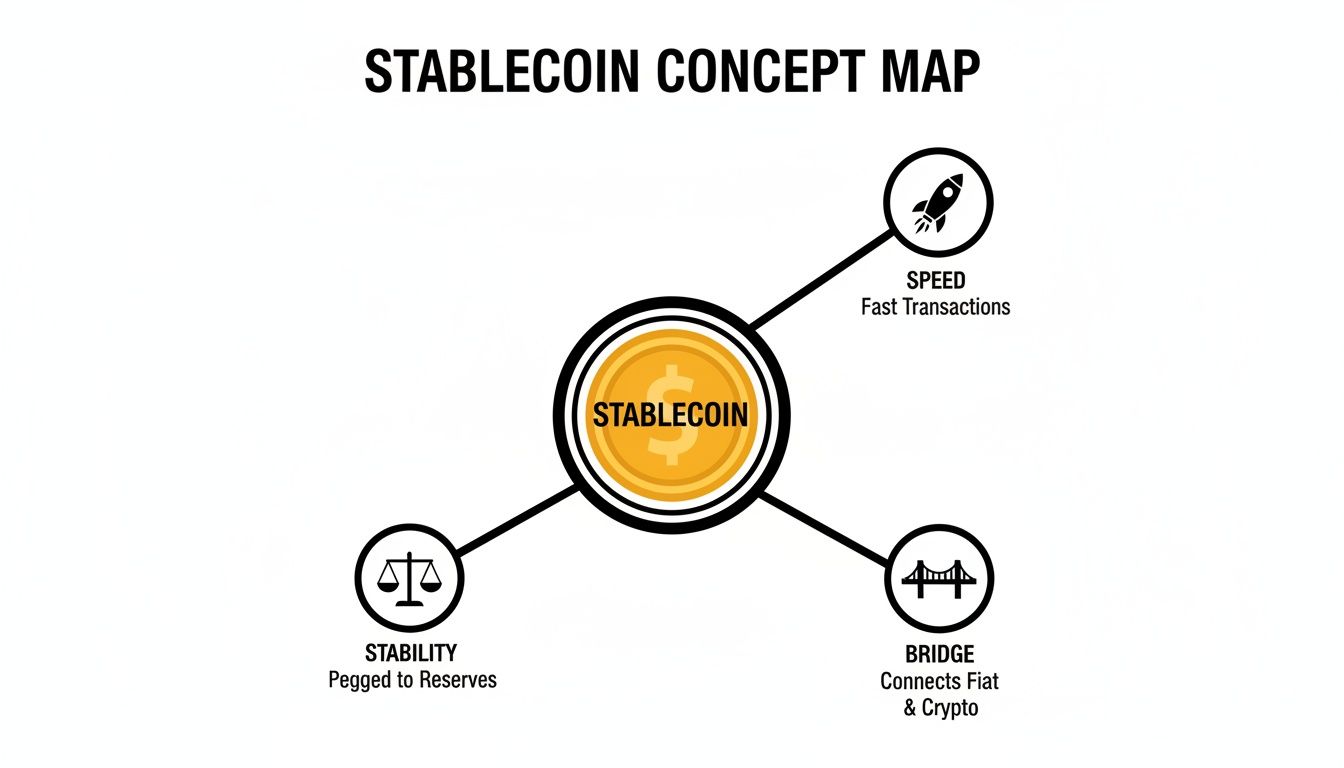
As you can see, that engineered stability is the foundation. It’s what gives stablecoins their speed and their unique ability to act as a bridge between the worlds of traditional finance and digital assets. Now that we've got the "how" covered, let's explore the powerful things they unlock.
Making Global Payments Faster and Cheaper

One of the most powerful, real-world applications for stablecoins is their ability to completely reshape how we send money across borders. For decades, international payments have been notoriously slow, expensive, and clunky. The entire process feels like a holdover from another era, because, well, it is.
Think about a freelance designer in Argentina finishing a project for a client in Germany. To get paid, that money has to bounce between a whole chain of correspondent banks. Each bank in that chain skims a fee, adds a delay, and creates another point where something could go wrong.
This old-school system is exactly why a simple wire transfer can take three to five business days to finally show up. It’s a relic built for a pre-internet world, one that only operates during banking hours and relies on a messy web of intermediaries.
Cutting Out the Middleman
Stablecoins blow this system wide open. Because they operate on a blockchain, they create a direct, peer-to-peer payment channel between the sender and the receiver, no matter where they are. And this network doesn't sleep—it's running 24/7/365, meaning you can send money anytime, day or night, weekends and holidays included.
This direct connection completely bypasses that convoluted web of intermediary banks. The upshot? A massive improvement in both speed and cost, turning a frustrating, multi-day ordeal into something that's over in minutes.
For our designer in Argentina, this is a game-changer. No more biting their nails waiting for a payment to clear, and no more watching a chunk of their earnings get eaten by fees. They get their money almost instantly and can use it right away. It's one of the most practical and impactful ways stablecoins are improving global commerce today.
A Stark Contrast in Speed and Cost
The difference between old-school finance and stablecoin payments isn't just a small step forward; it's a giant leap.
- Settlement Time: Traditional wires take 1-5 business days. A stablecoin transfer is settled in just seconds to minutes.
- Operating Hours: Banks work on a classic 9-to-5, weekday schedule. Blockchains are always on.
- Transaction Fees: An international wire can easily cost $25 to $50, not to mention currency conversion markups. Stablecoin transactions often cost just a few cents to a dollar, no matter how much you're sending.
This efficiency isn't just theoretical. When you look at the $800 billion global remittance market, these savings are life-changing. People sending money home to support their families can be sure that more of their hard-earned cash actually makes it to its destination.
Real-World Impact for Businesses and Individuals
The advantages go way beyond personal remittances. International businesses, freelancers, and online merchants are all primed to benefit.
Take an e-commerce shop that sells to a global customer base. By accepting stablecoins, the business can:
- Eliminate Chargebacks: Blockchain transactions are final and irreversible, which protects merchants from the fraudulent chargeback claims that are a constant headache with credit cards.
- Reduce Processing Fees: Stablecoins can slash transaction costs. To put it in perspective, traditional payment processing fees often eat up 2-3% of every single sale.
- Access New Markets: They open the door to customers in regions that might have poor banking infrastructure but widespread smartphone access.
This new financial plumbing is already being installed, and it's picking up steam. You can get a better sense of where things are headed in our deep dive on the state of cross-border payments in 2025. By delivering a faster, cheaper, and more open way to move money, stablecoins are building the foundation for a truly global and connected economy.
Powering the Decentralized Finance Ecosystem

While stablecoins are a game-changer for international payments, their most fundamental role is arguably as the bedrock of Decentralized Finance (DeFi). The entire DeFi world—a collection of open-access financial services running on blockchains—simply wouldn't work without them. Think of stablecoins as the essential lubricant keeping the gears of this new financial machine turning.
In a market notorious for wild price swings, stablecoins provide a much-needed anchor. They act as a stable unit of account, giving traders and investors a way to price assets and settle trades without being constantly exposed to gut-wrenching volatility. Just imagine trying to use a lending platform where your collateral could drop 20% in a single afternoon. It would be chaos.
This is the problem stablecoins solve. They create a reliable bridge. A trader can move from a volatile asset like Ethereum into a stablecoin like USDC to protect profits or sit on the sidelines during a market dip. Crucially, they can do all of this without ever cashing out to traditional fiat currency, which keeps everything fast, cheap, and "on-chain."
Fueling DeFi's Core Activities
Stablecoins aren't just a safe place to park your money; they are an active and essential ingredient in almost every DeFi protocol. They supply the liquidity and stability that let the ecosystem's most important functions run smoothly.
You'll find them at the center of all sorts of DeFi activities:
- Lending and Borrowing: Platforms like Aave and Compound are essentially decentralized money markets. Users deposit stablecoins to earn interest, while borrowers put up crypto collateral to take out stablecoin loans.
- Decentralized Exchanges (DEXs): On a DEX like Uniswap, stablecoins are vital for creating liquidity pools. A huge portion of trades happen against stablecoin pairs (like ETH/USDC), which act as a stable base for thousands of different tokens.
- Yield Farming and Staking: Many of the most popular strategies for earning returns in DeFi involve supplying stablecoins to liquidity pools or staking them in protocols to earn rewards.
Without a stable asset to grease the wheels, the entire DeFi structure would be far too risky and unpredictable for most people to use. Anyone looking to earn a return on their capital can explore the fundamentals of stablecoin borrowing to see just how central these assets are to generating yield.
A Reliable Foundation for Innovation
The stability that helps individual users also empowers DeFi developers. When you're building a new financial product, you need a dependable asset for settlement, pricing, and managing the treasury. Stablecoins are that reliable building block.
Think about how complex an automated market maker (AMM) or a synthetic asset protocol is. These systems are built on intricate algorithms that have to execute perfectly. Using a stablecoin as the main transactional asset simplifies everything, cuts down on risk, and makes the whole system more robust.
Stablecoins function as the blockchain-based equivalent of money, offering a liquid, globally transferable, and stable store of value that bridges the gap between volatile digital assets and traditional financial systems.
This reliability has cemented their position as the default currency of the DeFi world. The vast majority of trading volume and total value locked (TVL) in DeFi is denominated in stablecoins. They have, in effect, become the digital U.S. dollar for the decentralized economy. As DeFi matures, the benefits of stablecoins as its foundational layer will only grow, solidifying their place as a core piece of modern financial infrastructure.
Expanding Access to Global Financial Services

Beyond making life easier for global businesses, one of the most powerful aspects of stablecoins is their social impact. They represent a genuine opportunity for financial inclusion, opening up the financial system to billions of people who have been left on the sidelines by traditional banking.
For many, the only thing needed to get started is a smartphone and an internet connection. This is a game-changer. It completely sidesteps the need for physical bank branches, endless paperwork, and credit histories, which are massive hurdles in many developing nations. Stablecoins offer a direct on-ramp to the digital economy.
This becomes especially important in countries where high inflation is a constant threat. Someone in an underbanked region can convert their unstable local currency into a US dollar-pegged stablecoin. In doing so, they're protecting their savings from being devalued, a simple act of wealth preservation that was previously impossible for most.
The Dawn of Programmable Money
But stablecoins are more than just digital dollars for holding and sending. They’re the bedrock of a fascinating concept called programmable money. Because stablecoins are built on blockchains, they can be woven into smart contracts—bits of code that automatically execute when specific conditions are met.
This opens the door to a whole new world of automated, transparent, and incredibly efficient financial services. You can think of it like putting your money on autopilot, all backed by the security of a blockchain. The possibilities are truly staggering.
Programmable money enables financial agreements and transactions to be automated with unprecedented precision and without intermediaries. This shift makes financial systems more efficient, transparent, and accessible to everyone.
This ability to program money creates real-world advantages for everyday people and companies by automating tasks that are currently slow, expensive, and filled with potential for human error.
Real-World Applications of Programmable Stablecoins
This technology is already moving from theory to reality, building smarter financial plumbing right before our eyes.
Here are just a few examples of what’s now possible:
- Automated Payroll: A company could set up a smart contract to stream salaries to employees in real-time. Instead of waiting two weeks for a paycheck, you could literally watch your stablecoin balance tick up every second you work.
- Instant Insurance Payouts: Picture a travel insurance policy built on a smart contract. If a flight gets canceled (a fact the contract can verify from a public data source), it could instantly trigger a stablecoin payout directly to your digital wallet. No claims, no waiting.
- Transparent Supply Chains: A manufacturer could use programmable payments to instantly pay a supplier the moment goods are verified at a warehouse. This improves cash flow and builds tremendous trust between business partners.
These examples get to the heart of what makes stablecoins so special. They aren't just static digital assets; they're active, dynamic building blocks for a more responsive and fair financial system. By blending price stability with programmability, stablecoins give us the tools to build a more inclusive economy from the ground up.
Understanding the Risks and Regulatory Hurdles
It's easy to get excited about what stablecoins can do, but we can't ignore the very real risks that come with them. This is a powerful new technology, and with that power comes a huge amount of responsibility. To really get a handle on it, we have to look at the potential downsides, especially when it comes to transparency, market dominance, and the rules that are still being written.
At its core, a stablecoin is only as trustworthy as the assets backing it up. For coins pegged to currencies like the dollar, this means you have to trust the issuer is actually holding enough high-quality, easily accessible cash and equivalents to back every single token. Without regular, professional audits, you're basically taking their word for it—and that’s a shaky foundation to build on.
Market Concentration and Systemic Risks
One of the biggest red flags in the stablecoin world is how much power is held by just a few companies. Yes, this concentration has helped the market grow quickly, but it also means a massive amount of risk is centered in one or two places.
Right now, U.S. dollar-pegged stablecoins make up about 99% of the entire global supply. What’s more, just two issuers—Tether (USDT) and Circle (USDC)—control between 75% and 90% of that market. While this has been great for efficiency, it poses a serious systemic threat. What happens if one of them fails? The ripple effects could easily spill over into the traditional financial system. If you want to dig deeper into these numbers, Coindesk's stablecoin and CBDC report is a great resource.
This level of concentration hasn't gone unnoticed. Regulators around the globe are scrambling to build frameworks that can prevent a catastrophe without killing the innovation that got us here.
A disorderly collapse of a major stablecoin could reverberate across the financial system. The risk of contagion is a growing concern for central banks and financial watchdogs worldwide.
This really gets to the heart of the challenge for regulators: how do you encourage the good parts of stablecoins while protecting everyone from the bad? The answer seems to lie in creating clear rules that force issuers to be transparent and manage their reserves responsibly.
The Evolving Regulatory Landscape
Governments and financial authorities worldwide are no longer just watching from the sidelines; they are actively writing the rulebook for stablecoins. The aim is to build a clear framework that brings some much-needed order to the market.
Here are the main things they're focusing on:
- Reserve Requirements: Forcing issuers to back their tokens with the safest assets, like cash and short-term government bonds.
- Consumer Protection: Putting safeguards in place to protect you and me from fraud or an issuer going bankrupt.
- Financial Integrity: Making sure stablecoins comply with standard Anti-Money Laundering (AML) and Counter-Terrorist Financing (CFT) laws.
- Operational Resilience: Demanding strong security to prevent hacks and other technical failures.
Things are changing fast, and if you’re involved with stablecoins in any way, you have to stay on top of it. For a closer look at how these regulations are developing, our guide on stablecoin regulation offers a much more detailed breakdown.
Knowing about these hurdles isn't meant to scare you off. It's about empowerment. When you understand the risks and the rules being put in place to manage them, you can use stablecoins with a lot more confidence.
A Few Common Questions About Stablecoins
Diving into stablecoins for the first time? You're bound to have questions. Let's tackle some of the most common ones to give you a clearer picture of how they fit into the world of digital money.
Are Stablecoins Actually Safe?
That's the big question, isn't it? The safety of a stablecoin really boils down to how it's built and how open the issuer is about its operations. For the most part, fiat-collateralized stablecoins like USDC are considered the safest bet because they are backed 1-to-1 by real-world assets, like actual cash and U.S. government bonds.
But "safe" never means zero risk. The best way to gauge an issuer's reliability is to see if they publish regular, independent audits of their reserves. That transparency is your proof that every digital dollar they issue is actually backed by a real one. On the flip side, you have algorithmic stablecoins—they've historically been a much riskier game since there are no tangible assets propping them up.
Are Stablecoins a Good Investment?
You shouldn't think of stablecoins as an investment in the classic sense. Their whole point is to hold a steady value—like $1—not to shoot up in price. You aren't going to get rich holding them like you might with other cryptocurrencies.
Their real power is in what they let you do. They're a financial tool, not a speculative bet. Here’s why people actually use them:
- To send money quickly and cheaply, especially internationally.
- As a stable holding spot to step out of volatile crypto trades without having to cash out to a bank account.
- To engage with DeFi protocols, where you can lend them out or provide liquidity to earn yield.
So, while the coin itself won't grow in value, it opens the door to earning a return in other ways.
Can Anyone Use Stablecoins?
Absolutely. This is arguably one of their most powerful features. The accessibility of stablecoins blows the traditional financial system out of the water. As long as you have an internet connection and a smartphone, you can get a digital wallet and start using them.
This simple setup sidesteps all the usual hurdles—like needing a bank account, a good credit score, or even a fixed address—that lock billions of people out of the global economy. It's a massive step toward genuine financial inclusion, giving people in underserved regions a way to save, send money, and access financial services.
At their heart, stablecoins are a liquid, globally transferable, blockchain-based equivalent to cash. They're the bridge connecting the often-wild world of digital assets to the stability of traditional money.
What Is the Difference Between a Stablecoin and a CBDC?
They might both be digital currencies, but the key difference is who's behind them. Stablecoins are products of private companies, like Circle or Tether.
A Central Bank Digital Currency (CBDC), however, is the real deal—a digital version of a country's official currency, issued and backed directly by its central bank. Think of a CBDC as a digital dollar bill, carrying the full faith and credit of the government that issued it.
At Stablecoin Insider, our goal is to cut through the noise and give you the clarity you need to understand the future of finance. For more deep dives and analysis, head over to https://stablecoininsider.com.