Table of Contents
Chicago, December 24, 2025
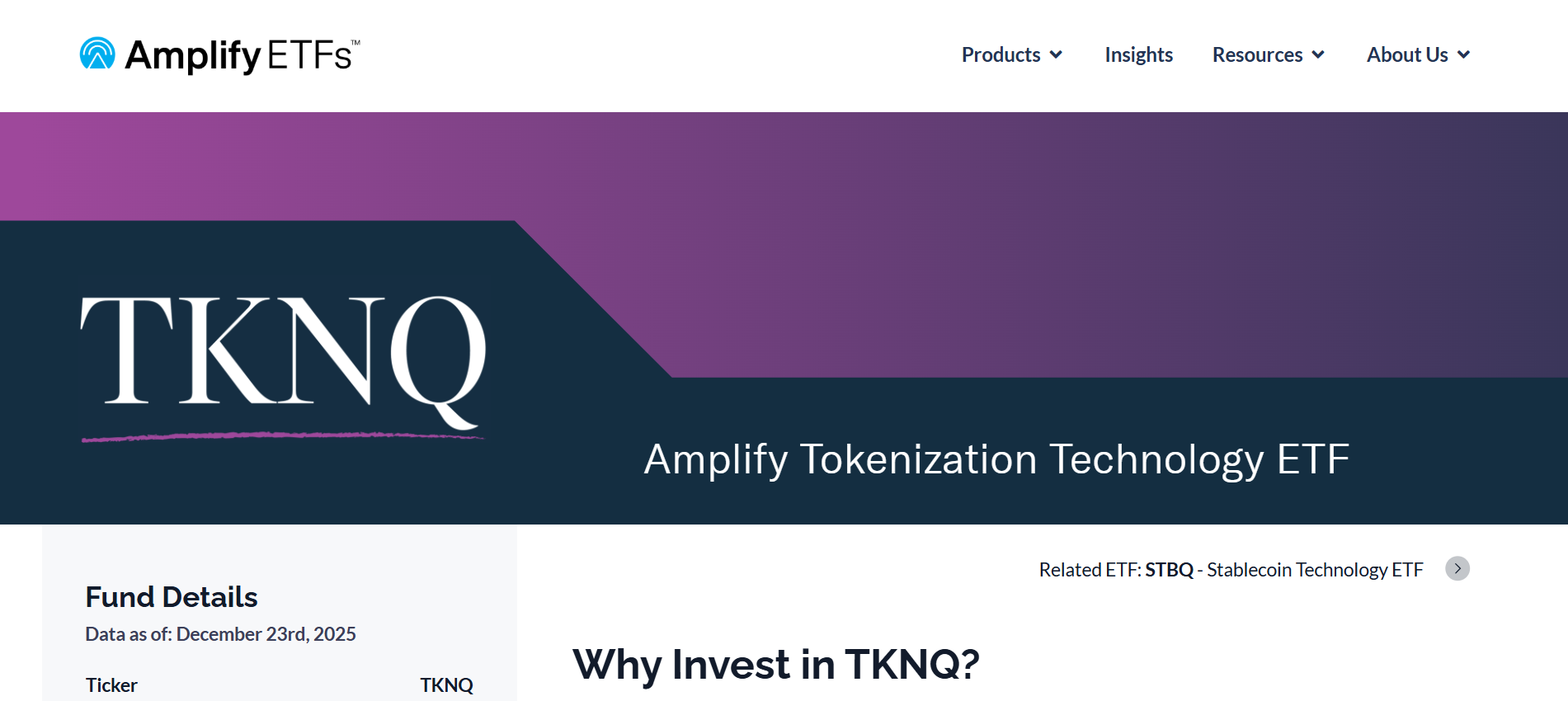
Amplify ETFs announced the launch of two pioneering exchange-traded funds on December 23, 2025: the Amplify Stablecoin Technology ETF (ticker: STBQ) and the Amplify Tokenization Technology ETF (ticker: TKNQ).
These funds began trading on NYSE Arca, marking the first ETFs to provide targeted exposure to stablecoin infrastructure and real-world asset tokenization.
The launches align with increased regulatory clarity from the U.S. GENIUS Act, signed into law in July 2025, which established a federal framework for payment stablecoins.
Amplify ETFs, managing over $16.6 billion in assets as of November 30, 2025, positions STBQ and TKNQ as hybrid vehicles blending traditional equities with cryptocurrency exposures.
Key Takeaways
- Amplify launches STBQ and TKNQ as first ETFs targeting stablecoin infrastructure and tokenization.
- STBQ tracks stablecoin-related payments firms and DeFi assets; allocates 25-50% to crypto ETPs.
- TKNQ focuses on RWA tokenization leaders; includes major banks and blockchain platforms.
- GENIUS Act provides regulatory clarity with 100% reserve requirements and audits.
- Both funds trade on NYSE Arca with 0.69% expense ratio; hybrid exposure suits institutional investors.
ETF Details and Objectives
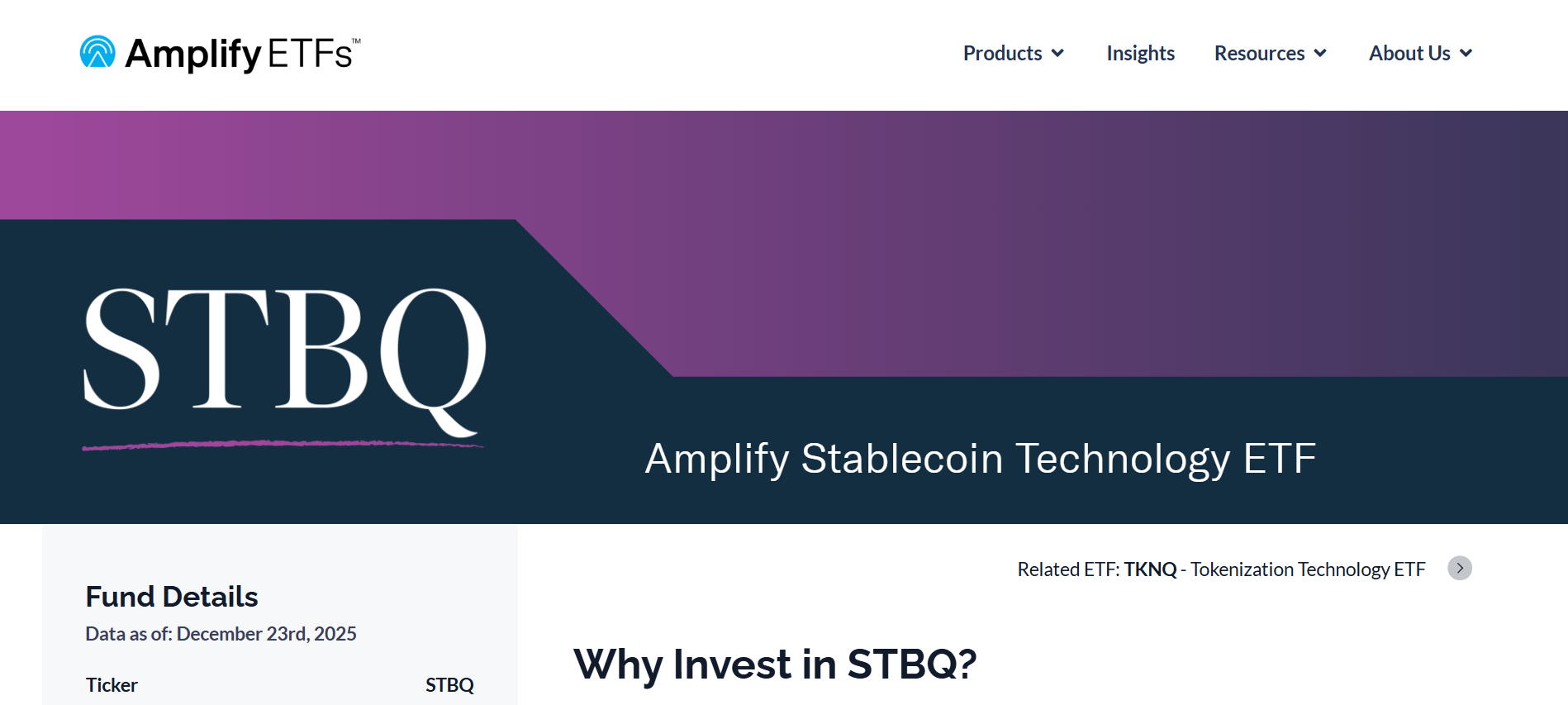
The Amplify Stablecoin Technology ETF (STBQ)
This tracks the MarketVector Stablecoin Technology Index (MVSTBQ). This rules-based index includes companies generating revenue from payments technology, digital asset infrastructure, trading platforms, stablecoin issuers, and related DeFi protocols.
At rebalance, STBQ allocates 25-50% to qualifying crypto assets, including exchange-traded products (ETPs) tied to tokens like XRP, SOL, ETH, and LINK.
Initial holdings total 24 positions, focusing on entities powering the stablecoin economy, such as issuers, platforms, exchanges, and infrastructure providers.
Stablecoins have seen rapid adoption, with market capitalization exceeding $250 billion and 2024 transfer volumes surpassing $27.6 trillion, outpacing Visa and Mastercard combined.
STBQ targets firms benefiting from stablecoins' role in payments, remittances, and cross-border settlements.
The Amplify Tokenization Technology ETF (TKNQ)
This tracks the MarketVector Tokenization Technology Index (MVTKNQ). It targets companies and crypto assets driving tokenization of real-world assets (RWAs), including platforms enabling fractional ownership, faster settlement, and broader market access.
Holdings span tokenization platforms, blockchain infrastructure, custodians, brokerages, and financial institutions like BlackRock, JPMorgan, Citigroup, and Nasdaq.
TKNQ starts with 53 positions and similarly allocates 25-50% to crypto-related assets meeting liquidity and market cap criteria at rebalance.
Tokenization digitizes assets such as real estate, bonds, and equities on blockchain, improving liquidity and transparency in traditionally illiquid markets.
Regulatory Context Driving Growth
The launches follow the Guiding and Establishing National Innovation for U.S. Stablecoins Act (GENIUS Act), enacted July 2025. This law requires stablecoin issuers to maintain 100% reserves in low-risk assets like U.S. dollars, short-term Treasuries, or bank deposits, with monthly public disclosures and audits.
It prioritizes stablecoin holders in insolvency, imposes anti-money laundering compliance, and excludes compliant stablecoins from SEC and CFTC oversight as securities or commodities. The framework limits issuance to regulated entities, including banks and approved nonbanks, fostering institutional confidence.
The GENIUS Act complements global developments, such as the EU's MiCA regulation, encouraging stablecoin use in tokenized asset settlement.
Analysts note these rules reduce risks exposed in past events like the 2022 TerraUSD collapse, paving the way for institutional participation in digital payments and capital markets.
Christian Magoon, CEO of Amplify ETFs, stated: "Stablecoins and tokenization are becoming important components of modern financial infrastructure. With STBQ and TKNQ, we deliver regulated ETF access to these advancing areas."
Market Implications
These ETFs provide investors diversified exposure without direct crypto custody. They capitalize on stablecoins' growth as digital cash proxies and tokenization's potential to transform asset markets.
Amplify's prior crypto-focused products, including spot ETF exposures, position it as an early innovator in blockchain-themed investments. The hybrid structure, combining equities with ETPs, offers a bridge for traditional portfolios into digital finance.
Conclusion
STBQ and TKNQ enable regulated investment in stablecoin and tokenization growth, backed by U.S. regulatory advancements under the GENIUS Act.
These funds position investors for digital finance infrastructure expansion.
Read Next:
- 2025 Stablecoin Year-End Report
- Best Chain for Stablecoin Micropayments in 2026
- Best Stablecoin On/Off-Ramps for 2026 Compared
FAQs:
1. What are STBQ and TKNQ ETFs?
STBQ targets stablecoin ecosystem companies and assets; TKNQ targets tokenization infrastructure firms and RWAs.
2. How do these ETFs gain crypto exposure?
Through ETPs and qualifying digital assets, comprising 25-50% of portfolios at rebalance.
3. What indexes do they track?
STBQ follows MarketVector Stablecoin Technology Index; TKNQ follows MarketVector Tokenization Technology Index.
4. How does the GENIUS Act impact these funds?
It establishes federal stablecoin rules, boosting compliance and institutional adoption in related sectors.
5. What is the expense ratio?
0.69% for both STBQ and TKNQ.
6. Where do they trade?
NYSE Arca exchange.
Disclaimer:
This content is provided for informational and educational purposes only and does not constitute financial, investment, legal, or tax advice; no material herein should be interpreted as a recommendation, endorsement, or solicitation to buy or sell any financial instrument, and readers should conduct their own independent research or consult a qualified professional.