
Table of Contents
Over the past 36 months Europe’s financial giants watched from the sidelines as US dollar stablecoins became the reserve currency of the internet.
Now, a new contender has entered the arena, and it’s not just another bank project.
AllUnity, a powerhouse consortium backed by DWS (Deutsche Bank's asset management arm), Flow Traders, and Galaxy Digital, is launching Euro AU, a euro-denominated e-money token designed to take the Euro global.
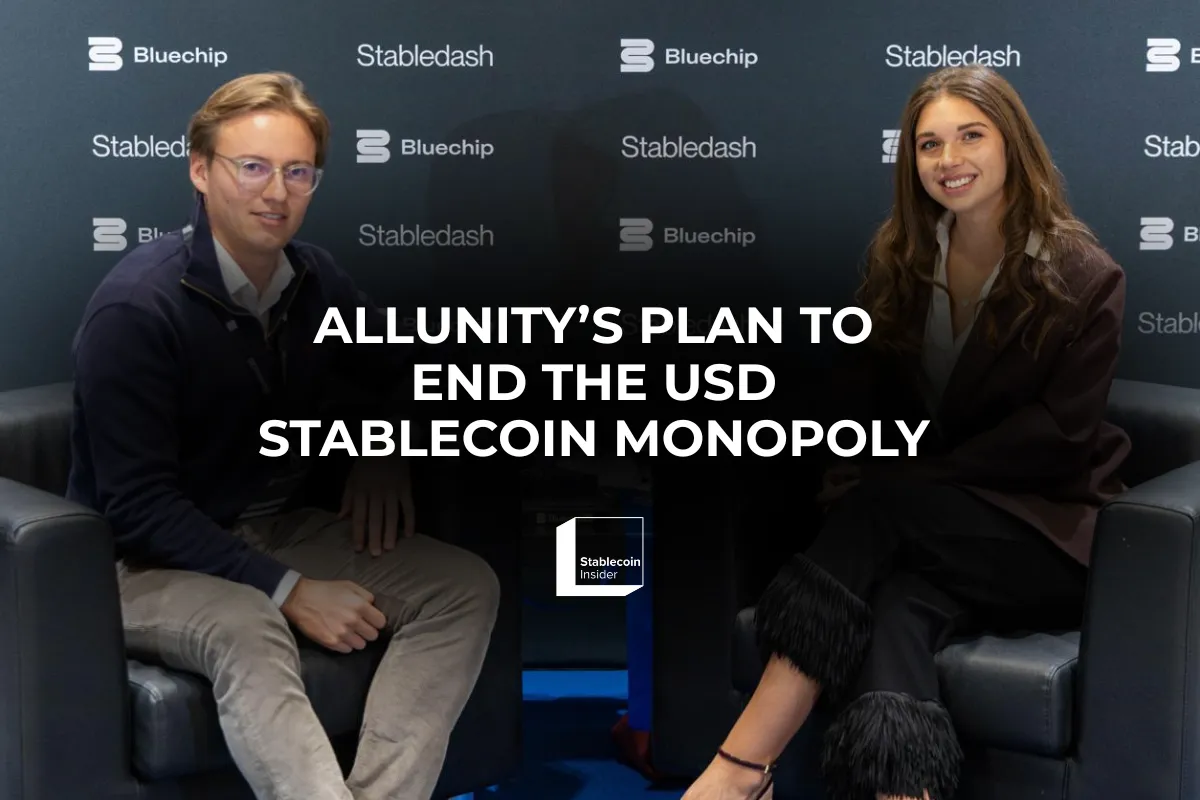
In a follow-up discussion at the Bluechip25 stage, Chiara Munaretto sat down with Luis Schaubhut, Chief of Staff at AllUnity, to discuss why the Euro has been missing from the digital asset revolution and how they plan to fix the "infrastructure bottleneck" that has held European adoption back for a decade.
The "Why Now": Reclaiming European Sovereignty
Luis is blunt about the current state of play: the Euro is punching far below its weight in the digital economy.
- The USD Monopoly: Over 90% of stablecoin transactions are in USD. This isn't just a market trend; it's a strategic vulnerability for Europe.
- Global vs. Local: While the Euro works perfectly within the SEPA (Single Euro Payments Area) system for traditional transfers, it lacks a "global rail" for the programmable economy.
- The Mission: AllUnity’s goal is to make the Euro as globally accessible and liquid as its US counterparts, ensuring Europe isn't sidelined as financial markets move on-chain.
The Licensing Breakthrough: BaFin and MiCA
Unlike many "crypto-first" projects, AllUnity took the front door.
- BaFin Approved: Luis reveals that AllUnity secured its licensing through BaFin (Germany’s Federal Financial Supervisory Authority), operating as a fully regulated E-Money Token (EMT) issuer under MiCA.
- Regulatory Evolution: He notes that regulators have evolved from being skeptical to becoming "deeply technical" partners who understand the difference between speculative tokens and regulated tokenized money.
The Corporate Bottleneck: "Where are the Wallets?"
One of the most insightful parts of the interview addresses why corporate Europe hasn't adopted stablecoins yet.
The "Porsche & Mercedes" Problem:
Luis explains that even if a giant like Mercedes-Benz wants to use a Euro stablecoin to pay its thousands of suppliers, those suppliers don't have wallets.
Infrastructure Gap:
The technology exists, but the "last mile", onboarding corporate treasury systems into the digital asset space, is still being built.
B2B First:
AllUnity is focusing strictly on the Wholesale/B2B market first, believing that retail adoption will only follow once the industrial "plumbing" is digitalized.
Collaboration Over Competition
When asked about the "9-bank consortium" (the project featuring Raiffeisen and ING), Luis offers a surprisingly pragmatic view:
"We don't see them as competitors; we see them as validators of the market."
He argues that for a Euro stablecoin to succeed, you need neutrality. While a bank-issued coin is great for that specific bank's customers, AllUnity (backed by an asset manager, a market maker, and a crypto specialist) aims to be the neutral infrastructure that all banks and corporates can plug into.
Stablecoin vs. Digital Euro (CBDC)
Like Vid Hribar, Luis draws a sharp line between their project and the ECB's initiatives:
- Digital Euro (2029+): Is the government’s answer for retail "digital cash."
- Euro AU: Is the private sector’s tool for capital markets, DeFi, and Industry 4.0.
- Timeline Gap: With AllUnity already live as of late 2025/early 2026, they are filling a multi-year gap before the Digital Euro is even scheduled to arrive.
The Verdict: Agile or Irrelevant
Luis concludes with a warning for the banking sector: banks must learn to build as "agile as startups" if they want to survive this transition.
The technology is no longer the experiment. The business model is.
Related Interview: Why 9 European Banks Are Issuing One Euro Stablecoin and What It Means for Europe’s Financial Future