
Table of Contents
The story here starts with one hard fact:
In 2024, stablecoins moved about $18.4 trillion in value, more than Visa at $15.7 trillion and Mastercard at $9.8 trillion combined.
By 2025, annual stablecoin volume estimates climbed above $27 trillion, with a total market cap passing $300 billion. At the same time, PayPal, Venmo, and Cash App together process only a fraction of that flow.
The question for 2026 is not if a single “payments-grade” stablecoin could absorb those app-based volumes, but which design and issuer are actually positioned to do it.
Key Takeaways
- Stablecoin rails are already bigger than any single card network. They moved about $18.4T in 2024, with some methodologies putting the number above $27T.
- Only a small but rapidly growing slice is real-world payments. Payment-linked volumes around $1.6T–$2.4T show genuine commerce is starting to migrate.
- Regulation has picked winners. The GENIUS Act in the U.S. and MiCA in the EU push issuers toward fully backed, highly liquid, and heavily supervised designs.
- USDC and PYUSD are best positioned for 2026. USDC leads on network-level integration and scale; PYUSD has inside access to PayPal and Venmo’s user base.
- By 2026, “absorption” will look like one or two stablecoins quietly handling the settlement behind PayPal, Venmo, Cash App, Visa, and Western Union, not a flashy front-end replacement of those brands.
Baseline: How Big Are PayPal, Venmo, Cash App, and Stablecoins?
First, get the scale right.
The Incumbents: PayPal, Venmo, Cash App
Recent data:
- PayPal
- Q2 2025: total payment volume (TPV) about $443.6 billion for the quarter.
- That implies annualized TPV of roughly $1.7–1.8 trillion.
- Around 438 million active accounts.
- Venmo
- Around 92 million active Venmo users as of 2024.
- Venmo handled about $275 billion in TPV in 2023.
- Cash App
- About 57 million monthly transacting users in 2024.
- 2024 inflows through Cash App were roughly $283 billion.
So today’s “super-apps” live roughly in the hundreds of billions of annual volume, with user bases in the tens to hundreds of millions.
Stablecoins Versus Card Networks
Now compare that to the stablecoin rails:
- Stablecoin transfer volume grew from about $3.3 billion in 2018 to around $18.4 trillion in 2024, surpassing Visa’s $15.7 trillion and Mastercard’s $9.8 trillion in the same year.
- Multiple industry and consulting datasets put 2024 stablecoin volume above $27 trillion, highlighting how quickly these rails have scaled.
- By late 2025, several analyses agree that total stablecoin market cap is just over $300 billion, with daily transfer volumes that, depending on methodology, sit in the low trillions of dollars.
However, not all of that is “real-world payments”:
- European regulatory research estimates less than 10% of stablecoin transfers are tied to real-world purchases; proxies for payment-linked stablecoin volumes were about $1.6 trillion in 2023 and $2.4 trillion in 2024.
- Independent studies show that up to 70% of volume in 2024 was bot or internal activity, especially on high-throughput chains.
Still, even payment-linked stablecoin volumes in the low trillions already sit in the same ballpark as PayPal-scale flows.
Quick Comparison Table
Annualised Scale Snapshot (Latest Full-Year Or Best Available Recent Figures)
| Rail / App | Year (Data) | Users (Approx.) | Annual Volume (Approx.) |
|---|---|---|---|
| PayPal (Incl. Venmo) | 2024–25 | 438M accounts | ≈ $1.7–1.8T TPV |
| Venmo (Stand-Alone) | 2023–24 | 92M active users | $275B TPV (2023) |
| Cash App | 2024 | 57M monthly actives | $283B inflows (2024) |
| Visa | 2024 | Billions of cards | $15.7T transfer volume |
| Mastercard | 2024 | Billions of cards | $9.8T gross dollar volume (GDV) |
| Stablecoins (All) | 2024 | Tens of millions of wallets (est.) | $18.4–27.6T transfers (method-dependent) |
Key takeaway: at the raw value-transfer layer, stablecoins are already bigger than any single card network and dwarf PayPal/Venmo/Cash App, even after you haircut the speculative or bot activity.

Why A Single “Payments-Grade” Stablecoin Could Absorb P2P App Volume
For a 2026 prediction, you need to understand why value might migrate from apps to rails.
Structural Difference: Closed Apps Versus Open Settlement
- PayPal, Venmo, and Cash App are closed systems:
- Users need accounts within a specific platform.
- Interoperability is mediated through bank rails, ACH, or card networks.
- Cross-border payments are layered on top of FX infrastructure and correspondent banks.
- Stablecoins are open settlement tokens:
- Any compatible wallet, exchange, or app can send/receive them.
- They operate 24/7 with finality in seconds or minutes.
- They are programmable; smart contracts can move money automatically.
Estimates from payments networks indicate that stablecoins already represent a non-trivial single-digit percentage share of U.S. cashless payments and that global stablecoin volumes jumped from roughly $3.5 trillion to over $5.5 trillion between 2023 and 2024, depending on data source and filters.
The “absorption” of PayPal/Venmo/Cash App doesn’t necessarily mean those brands vanish. It means:
Their underlying settlement layer could shift from bank accounts and card networks to one dominant USD-pegged stablecoin that everyone accepts by default.
Economics: Fees And Float
- Card payments often cost merchants 2–3% in interchange and network fees.
- Stablecoins running on efficient chains can settle transactions for fractions of a cent in gas fees, depending on chain congestion.
- Issuers (like Circle, Tether, or PayPal via PYUSD) earn stablecoin interest on reserves held in short-term Treasuries and cash; for example, Circle has reported hundreds of millions of dollars in quarterly revenue largely from interest on USDC reserves, with tens of billions of USDC in circulation.
So there is real economic pressure for:
- Merchants to prefer lower-fee stablecoin settlements where regulation allows.
- Issuers and payment networks to run more of their flows through interest-bearing tokens instead of zero-yield bank balances.
The Regulatory Lock-In: GENIUS Act, MiCA, And Bank-Grade Stablecoins
One of the big 2025 shifts was regulatory clarity.
- In the U.S., the GENIUS Act (signed July 18, 2025) created a federal framework for payment stablecoins, aligning state and federal rules and putting bank and non-bank issuers under clear supervisory regimes.
- In the EU, MiCA (Markets in Crypto-Assets) requires euro-denominated stablecoins to keep 1:1 reserves in highly liquid assets, such as cash and short-term government bonds, with strict redemption and disclosure rules.
This matters because:
- Any “one stablecoin” that wants to sit under PayPal, Venmo, Cash App, Visa, Mastercard, and global banks needs to meet bank-like reserve, disclosure, and compliance standards.
- It sharply narrows the field to a handful of fully compliant, heavily audited issuers.
Contenders: Who Could Realistically Become The 2026 Payments Stablecoin?
Let’s walk through the main categories, using only data we actually have.
1. USDC: The Regulatory-First, Network-Integrated Candidate
Key facts:
- USDC had around $73.7 billion in circulation as of Q3 2025, up more than 100% year-over-year.
- Circle’s quarterly revenue in 2025 has been on the order of hundreds of millions of dollars, mostly from interest on USDC reserves, with an average of roughly $60+ billion USDC in circulation that quarter.
- Visa started settling USDC on Ethereum in 2021, expanded to Solana in 2023, and by 2025 had broadened stablecoin settlement capabilities in multiple regions and programs.
USDC is already embedded in:
- Card networks: Visa and Mastercard pilots using USDC for settlement and payouts.
- Merchant acquirers: Global acquirers such as Worldpay and Nuvei participating in USDC settlement pilots.
- Institutional rails: Banks and fintechs integrating USDC as a treasury and settlement asset.
From a “who can absorb PayPal + Venmo + Cash App volume” angle, USDC has:
- Regulatory alignment in the U.S. and abroad.
- Deep integration with existing rails (Visa, Mastercard, acquirers).
- A large, growing supply and transaction footprint.
2. PayPal USD (PYUSD): The Insider With Direct Access To PayPal And Venmo
PayPal’s PYUSD has one obvious advantage: distribution inside PayPal and Venmo.
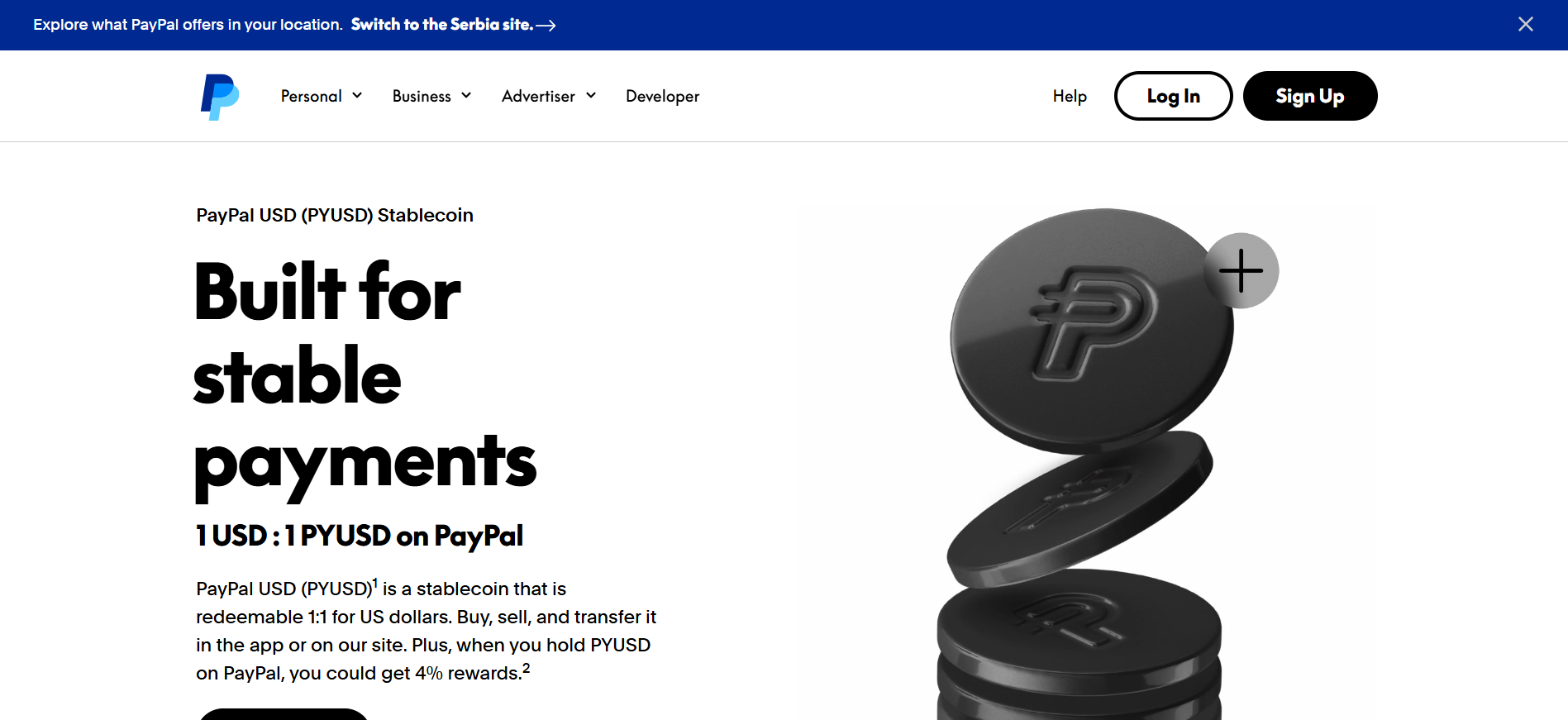
- PYUSD is a dollar-backed stablecoin, fully backed by U.S. dollar deposits and Treasuries, redeemable 1:1.
- By late 2025, PYUSD reached roughly $1.3–1.4 billion in market cap, making it the sixth-largest stablecoin, after more than 200% growth that year.
- Coinbase and PayPal have partnered to waive fees on PYUSD transfers and allow direct redemption to U.S. dollars, explicitly targeting payments usage.
PayPal has also announced plans to launch PYUSD on payment-focused chains like Stellar, pending regulatory approvals.
If you combine:
- 438M PayPal accounts and 92M Venmo users,
- Native PYUSD balances,
- And zero-fee rails into Coinbase’s ecosystem,
…it’s easy to imagine a 2026 where a huge portion of PayPal/Venmo volume quietly shifts from internal ledger entries to PYUSD-backed stablecoin transfers, even if the user never notices.
3. Bank And Remittance Stablecoins: Western Union’s USDPT And Euro Projects
In 2025, banks and remittance giants started announcing their own tokens:
- Western Union - USDPT
- Western Union is launching the U.S. Dollar Payment Token (USDPT) on Solana in H1 2026, issued by Anchorage Digital Bank, alongside a “Digital Asset Network” connecting cash and crypto payments.
- European Bank Consortium - Qivalis
- A group of 10 major European banks (including ING, UniCredit, BNP Paribas and others) formed Qivalis to issue a euro-backed stablecoin from Amsterdam. Launch is targeted for H2 2026, pending an e-money or similar license from the Dutch central bank.
- KlarnaUSD
- Klarna launched KlarnaUSD as a dollar stablecoin, citing estimates that stablecoin transactions have reached around $27 trillion annually and might overtake legacy networks before decade-end.
These bank-grade tokens will be strong in regional and remittance niches, but they start from:
- A smaller base than USDC or PYUSD.
- Mostly regional regulatory and distribution footprints.
4. Tether (USDT): Volume Giant, But Not The Likely “Front-End” Coin
USDT still dominates stablecoin market share and profits, but:
- U.S. and EU regulators are increasingly focused on reserve transparency and systemic risk.
- Institutional and card-network pilots have leaned more heavily toward USDC and bank-issued tokens for settlement.
USDT will likely continue as a trading and offshore liquidity giant, but it is much less likely to be the compliant stablecoin that PayPal, Visa, Western Union, and European banks align on for mainstream retail payments.
The Real-World Usage Problem: Stablecoins As Payments, Not Just Trading Fuel
Even if a single stablecoin becomes the default settlement asset, it still has to solve two big friction points:
- Merchant Acceptance
- Card payments are accepted at tens of millions of merchants; stablecoins are just starting to be natively accepted in POS systems and online checkouts.
- Visa, Mastercard, Stripe and others are building bridges (for example, stablecoin payouts to wallets), but full merchant-side acceptance will take time.
- Consumer Incentive To Hold Stablecoins
- Credit cards offer points and cash-back; bank deposits and money market funds pay interest; stablecoins often pay nothing at the wallet level.
- Issuers earn the interest on reserves; if they start sharing more yield with end users, holding balances for day-to-day spending becomes more compelling.
Regulatory and central bank research is a useful reminder: only a small share of stablecoin volume today is genuine consumer or merchant payments, even though the infrastructure is already capable.
Payment-linked volumes are measured in the low trillions versus total flows in the tens of trillions.
2026 Prediction: What “Absorption” Of PayPal, Venmo, And Cash App Actually Looks Like
Given the data, a realistic prediction for 2026 looks like this.
The Rails, Not The Brands, Converge
By 2026, multiple trends are converging:
- Visa Direct stablecoin payouts are being rolled out globally for creators and gig workers, using USD-backed stablecoins as settlement assets.
- Mastercard is joining Paxos’ Global Dollar Network to support stablecoins like USDC, PYUSD, and others across its network.
- Western Union’s USDPT and Qivalis’ euro stablecoin go live, bringing banks and remittance giants directly onto stablecoin rails.
In that environment, “absorbing PayPal, Venmo, and Cash App” likely means:
- PayPal and Venmo increasingly hold PYUSD and/or USDC as their own treasury and settlement asset.
- Cash App (through Block) leaning on one or two regulated USD stablecoins for cross-border and instant settlement.
- Visa and Mastercard giving all of these apps a shared, multi-stablecoin settlement layer in the background.
Consumers may still see “PayPal balance” or “Venmo balance,” but behind the scenes, a single dominant stablecoin (or narrow cluster) will be used for most inter-app settlement and treasury management.
If You Force A Single-Coin 2026 Call
Based strictly on:
- Regulatory clarity (GENIUS, MiCA),
- Depth of integration with Visa/Mastercard and banks,
- Current market cap and growth,
- Direct distribution into PayPal/Venmo or merchant networks,
a conservative, data-driven 2026 scenario looks like:
- USDC as the primary network-level settlement stablecoin, particularly for Visa/Mastercard, banks, and cross-border flows.
- PYUSD as the primary PayPal/Venmo-native stablecoin, used in a growing share of those apps’ internal balances and payouts.
- Bank-issued coins like USDPT (Western Union) and Qivalis’ euro stablecoin filling specific corridors (remittances, EU payments).
In practice, that means:
By 2026, USDC is the most likely single stablecoin to “absorb” the combined value flows of PayPal, Venmo, and Cash App at the settlement layer, while PYUSD captures a large share of those flows inside the PayPal/Venmo ecosystem.
That is still a scenario, not a guarantee, but it is directly supported by current integration patterns and regulatory positioning, not speculation.
What This Means For Builders, Institutions, And Users
For Fintech And Web3 Builders
- Design for USDC-first and PYUSD-aware settlement in the U.S., with an eye on USDPT and euro stablecoins for specific corridors.
- Leverage Visa/Mastercard stablecoin settlement APIs as they roll out, rather than rebuilding every payment flow from scratch.
- Watch payment-linked volume metrics; the growth from around $1.6T (2023) to $2.4T (2024) in real-world use is the signal; the $20–27T headline volume is mostly noise.
For Institutions
- Treat compliant stablecoins as liquid, programmable “inside money” that can sit alongside deposits and money-market funds.
- Build policy playbooks for GENIUS- and MiCA-compliant issuers only; anything outside that perimeter carries materially higher regulatory risk.
For Individual Users
- The shift may feel subtle: you’ll still tap a card or send a Venmo payment.
- Underneath, a larger share of those flows will run on USDC, PYUSD, or bank-issued stablecoins, bringing:
- Faster settlement,
- Cheaper cross-border transfers,
- And potentially, interest-sharing on balances if issuers start passing yield through.

Conclusion: Why The “One Stablecoin” Thesis Matters In 2026
By 2026, stablecoins will not just mirror traditional rails in scale; they will underpin a growing share of real-world payments, payroll, and remittances.
The hard numbers already show trillions in annual payment-linked volume and card networks actively piloting stablecoin settlement.
USDC, PYUSD, and bank-issued tokens like USDPT and qivalis stand out because they combine regulatory compliance, transparent reserves, and deep integration with existing payment giants.
In practical terms, “absorption” means that the same PayPal, Venmo, and Cash App interfaces will increasingly ride on one dominant stablecoin rail, even if users never see the ticker.
Understanding which tokens meet those criteria in 2025 is the clearest way to anticipate where consumer and institutional money will actually move in 2026.
Read Next:
FAQs:
1. If Stablecoins Already Move More Value Than Visa And Mastercard, Why Don’t We See Them Everywhere In Shops?
Most stablecoin volume is still driven by trading, DeFi, and internal transfers, not point-of-sale purchases. Payment-linked volumes in the low trillions are growing fast but remain a fraction of total transfer volume. Merchants also need upgraded terminals, accounting tools, and clear regulation before accepting stablecoins at scale.
2. Could One Stablecoin Really “Replace” PayPal, Venmo, And Cash App?
It’s more precise to say one or two stablecoins can become the common settlement layer underneath those apps. The brands will likely continue as user interfaces, while stablecoins handle treasury and inter-app settlement in the background.
3. Why Is USDC A Leading Candidate For 2026?
USDC combines large and growing supply, strong reserve income and compliance, and deep integration with Visa, merchant acquirers, and banks. That mix makes it highly compatible with emerging stablecoin regulatory frameworks and mainstream payment rails.
4. What Gives PYUSD A Serious Chance In This Race?
PYUSD is directly embedded into PayPal and Venmo, with more than 400M total accounts and tens of millions of active P2P users. If PayPal routes an increasing share of internal balances and merchant settlement through PYUSD, it can quickly reach multi-hundred-billion-dollar annual payment volumes even with a relatively small market cap.
5. How Important Are Bank-Issued Stablecoins Like Western Union’s USDPT Or qivalis’ Euro Token?
They are critical for specific corridors: remittances, European payments, and bank-to-bank settlement. Western Union’s USDPT (launch planned for H1 2026) and the qivalis euro coin (targeted for H2 2026) show that banks and money transfer operators see stablecoins as strategic infrastructure rather than a niche experiment.