Table of Contents
Think of Symbiosis Finance as a universal remote for your crypto. It’s a cross-chain aggregator that lets you swap any token on one blockchain for a completely different token on another—all in a single click. No more confusing, multi-step journeys through different bridges and exchanges.
Navigating DeFi's Fragmented Universe
The world of decentralized finance (DeFi) is booming, but it’s not exactly a unified system. It's more like a cluster of separate digital islands. You have bustling economies on Ethereum, Solana, BNB Chain, and Avalanche, each with its own apps, tokens, and unique opportunities. The big problem? Moving your assets between these islands is a real headache.
This fragmentation causes a lot of friction. If you want to move a token from one chain to another, you’re usually forced into a frustrating sequence: find a bridge that works, "wrap" your token, pay gas fees on both chains, and then finally swap it on a decentralized exchange (DEX) once you arrive. It’s clunky, expensive, and opens the door to security risks at every step.
The Problem of Disconnected Liquidity
The biggest consequence of this setup is that liquidity gets trapped in silos. The DEXs on one blockchain can’t talk to the DEXs on another, which means you can't easily get the best price for an asset if it’s spread across different networks.
This leads to some common, frustrating problems that hold DeFi back:
- A Terrible User Experience: Newcomers and even seasoned pros get tired of juggling multiple browser tabs for bridges and DEXs. It's confusing and a huge time sink.
- High Costs: Every single step in a manual cross-chain swap comes with its own network fee. These fees stack up fast, often making smaller trades completely pointless.
- Price Slippage: When liquidity is thin on a particular chain, a single trade can drastically move the price. You end up getting a much worse deal than you expected.
- Missed Opportunities: The best yield farms or trading opportunities might be on a different chain, but by the time you navigate the bridging process, the chance is often gone.
The entire point of the Symbiosis Finance cross-chain aggregator is to fix these exact issues. It stitches this scattered landscape together, offering one simple interface to handle any-to-any token swaps. For a more detailed look at the challenges in this space, our guide on cross-chain DeFi breaks it down even further.
To really grasp what Symbiosis brings to the table, it helps to see the problems it directly addresses.
Common Cross-Chain Problems Solved by Symbiosis
| DeFi Challenge | The Symbiosis Solution |
|---|---|
| Complex Multi-Step Swaps | A one-click experience. Users just select their start and end tokens, and the protocol handles all bridging and routing behind the scenes. |
| Fragmented Liquidity | Aggregates liquidity from dozens of DEXs across multiple chains, ensuring users get the best possible price for their swap. |
| High Transaction Costs | Optimizes the transaction path to minimize gas fees and slippage, bundling multiple steps into a single, efficient operation. |
| Poor User Experience | Replaces the need for multiple interfaces with a single, intuitive platform. No more manual bridging or wrapped token management. |
In short, Symbiosis takes a complicated, high-friction process and makes it simple.
Symbiosis is designed to abstract away the complexity. Instead of forcing users to think about bridges, wrapped tokens, and destination DEXs, it simply asks, "What do you have, and what do you want?" The protocol handles the rest.
By plugging into countless liquidity sources across many networks, Symbiosis automatically finds the most efficient and cheapest route for your trade. It turns a frustrating chore into a smooth, one-click action, helping build a future where capital can flow freely to wherever it’s most valuable.
How Symbiosis Executes Any-to-Any Swaps
Think of Symbiosis Finance less like a single bridge and more like a master logistics network for your crypto. It’s not just about getting from point A to point B; it’s about finding the smartest, most efficient route. This system is powered by two key pieces working together: an on-chain engine and an off-chain communication network.
The secret sauce is how Symbiosis uses stablecoins. At its core, the protocol relies on on-chain Automated Market Makers (AMMs) that hold concentrated pools of stablecoins. These pools are the universal transit hubs. When you start a swap, your token is first traded for a stablecoin on its home chain. That stablecoin then zips across the bridge to the destination chain, where it's immediately swapped for the token you actually want. This approach is incredibly capital-efficient because Symbiosis doesn't need to create and manage separate liquidity pools for every possible token pair out there.
The Two-Part Transaction Flow
The real magic is in the handoff between the on-chain smart contracts and the off-chain relayer network. It's a carefully choreographed process built for both speed and security.
- On-Chain Swap (Source Chain): It all starts on the blockchain where your funds are. Symbiosis's smart routing automatically finds the best decentralized exchange (DEX) to swap your starting token (say, MATIC on Polygon) into a Symbiosis-wrapped stablecoin like sUSDC. This ensures you're getting the best possible rate for the first leg of the journey.
- Off-Chain Communication (Relayer Network): As soon as that first swap happens, the Symbiosis Relayer Network kicks into gear. This is a decentralized group of validators that constantly watch the source chain. They see the event, verify it's legitimate, and then securely pass the instructions over to the destination chain. Think of them as the trusted messengers in this whole operation.
- On-Chain Swap (Destination Chain): The relayers’ message triggers the final step. The wrapped stablecoin is swapped for the token you want (for example, AVAX on Avalanche), again using the most liquid DEX on that network. The AVAX is then sent straight to your wallet.
By using stablecoins as the go-between, Symbiosis creates a common "language" for moving value around. This neatly sidesteps the need for clunky, complex wrapped assets for every single token and boils the entire cross-chain puzzle down to a clean, two-swap model.
The infographic below helps visualize how Symbiosis takes all the fragmented crypto assets across different chains and creates one smooth, unified experience.
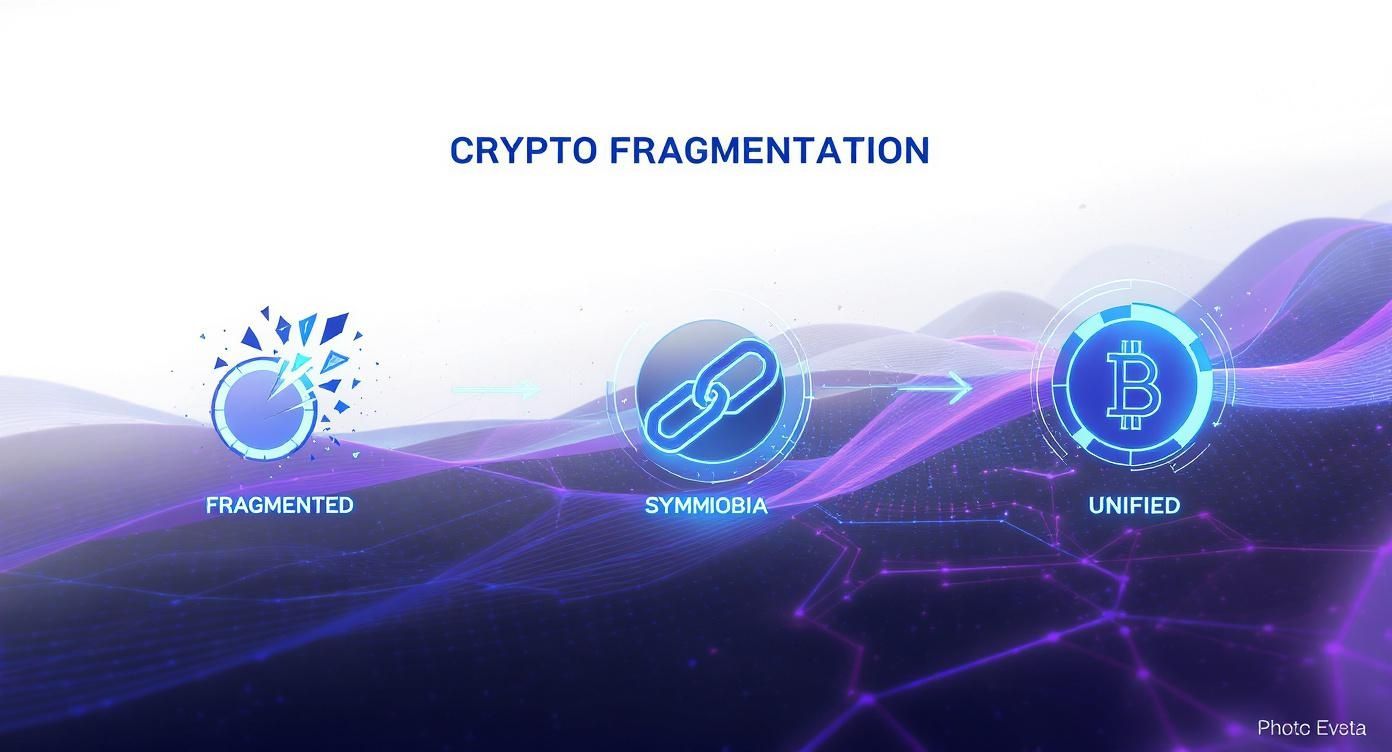
This entire flow is the core value of a symbiosis finance cross-chain aggregator. It turns what used to be a frustrating, multi-step chore into what feels like a single, simple transaction.
A Practical Example Step-by-Step
Let's make this real. Imagine you have 100 MATIC on Polygon and you want to turn it into AVAX on Avalanche.
- Step 1: Initiation: You connect your wallet to Symbiosis, put in 100 MATIC, and pick AVAX as the token you want to receive. The interface immediately shows you a quote for how much AVAX you'll get after fees.
- Step 2: Source Swap: You hit confirm. Behind the scenes, the aggregator finds the best deal on a Polygon DEX (like QuickSwap) to turn your 100 MATIC into sUSDC.
- Step 3: Cross-Chain Message: The Relayer Network spots the new sUSDC being created on Polygon, confirms everything is correct, and shoots a secure message to the Symbiosis smart contract waiting on Avalanche.
- Step 4: Destination Swap: The Avalanche contract gets the message and instantly triggers a swap from sUSDC into AVAX, pulling liquidity from the best-priced DEX on Avalanche (like Trader Joe).
- Step 5: Completion: The final amount of AVAX lands directly in your Avalanche wallet. You just performed a complex cross-chain swap without ever having to leave the Symbiosis app.
To you, the user, it all feels like a single click. But under the hood, the protocol is juggling liquidity and messages across two completely separate blockchain ecosystems. It's this kind of seamless experience that defines the modern cross-chain aggregator.
For a broader perspective on how this technology works across the industry, feel free to explore our detailed guide on the OpenOcean cross-chain aggregator to compare different protocols and their unique approaches.
How Symbiosis Pulls Off Cross-Chain Swaps
So, how does Symbiosis make a complex, multi-chain transaction feel like a single click? The magic lies in two core components working together: a powerful aggregation engine and a decentralized cross-chain communication protocol.
At its heart, Symbiosis is a liquidity aggregator. Think of it like a travel site for your crypto. You wouldn’t check just one airline when booking a flight; you’d use a service that scans dozens to find the best deal. Symbiosis does exactly that for your assets.
When you want to swap, the protocol doesn't just rely on one decentralized exchange (DEX). Its smart routing system scouts multiple liquidity sources—like Uniswap, PancakeSwap, or Trader Joe—on both the starting and ending chains. This hunt for liquidity ensures you get the best possible exchange rate by reducing slippage and finding the deepest pockets of capital for your trade.
Smart Routing: Getting the Best Price, Every Time
The whole point of the aggregation engine is to map out the most capital-efficient route for your tokens. It’s not just about finding a good price; it’s about optimizing the entire journey.
Here’s a breakdown of how it works:
- Step 1: Source Chain Swap: First, the router finds the best DEX on the starting network to trade your token for a stablecoin. This minimizes price impact right out of the gate.
- Step 2: Cross-Chain Transfer: The stablecoin is then sent across chains using the core Symbiosis bridging protocol.
- Step 3: Destination Chain Swap: Once the stablecoin arrives, the router scans all available DEXs on the destination network to find the cheapest way to convert it into the final token you want.
By breaking the process down and optimizing each leg of the journey, Symbiosis makes sure you're getting the most value. This kind of tech has become essential in DeFi. In fact, by 2025, the total volume handled by crypto aggregators had jumped by 300% year-over-year, largely thanks to the rise of modular blockchains and protocols that can execute omnichain swaps in under 30 seconds.
The Relayer Network: The Bridge-Keepers
Once the best route is found, how does your transaction actually get from one chain to another without getting lost or stolen? That's the job of the Symbiosis Relayer Network.
This isn't some centralized server. It’s a decentralized group of independent validators who keep an eye on Symbiosis smart contracts across all supported blockchains.
When you kick off a swap on the source chain, these relayers all see it happen. They work together to confirm the transaction is legitimate, then collectively sign off on a message that tells the destination chain what to do next.
Why this matters: This decentralized approach is the foundation of good cross-chain security. Instead of putting your trust in a single company, you’re relying on a whole network of validators who have to stake SIS tokens (and their own money) to participate. They're financially motivated to play by the rules.
Backing them up is the Security Module, which serves as the final checkpoint. It double-checks the signatures from the relayers before giving the green light for the destination chain’s smart contract to release your funds. This two-pronged system—decentralized validation plus a security backstop—creates a much safer environment for your assets.
If you want to dig deeper into how these mechanisms compare to others, our guide on crypto cross-chain bridges breaks down the different security models out there. Ultimately, this architecture turns what used to be a risky, manual bridging process into something smooth and automated.
Understanding the SIS Token's Role
https://www.youtube.com/embed/zEQ6iNsZSZk
Every strong decentralized protocol needs a native token to power its engine, and for the Symbiosis Finance cross-chain aggregator, that's the SIS token. This isn't just another coin for speculation. SIS is deeply integrated into the protocol's DNA, serving two critical functions: governance and network security.
You can think of the SIS token as part ballot, part security bond. It gives holders a direct say in the platform's future while also acting as the economic backbone that keeps the entire system honest and secure.
Driving Protocol Governance
First and foremost, SIS is the key to decentralized governance through the Symbiosis DAO (Decentralized Autonomous Organization). In this setup, the community of SIS holders essentially acts as the protocol's steering committee. If you hold SIS, you can propose changes or vote on ideas from other community members.
This isn't just for show. The community makes real decisions that shape how the platform grows and operates. For instance, SIS holders vote on things like:
- Adding New Chains: Deciding which networks, like Solana or Arbitrum, get integrated next.
- Setting Protocol Fees: Tweaking the fee structure for swaps to stay competitive while ensuring the protocol remains sustainable.
- Managing the Treasury: Deciding how to use community funds for developer grants, marketing campaigns, or liquidity programs.
- Approving Upgrades: Green-lighting technical updates to improve the protocol's features or patch vulnerabilities.
This approach ensures Symbiosis evolves based on what its users actually want, not what a central team dictates. It truly becomes a public utility guided by its community.
Securing the Relayer Network
Beyond voting, the SIS token is absolutely essential for securing the network that handles cross-chain communication. This is the Symbiosis Relayer Network—a group of validators who confirm transactions between different blockchains. They operate on a Proof-of-Stake model.
To join this network as a validator, you have to buy and "stake" a substantial amount of SIS tokens. This staked SIS acts as collateral, or a good-behavior bond. If a validator tries to pull a fast one—like approving a fake transaction—their staked SIS gets "slashed," and they lose their money. It’s a powerful financial deterrent that keeps everyone honest.
The SIS token cleverly turns network security into an economic game. By forcing validators to have skin in the game, it makes sure their financial interests are perfectly aligned with the health of the entire ecosystem.
The SIS token's job is really twofold: guiding the protocol's direction and guaranteeing its security. If you're new to the mechanics of token exchanges, our guide on how to swap stablecoins is a great place to start, as it covers the foundational concepts that power these more advanced cross-chain systems.
To put it all together, here's a quick breakdown of what the SIS token really does.
Core Functions of the SIS Token
| Utility | Purpose in the Ecosystem |
|---|---|
| Governance | Grants SIS holders voting rights in the Symbiosis DAO to direct the protocol's future development and economic policies. |
| Network Security | Requires validators in the Relayer Network to stake SIS as collateral, ensuring honest behavior through economic incentives. |
At the end of the day, the SIS token is the lifeblood of Symbiosis, providing the structure for both its community-led governance and its decentralized security.
Symbiosis in Action: Real-World Applications
It’s one thing to understand the architecture of the Symbiosis Finance cross-chain aggregator, but seeing it solve actual problems is where the lightbulb really goes on. So, let's step away from the technical diagrams and look at how people are using Symbiosis every day.
These examples show how a simple, one-click, any-to-any swap opens up a whole new world of DeFi strategies that used to be a massive headache. Whether you're chasing the best returns or pouncing on market glitches, Symbiosis is the key to a much more agile and profitable DeFi experience.
Chasing Yield Across Chains
Let's meet Alex, a classic yield farmer. He's got $10,000 in USDC on Ethereum, but the yields are pretty sleepy. He does some digging and finds a new lending protocol on Arbitrum paying a sweet 15% APY on a different stablecoin, DAI.
Before Symbiosis, this was a long and painful journey:
- Pay a hefty gas fee to send his USDC to a bridge.
- Wait around for the transaction to go through.
- Pay another gas fee on Arbitrum to get his bridged USDC.
- Find a DEX on Arbitrum, pay another fee (and take a slippage hit) to swap USDC for DAI.
- Finally, deposit the DAI into the new lending protocol.
This whole process is slow, expensive, and frankly, full of moments where something could go wrong.
With Symbiosis, Alex’s workflow becomes a single, elegant move. He just tells the app he wants to go from USDC on Ethereum to DAI on Arbitrum. That’s it. Symbiosis handles all the bridging and swapping in the background, landing the DAI right in his Arbitrum wallet in one efficient transaction. He can get his funds working and start earning that yield almost instantly.
Capitalizing on Arbitrage Opportunities
Now, let's look at Ben, a trader who lives for spotting price differences. He sees that the LDO token is trading at $2.50 on BNB Chain, but it's $2.55 on Optimism. That 2% gap is a clear arbitrage opportunity just waiting to be claimed.
Trying to do this manually is a race against the clock he'd almost certainly lose. He’d have to buy LDO on BNB Chain, bridge it over to Optimism, and then sell it. By the time the bridge transfer completes minutes later, that price difference is probably gone.
This is where Symbiosis changes the game. Ben can execute an instant cross-chain swap, trading BUSD on BNB Chain directly for WETH on Optimism in a single click. The platform’s smart routing finds the most efficient path, allowing him to exploit the arbitrage window before it closes.
This kind of power isn't just for simple trades anymore. The entire DeFi space is moving toward unified, multi-chain tools. We’re seeing a huge rise in things like decentralized perpetual contract trading, with aggregator platforms becoming the go-to solution. It's all part of a bigger trend toward making cross-chain finance feel seamless. You can actually read more about this in a recent H1 2025 industry report that dives deep into these trends.
How Symbiosis Stacks Up
To really get why this is a big deal, it helps to compare Symbiosis to the other tools out there.
| Feature | Standard Bridge | Centralized Exchange | Symbiosis Aggregator |
|---|---|---|---|
| Asset Swaps | Transfers only one asset (often wrapped) | Requires deposits, trades, and withdrawals | Any-to-any token swaps in one transaction |
| Custody | Non-custodial, but assets are locked in a contract | Custodial (you give up control of your keys) | Fully non-custodial from start to finish |
| User Experience | Multi-step and complex (bridge, then swap) | Requires KYC and multiple transactions | Single-click, seamless experience |
| Capital Efficiency | Often relies on fragmented liquidity pools | Centralized order books | Aggregates liquidity from multiple DEXs for best rates |
While regular bridges are fine for moving a single asset, and centralized exchanges offer deep liquidity, neither can match the smooth, non-custodial, any-to-any swap that a true symbiosis finance cross-chain aggregator provides. Symbiosis truly brings together the best of both worlds—the freedom of decentralization and the efficiency of smart aggregation—all in one place.
Your Questions About Symbiosis Answered
Even after getting a grasp of the architecture, it's natural to have questions when you're looking at a powerful tool like the Symbiosis Finance cross-chain aggregator. Let's clear up some of the most common ones to give you a better sense of how it works and what makes it stand out.
What Makes Symbiosis Different from a Standard Crypto Bridge?
Think of a standard crypto bridge as a single ferry line. It's built to move a specific asset, like USDC, from one blockchain to another. It’s a simple A-to-B transfer, and you're often left with a "wrapped" token on the other side. Once you arrive, you still have to find a local exchange to trade it for what you actually wanted.
Symbiosis is much more than that—it’s the entire travel agency and transportation hub rolled into one.
It’s an aggregator that combines the bridge and the swap. You can start with ETH on Ethereum and, in one click, end up with SOL on Solana. Symbiosis handles the messy parts in the background, finding the best swap rates on both chains and bridging the assets without you ever needing to deal with wrapped tokens or use a DEX manually. For a primer on the basic mechanics, our guide on how to bridge tokens is a great place to start.
How Does Symbiosis Guarantee the Best Swap Rates?
Symbiosis gets the best rates because it doesn't just rely on its own liquidity. Instead, it acts like a smart shopper for your trade. Its routing engine is constantly scanning dozens of decentralized exchanges (DEXs) on both the starting and destination chains.
When you kick off a swap, the aggregator finds the DEX with the best liquidity and lowest slippage to turn your initial token into a stablecoin. After that stablecoin is bridged, the process repeats on the other side, finding the most efficient DEX to complete the trade into your final token.
By tapping into the liquidity of the entire market instead of just one internal pool, Symbiosis dramatically reduces price impact. This means more of your money makes it to the destination, giving you the best possible rate at that moment.
What Are the Main Fees When Using the Symbiosis Aggregator?
Nobody likes hidden costs. Symbiosis bundles everything into a transparent breakdown you see before confirming any swap. The fees generally fall into three buckets:
- Network Gas Fees: This is the standard gas fee you pay on the source chain to get your transaction started. It’s the same kind of fee you'd pay for any on-chain action.
- Relayer Network Fee: A small fee goes to the decentralized validators who run the Symbiosis Relayer Network. This compensates them for securely verifying and passing your transaction between chains.
- DEX Swap Fees: The total cost also includes the small trading fees charged by the DEXs that Symbiosis uses on both ends of the transaction to execute your swaps.
The routing algorithm is smart enough to factor all these costs in when finding the cheapest path, so you shouldn't run into any nasty surprises.
How Does Symbiosis Approach Security?
In the world of cross-chain protocols, security is everything. Symbiosis tackles this with a multi-layered approach. First off, all its smart contracts go through exhaustive audits by respected security firms like PeckShield and SlowMist. This helps stamp out vulnerabilities before the code ever goes live.
Beyond that, the system is designed to be decentralized at its core. The Relayer Network isn't run by a single company; it's operated by a group of independent validators who must stake SIS tokens as a sort of security deposit. This gives them a strong financial incentive to play by the rules. If they act maliciously, their staked funds get slashed. This blend of third-party audits and built-in economic security creates a strong framework to keep user funds safe.
Ready to experience seamless cross-chain swaps without the hassle? Visit Stablecoin Insider to learn more and stay ahead in the world of digital assets at https://stablecoininsider.com.