Table of Contents
In the search for yield, stablecoins offer a compelling proposition: the potential for high returns without the price volatility characteristic of assets like Bitcoin or Ethereum. However, identifying the platforms that consistently offer the stablecoins with highest APY can be a challenging and time-consuming task. The crypto yield market is fragmented, with rates fluctuating daily across dozens of centralized finance (CeFi) and decentralized finance (DeFi) protocols.
This guide solves that problem by providing a curated, data-driven roundup of the top platforms and protocols for earning yield on your stablecoins. We cut through the noise to bring you a direct comparison of leading options, from user-friendly centralized exchanges like Coinbase and Uphold to decentralized lending powerhouses like Aave and Compound. We also explore yield aggregators such as Yearn Finance and data tools like DeFiLlama Yields that help you navigate the complex DeFi ecosystem.
For each entry, you will find:
- Current APY ranges and the stablecoins supported.
- A clear explanation of how the yield is generated.
- An assessment of the associated risks, including smart contract, counterparty, and peg stability concerns.
- Actionable steps, complete with screenshots and direct links, to help you start earning.
Our goal is to equip you with the specific information needed to compare opportunities and make informed decisions. This resource is designed to be your go-to reference for maximizing your stablecoin returns safely and effectively, updated regularly to reflect the most current market conditions.
1. Coinbase
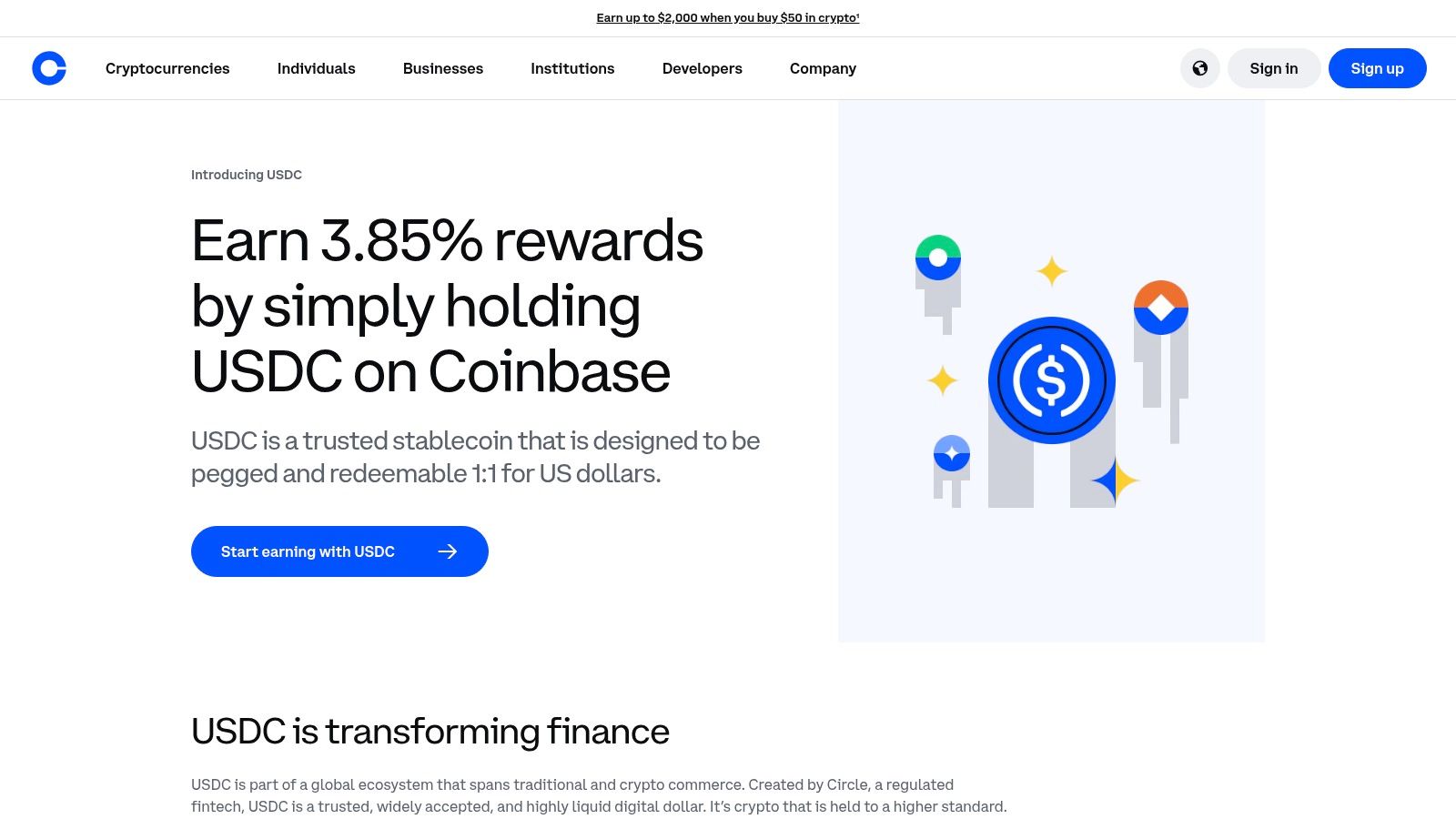
Coinbase offers one of the most straightforward entry points for US-based users looking to earn yield on their stablecoins. As a major, publicly-traded, and regulated US exchange, it provides a trusted environment for purchasing USD Coin (USDC) directly with US dollars and earning rewards with minimal complexity, positioning it as a key platform for those seeking stablecoins with highest APY from a centralized source.
The platform's primary appeal lies in its simplicity. Users can buy USDC and automatically start earning a base rewards rate just for holding it in their Coinbase account. There are no complex DeFi protocols to navigate, no gas fees to manage, and no smart contract risks to evaluate, making it an ideal starting point for beginners.
Key Features and Yield Generation
Coinbase’s USDC yield is generated through its own corporate operations and lending activities, sharing a portion of the revenue with users. It offers two main reward tiers:
- Base USDC Rewards: A foundational APY applied to all USDC held on the platform by eligible users. Rewards accrue daily and are paid out monthly directly into your USDC balance.
- Boosted USDC Rewards: For more active traders, Coinbase provides a higher APY tier. This requires users to opt into an Advanced or Perpetuals portfolio and meet certain eligibility criteria, which may include trading activity or account balance minimums. Payouts for boosted rewards are typically weekly.
Expert Tip: To maximize your yield on Coinbase, check your eligibility for the Boosted Rewards program within the Advanced trading interface. Even a small percentage increase can significantly impact your overall returns on larger stablecoin balances.
Risk Assessment and Usability
The user experience is clean and intuitive, consistent with Coinbase's reputation for being user-friendly. The fiat on-ramp is one of the best in the industry, allowing for easy deposits via bank account, debit card, or wire transfer.
| Feature/Risk | Coinbase Evaluation |
|---|---|
| How APY is Generated | Corporate revenue sharing from USDC ecosystem activities. |
| Counterparty Risk | Low. As a regulated public company, Coinbase is subject to stringent financial reporting and auditing. |
| Peg Risk (USDC) | Low. USDC is backed 1:1 by cash and short-term U.S. Treasuries, with monthly attestations from Grant Thornton LLP. |
| Smart Contract Risk | N/A. This is a centralized finance (CeFi) product, so users are not directly interacting with smart contracts. |
| Regulatory Risk | Low to Medium. While Coinbase is regulated in the US, the broader regulatory landscape for crypto yield products is still evolving. |
While the base APY is often lower than what can be found in DeFi, the trade-off is significantly reduced risk and complexity. For institutional or high-net-worth individuals, more sophisticated options are available; you can discover more about institutional-grade stablecoin yield on Coinbase Prime. The primary drawback is that rates are variable and can be changed by Coinbase at any time without warning.
Website: https://www.coinbase.com/usdc/
2. Uphold
Uphold offers a unique, task-based approach for users to earn yield on their stablecoins within a user-friendly, centralized platform. Available to US users, it stands out by gamifying the yield-earning process, rewarding users with competitive APYs for simple, recurring monthly activities. This model makes it an excellent choice for individuals looking for stablecoins with highest APY without navigating the complexities of DeFi protocols.
The platform's core value proposition is its "Rewards" program, which provides a clear path to earning yield. Instead of just holding assets, users must complete a short checklist of monthly tasks, such as checking the app, making a minimum deposit, and executing a trade. This structure is designed to encourage active engagement while providing a transparent way to unlock higher returns on stablecoin holdings.
Key Features and Yield Generation
Uphold generates yield through its own lending and staking operations, then distributes a portion of the earnings to users who meet the monthly activity requirements. This CeFi model abstracts away the underlying complexities for the end-user.
- Task-Based Rewards: Users qualify for the advertised APY by completing three simple tasks each month: check into the app, deposit $50 or more, and trade $50 or more.
- Published Reward Tiers: Uphold maintains a transparent rewards page listing the current APY for supported stablecoins and other digital assets, with rates of up to 5.25% on select coins.
- Weekly Payouts: Rewards are calculated and paid out weekly directly into your account in the same asset you are holding, allowing your earnings to compound over time.
Expert Tip: Set a recurring monthly calendar reminder to complete Uphold's three simple tasks. Since qualification is on a monthly basis, missing a task means you will not earn rewards for that period. Automating this habit ensures you consistently unlock the platform's highest APY.
Risk Assessment and Usability
Uphold's interface is built for simplicity, catering to both new and intermediate crypto users. The fiat on-ramp is straightforward, supporting bank accounts and debit cards, making it easy to get started. The task-based system is clearly explained within the app, removing guesswork from the yield-earning process.
| Feature/Risk | Uphold Evaluation |
|---|---|
| How APY is Generated | Corporate revenue from lending and staking activities, shared with qualifying users. |
| Counterparty Risk | Low to Medium. Uphold is a regulated financial institution but operates as a private company. |
| Peg Risk (Various) | Varies by Asset. Users must assess the specific stablecoin they choose to hold (e.g., USDT, TUSD). |
| Smart Contract Risk | N/A. As a centralized platform, users are not directly exposed to on-chain smart contract vulnerabilities. |
| Regulatory Risk | Medium. The regulatory environment for crypto rewards and staking programs in the US is dynamic and subject to change. |
The primary advantage of Uphold is its clear and achievable path to earning competitive stablecoin yields. The main drawbacks are that the rates are contingent on performing monthly activities, and the availability of specific stablecoins and their corresponding rates can vary by jurisdiction.
Website: https://uphold.com/en-us/rewards
3. Crypto.com Earn (US)
Crypto.com provides a widely accessible platform for US users to generate yield on their stablecoins through its popular Crypto Earn program. As a major global exchange with a dedicated US presence, it offers a secure and regulated environment for earning rewards on a diverse range of stablecoins, making it a strong contender for those searching for stablecoins with highest APY within a streamlined, mobile-first ecosystem.
The platform's main advantage is its flexibility and tiered reward system. Users can select from various stablecoins like USDC, Tether (USDT), and Dai (DAI), and then choose between flexible or fixed-term lockups to optimize their returns. This level of customization, combined with a clean user interface that includes an in-app rate calculator, makes it an attractive option for both new and experienced users who want more control over their earning strategy than a simple hold-and-earn model.
Key Features and Yield Generation
Crypto.com generates yield primarily by lending out deposited assets to institutional and retail borrowers, sharing a portion of the interest earned with its users. The reward rates are influenced by several factors, which users can adjust to fit their goals:
- Term Length: Users can choose a flexible term (withdraw anytime), a 1-month fixed term, or a 3-month fixed term. Longer terms offer higher APYs.
- Token Selection: The platform supports multiple stablecoins, with rates varying for each.
- CRO Stake: Users who stake Crypto.com's native token, CRO, can unlock higher reward tiers. The more CRO staked, the better the APY on stablecoins.
- In-App Calculator: The US app features a transparent Earn calculator that shows the exact APY you will receive based on your chosen token, term, and CRO stake tier before you commit your funds.
Expert Tip: Before depositing, use the in-app Earn calculator to model different scenarios. Sometimes, the APY boost from a longer 3-month term can provide a better return than staking a small amount of CRO for a 1-month term. Always check the specific rates in your app, as they can differ from promotional materials.
Risk Assessment and Usability
The user experience on the Crypto.com app is modern and intuitive, simplifying the process of depositing funds and allocating them to the Earn program. The platform provides transparent US-specific help pages that detail state-by-state availability and any applicable restrictions.
| Feature/Risk | Crypto.com Earn Evaluation |
|---|---|
| How APY is Generated | Lending deposited assets to retail and institutional borrowers. |
| Counterparty Risk | Medium. Funds are lent out by Crypto.com, creating counterparty risk. The company is a large, established entity, which mitigates this, but the risk is inherent to CeFi lending. |
| Peg Risk (Various) | Low to Medium. Varies by stablecoin. USDC has low peg risk, while others may carry different risk profiles. |
| Smart Contract Risk | N/A. As a centralized platform, users are not directly exposed to DeFi smart contract vulnerabilities. |
| Regulatory Risk | Medium. Crypto yield products in the US face ongoing regulatory scrutiny. Crypto.com has specific state-by-state disclosures due to the evolving legal landscape. |
While the platform offers competitive rates, a significant drawback is that the best APYs are locked behind CRO staking tiers, requiring an additional investment. Furthermore, rates can vary by jurisdiction within the US, and not all stablecoins or features are available in every state. Users should always verify their local eligibility directly within the app.
Website: https://crypto.com/us/earn
4. Aave
Aave stands as one of the largest and most respected decentralized lending protocols in the DeFi space, offering a robust marketplace for users to earn on their digital assets. By supplying stablecoins like USDC, USDT, and DAI, users can earn variable interest rates driven by real-time market supply and demand. This makes it a go-to platform for DeFi-native users seeking to find stablecoins with highest APY directly on-chain across multiple networks.
The core principle of Aave is its non-custodial lending pools. Users connect a Web3 wallet, supply their stablecoins to the protocol, and receive interest-bearing aTokens in return. These tokens represent their share of the pool and accrue interest with every block. The entire process is automated by smart contracts, providing a transparent and permissionless way to earn yield without a centralized intermediary.
Key Features and Yield Generation
Yield on Aave is generated directly from the interest paid by borrowers. The protocol uses an algorithmic model to determine the interest rate based on the pool's "utilization rate." When demand to borrow a specific stablecoin is high, the supply APY increases to incentivize more deposits.
- Market-Driven APYs: Supply APYs are variable and update in real-time, reflecting the current borrowing demand for each specific stablecoin.
- Multi-Chain Support: Aave is deployed on numerous networks, including Ethereum, Arbitrum, and Base, allowing users to choose an environment that best suits their needs regarding fees and transaction speeds.
- Mature Risk Framework: Aave has a well-established governance system and a methodical approach to risk management, including asset-specific parameters like loan-to-value ratios and liquidation thresholds.
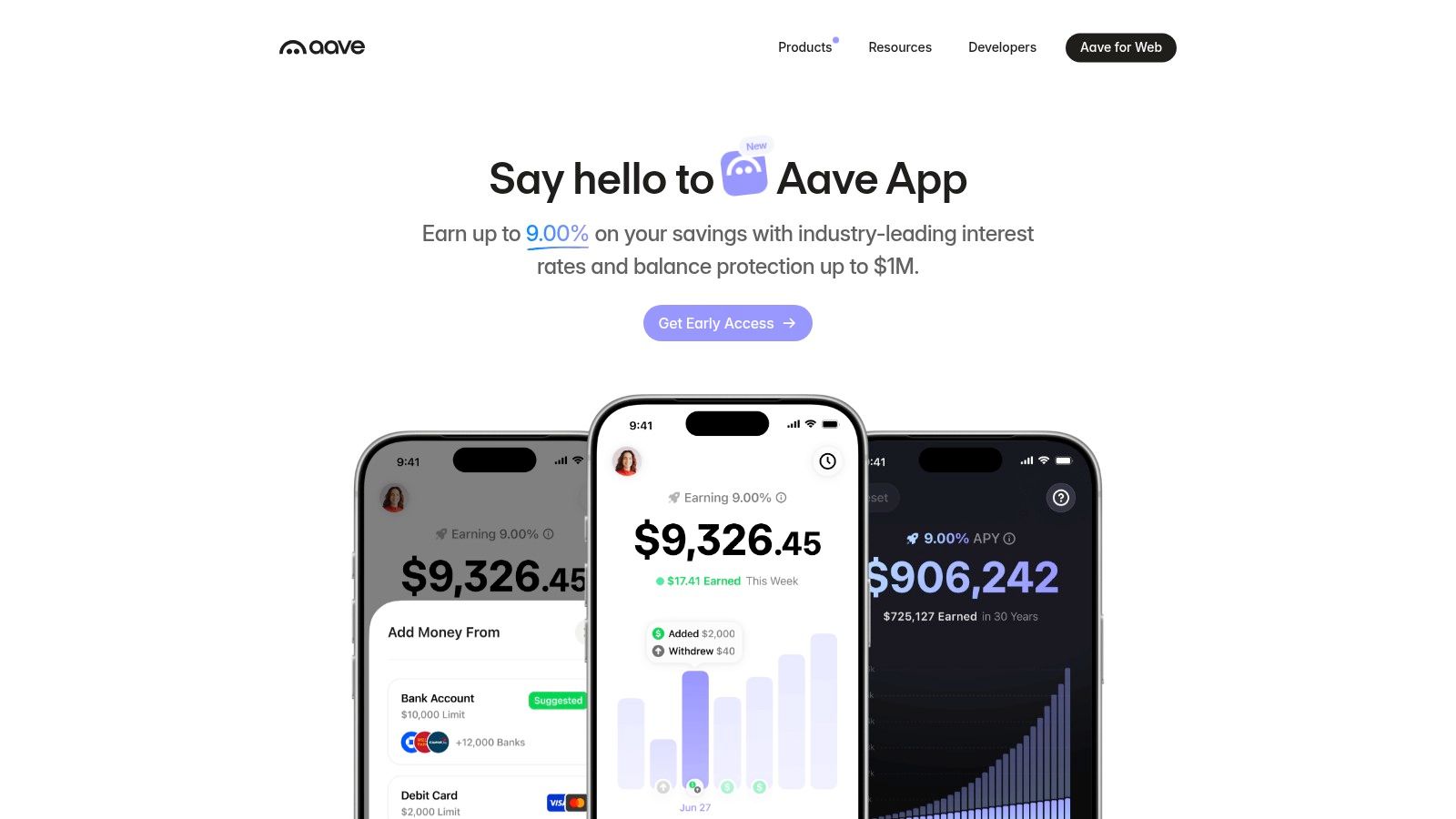
- Aave App: A new, more consumer-friendly interface is in a staged rollout, simplifying the user experience and introducing features like balance protection programs.
Expert Tip: Monitor the utilization rates for stablecoins on different chains within Aave. Sometimes, a newer or less-trafficked chain like Base or Arbitrum may offer a temporarily higher APY on USDC or DAI due to a surge in localized borrowing demand.
Risk Assessment and Usability
While the Aave interface is streamlined, it requires a solid understanding of self-custody and DeFi fundamentals, such as managing a wallet and paying gas fees. The platform offers high liquidity and a transparent view of market conditions. For those ready to dive deeper into on-chain yield, you can explore our full guide on how to earn stablecoin yield with Aave.
| Feature/Risk | Aave Evaluation |
|---|---|
| How APY is Generated | Variable interest paid by borrowers in decentralized lending pools. |
| Counterparty Risk | N/A. The protocol is a decentralized set of smart contracts, removing the traditional counterparty. |
| Peg Risk (USDC/DAI/etc.) | Low to Medium. Varies by stablecoin. Aave supports highly-backed assets like USDC alongside decentralized ones like DAI. |
| Smart Contract Risk | Medium. As a DeFi protocol, there is inherent risk of bugs or exploits, though Aave is heavily audited and battle-tested. |
| Regulatory Risk | Medium to High. The regulatory landscape for decentralized lending protocols is uncertain and actively evolving globally. |
The main trade-off with Aave is that users assume full responsibility for their funds and must navigate the complexities of smart contract interactions. However, for this added responsibility, they gain access to transparent, market-driven yields that are often higher than those found on centralized platforms.
Website: https://aave.com/
5. Compound
Compound is a cornerstone of the decentralized finance (DeFi) ecosystem, offering a battle-tested and transparent lending protocol where users can supply stablecoins like USDC, USDT, and DAI to earn interest. As one of the original "blue-chip" DeFi primitives, it provides a reliable on-chain environment for users to generate yield directly from their non-custodial wallets, making it a foundational platform for those searching for stablecoins with highest APY through decentralized lending.
The protocol operates on a simple yet powerful model: users supply assets to a liquidity pool, and borrowers take loans from that pool, paying interest that is then distributed to the suppliers. The APYs are variable and determined algorithmically based on the supply and demand for each specific asset. This dynamic system ensures rates are always reflective of current market conditions.
Key Features and Yield Generation
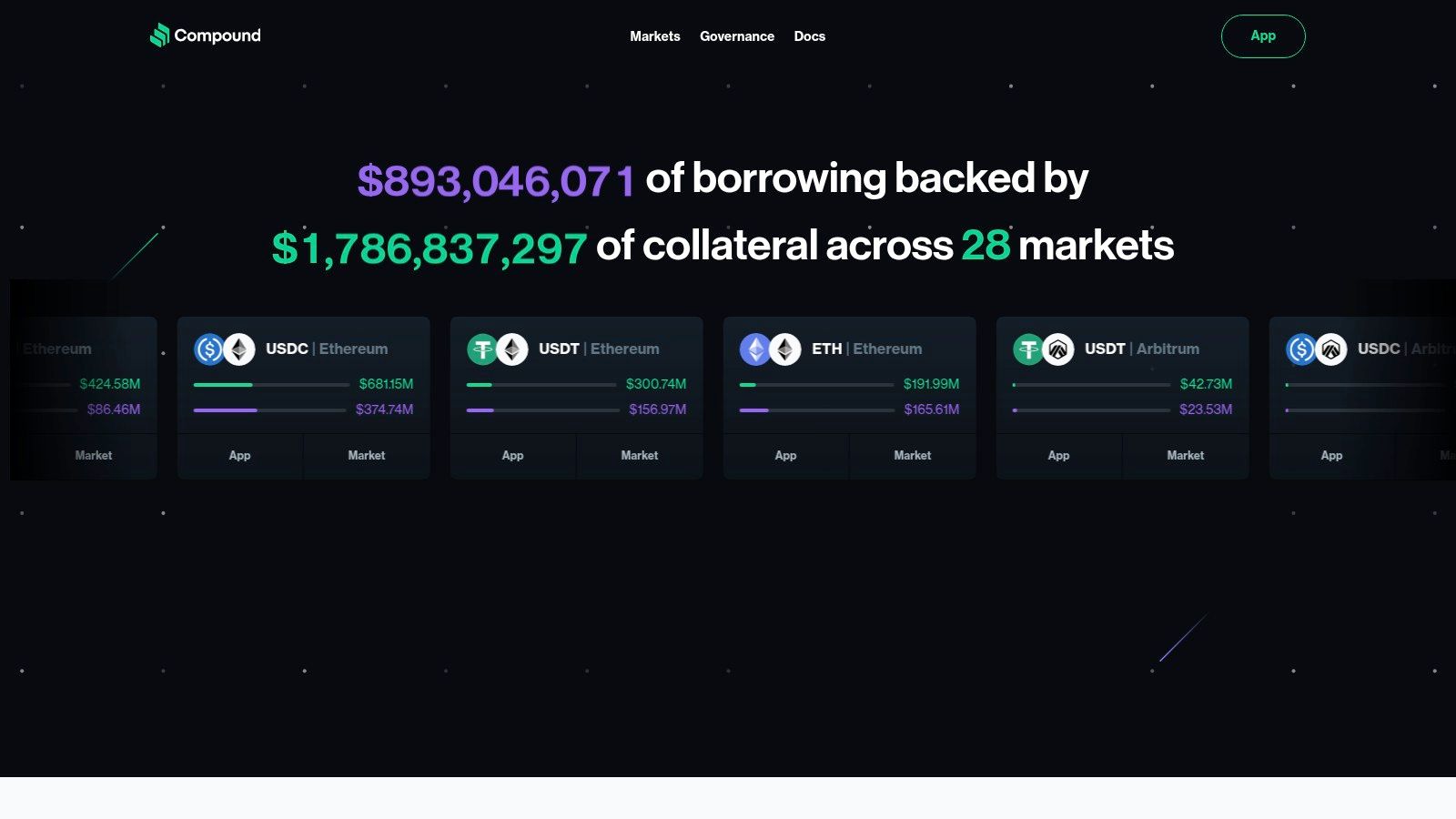
Compound’s yield is generated directly from the interest paid by borrowers. Its V3 markets, known as Comet, have been optimized for capital efficiency and security, offering distinct pools for specific assets.
- Algorithmic Interest Rates: The Supply APY for each stablecoin fluctuates in real-time based on the market's utilization rate. Higher borrowing demand leads to higher APYs for suppliers.
- Multi-Chain Support: Originally an Ethereum mainstay, Compound has expanded its V3 markets to Layer 2 solutions like Arbitrum and Polygon, allowing users to earn yield with significantly lower transaction fees.
- Non-Custodial Lending: Users interact with the protocol directly from their own wallets (e.g., MetaMask, Ledger), maintaining full custody of their assets at all times. The supplied assets are represented by cTokens, which accrue interest.
Expert Tip: Monitor the "Utilization" metric on the Compound interface for each stablecoin market. Markets with high utilization (e.g., above 80%) typically offer the most competitive APYs. Setting up alerts for these levels can help you capitalize on temporary rate spikes.
Risk Assessment and Usability
The official web interface at app.compound.finance is clean and provides a clear overview of available markets, your supplied balances, and current APYs. Connecting a wallet and supplying assets is a straightforward process for anyone familiar with basic DeFi interactions.
| Feature/Risk | Compound Evaluation |
|---|---|
| How APY is Generated | Interest paid by overcollateralized borrowers in a decentralized lending market. |
| Counterparty Risk | Low. The protocol is an autonomous set of smart contracts, removing traditional counterparty risk. The risk shifts to the code itself. |
| Peg Risk (Stablecoins) | Low to Medium. Dependent on the stablecoin supplied (e.g., USDC has low risk, whereas others might have higher risk). |
| Smart Contract Risk | Low. Compound's contracts are extensively audited and have been battle-tested over several years, but all smart contracts carry inherent risk of bugs or exploits. |
| Regulatory Risk | Medium. DeFi lending protocols operate in a gray area in many jurisdictions, and future regulations could impact their operation. |
While Compound is one of the most trusted names in DeFi, its APYs are highly variable and can decrease rapidly if large amounts of liquidity enter a pool or borrowing demand falls. Furthermore, users must be diligent in using the official website, as spoofed domains have been a risk in the past. To explore this platform in greater detail, you can learn more about earning stablecoin yield with Compound. The platform's long track record and robust security posture make it a go-to choice for DeFi-native yield generation.
Website: https://compound.finance/
6. DeFiLlama Yields
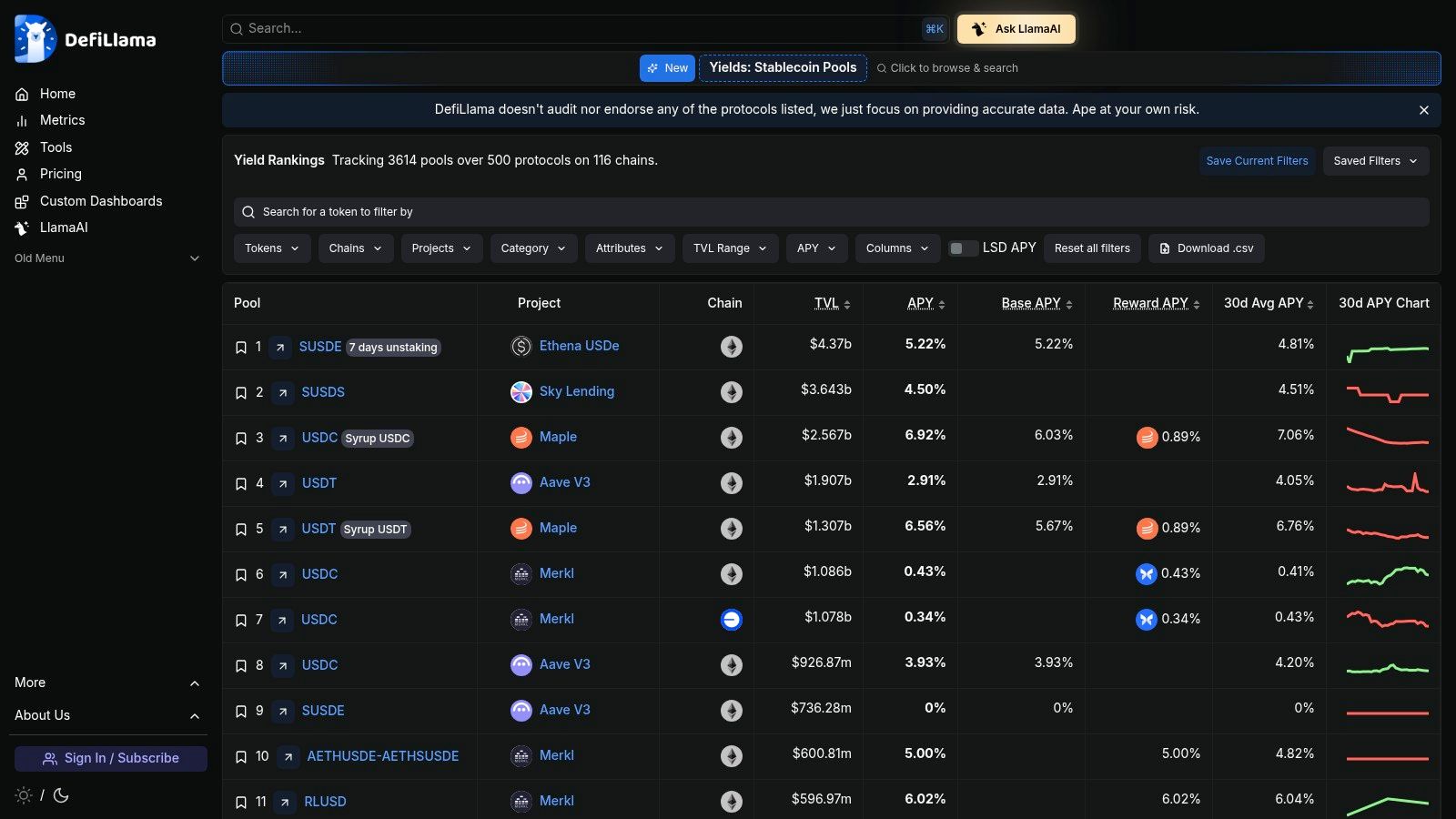
DeFiLlama Yields serves as an essential data aggregator and starting point for experienced users hunting for the absolute stablecoins with highest APY across the entire DeFi landscape. Rather than being a platform where you deposit funds, it is a powerful, neutral dashboard that scans and ranks thousands of yield-generating pools across hundreds of protocols and blockchains, providing a comprehensive, real-time market overview.
The platform’s core value lies in its breadth and transparency. It allows users to quickly identify top-performing stablecoin pools, filter by chain, protocol, or specific stablecoin, and then click through directly to the source protocol to invest. This saves countless hours of manual research and provides visibility into niche opportunities that might otherwise go unnoticed, making it an indispensable tool for serious yield farmers.
Key Features and Yield Generation
DeFiLlama does not generate yield itself; it simply reports the APYs offered by various DeFi protocols. The yields listed are generated through diverse mechanisms depending on the underlying pool:
- Liquidity Providing: Earning trading fees and token rewards for providing stablecoin pairs to decentralized exchanges (DEXs).
- Lending: Supplying stablecoins to money markets where borrowers pay interest.
- Structured Products: Yields from more complex strategies, including options vaults or delta-neutral positions.
Expert Tip: Use the "ApyType" and "TVL" filters on DeFiLlama. Filtering for "Base APY" helps you see yields from core activities like lending and trading fees, which are often more sustainable than reward-based APYs. Sorting by high TVL can help you find more established, potentially less risky pools.
Risk Assessment and Usability
The user experience is data-dense but highly functional, designed for users who are comfortable navigating DeFi. It is a free, no-login-required tool that presents information clearly. The primary risk is not with DeFiLlama itself, but with the underlying protocols it links to. Users must perform their own due diligence on any protocol they choose to invest in.
| Feature/Risk | DeFiLlama Yields Evaluation |
|---|---|
| How APY is Generated | Varies by protocol; includes lending, liquidity mining, and structured products. |
| Counterparty Risk | N/A. DeFiLlama is an aggregator and does not custody funds. Risk lies with the chosen end-protocol. |
| Peg Risk (Stablecoin) | Variable. Depends entirely on the stablecoin in the chosen pool (e.g., USDC, DAI, Frax). |
| Smart Contract Risk | High. Users must assess the smart contract risk of every protocol they interact with via DeFiLlama's links. |
| Regulatory Risk | Medium to High. The regulatory status of the underlying DeFi protocols can be uncertain and varies by jurisdiction. |
While DeFiLlama is an unparalleled tool for discovery, it is not a "one-click" solution. It is the starting point for a deeper investigation. The platform provides helpful context like protocol TVL and links to audits, but the onus is on the user to verify the safety of any listed opportunity. You can find out more about top-tier stablecoin aggregators to compare different data dashboards. The main drawback is that the highest APYs often come from new, unaudited, or highly complex protocols, demanding significant user expertise to evaluate safely.
Website: https://defillama.com/yields/stablecoins
7. Yearn Finance
Yearn Finance is one of DeFi’s original and most respected yield aggregators, offering a "set-and-forget" solution for users seeking optimized, on-chain yields. Its automated vaults deploy sophisticated, actively managed strategies that route stablecoins into various protocols to generate returns. This hands-off approach makes Yearn a cornerstone platform for investors looking for some of the stablecoins with highest APY without the need for constant manual management.
The core value proposition of Yearn is its automation and strategy diversification. Instead of manually moving funds between lending protocols or liquidity pools to chase the best rates, users can deposit their stablecoins into a Yearn Vault. The vault's underlying smart contracts then automatically execute a series of actions, such as lending, providing liquidity, and farming rewards, to maximize returns while auto-compounding the gains.
Key Features and Yield Generation
Yearn's vaults are its flagship product, where yield is generated through a dynamic combination of on-chain activities. Each vault is managed by one or more "Strategists" who design and monitor the investment logic.
- Automated Vaults: Users deposit stablecoins like DAI, USDC, or USDT into a specific vault. The vault then deploys these funds across various battle-tested DeFi protocols (like Aave, Compound, or Curve) to earn lending interest, trading fees, and protocol token rewards.
- Auto-Compounding: All profits generated by the vault's strategy are automatically harvested and redeposited back into the vault, creating a powerful compounding effect that grows the user's principal over time.
- Strategy Diversification: Many vaults employ multiple strategies simultaneously, spreading risk and capturing yield opportunities across different segments of the DeFi ecosystem.
Expert Tip: Before depositing, use the Yearn interface to review a vault's specific strategy description. Understanding where your funds will be deployed (e.g., Aave lending vs. Curve liquidity provision) helps you align your deposit with your personal risk tolerance.
Risk Assessment and Usability
While the user interface is streamlined for a DeFi protocol, it requires familiarity with Web3 wallets like MetaMask and the payment of gas fees for transactions. The platform provides extensive documentation and transparent reporting on vault performance and fees.
| Feature/Risk | Yearn Finance Evaluation |
|---|---|
| How APY is Generated | A combination of lending interest, liquidity provider fees, and yield farming rewards from underlying DeFi protocols. |
| Counterparty Risk | Low to Medium. While Yearn itself is a decentralized protocol, the vaults interact with other DeFi protocols, which introduces layered counterparty risk. |
| Peg Risk (Stablecoin) | Low. Depends on the specific stablecoin vault (e.g., USDC, DAI). Yearn primarily utilizes well-established, highly liquid stablecoins. |
| Smart Contract Risk | Medium to High. This is the primary risk. Although Yearn’s contracts are heavily audited, interacting with multiple complex smart contracts across different protocols introduces risk of bugs or exploits. |
| Regulatory Risk | Medium. As a decentralized protocol, Yearn operates in a gray area. Future regulations on DeFi yield aggregation could impact its operations. |
The main benefit of Yearn is its efficiency; it socializes gas costs and automates complex yield farming actions that would be expensive and time-consuming for an individual user. To better understand how these complex platforms work, you can explore our deep dive into stablecoin yield aggregators. The primary drawbacks are the inherent smart contract risks and the variable, non-guaranteed nature of DeFi yields.
Website: https://yearn.fi/
Top 7 Stablecoins by APY Comparison
| Platform | Implementation complexity | Resource requirements | Expected outcomes | Ideal use cases | Key advantages |
|---|---|---|---|---|---|
| Coinbase | Low — custodial app, simple UX | USD fiat onramp, verified account | Low–moderate variable APY; boosted tiers for eligible users | US residents wanting easy fiat→USDC yield without DeFi | Strong fiat onramp, automatic payouts, clear documentation |
| Uphold | Low — centralized, task-based flow | Account and completion of simple monthly tasks | Moderate if tasks completed; weekly payouts | Users willing to do small app tasks to unlock rewards | Transparent task rules and published rates |
| Crypto.com Earn (US) | Low–Medium — in-app terms and tiers | Account, possible tier/state restrictions; choose fixed or flexible | Variable by token/term/tier; can be higher for fixed terms | Users who want term options and rate calculator in-app | Clean UI, Earn calculator, broad token coverage |
| Aave | Medium–High — DeFi, wallet connect | Self-custody wallet, gas fees; optional multi-chain setup | Market-driven variable APYs; can be competitive or volatile | DeFi-savvy users seeking on-chain, multi-chain supply yields | High liquidity, multi-chain support, transparent governance |
| Compound | Medium–High — DeFi lending primitive | Self-custody wallet, gas; verify official front-end | Variable supply APYs; simple lending mechanics | Users seeking a blue‑chip DeFi lending option | Long track record, simple model, battle-tested contracts |
| DeFiLlama Yields | Low — aggregator / research tool | Web access only; no custody or deposits | Discovery of current highest APYs (does not custody assets) | Researchers and yield hunters scanning many protocols/chains | Comprehensive listings, cross-chain coverage, free to use |
| Yearn Finance | Medium–High — vaults and strategy automation | Self-custody, gas (bridging possible), interact with vaults | Auto-compounded, strategy-driven variable yields | Users wanting hands-off, diversified DeFi yield strategies | Automated compounding, curated strategies, transparent docs |
The Final Verdict: Balancing High APY with Smart Risk Management
Navigating the landscape of high-yield stablecoin products requires a blend of diligence, strategic planning, and an unwavering commitment to risk management. Throughout this guide, we've explored a diverse array of platforms, from the user-friendly interfaces of centralized exchanges like Coinbase and Uphold to the decentralized, protocol-driven worlds of Aave, Compound, and Yearn Finance. The common thread is clear: opportunities to generate significant returns on your stable assets are abundant, but they are never without risk.
The core takeaway is that the pursuit of the stablecoins with highest APY is not a one-size-fits-all endeavor. Your personal risk tolerance, technical expertise, and investment horizon are the critical filters through which you must view every opportunity. A 20% APY on a new, unproven algorithmic stablecoin protocol carries a vastly different risk profile than a 5% APY on USDC held within a well-regulated, insured CeFi platform.
Key Takeaways and Actionable Next Steps
To synthesize our findings, remember these crucial principles before deploying your capital:
Diversify Across Platforms and Protocols: Never concentrate all your stablecoin holdings in a single product or ecosystem. Spreading your assets across a mix of CeFi and DeFi options, as we've discussed, mitigates counterparty and smart contract risk. For example, you might allocate a portion to a conservative platform like Coinbase for its simplicity and another portion to a yield aggregator like Yearn Finance for potentially higher, auto-compounding returns.
Understand the Yield Source: Always ask, "Where is the APY coming from?" Is it from overcollateralized lending (like Aave/Compound), liquidity provision incentives, or complex automated strategies (like Yearn)? Understanding the mechanism is the first step to understanding the risk. High yields often come from incentivizing new protocols, which carries inherent smart contract and sustainability risks.
Use Aggregators for Research, Not Blind Trust: Tools like DeFiLlama Yields are indispensable for discovering opportunities. However, they are starting points for your research. Use them to identify high-potential pools, then perform your own due diligence on the underlying protocol’s security audits, team reputation, and tokenomics before investing.
Choosing Your Path: A Practical Framework
How do you select the right tool for your specific needs? Consider this simple framework based on user profiles:
For the Set-and-Forget Investor: If you prioritize ease of use and security over maximizing every percentage point, centralized platforms like Coinbase or Crypto.com Earn are excellent starting points. The trade-off is typically a lower APY and counterparty risk, but the user experience is straightforward.
For the Hands-On DeFi Explorer: If you are comfortable managing your own wallet and interacting with smart contracts, direct engagement with protocols like Aave and Compound offers greater control and transparency. You can actively manage your collateral and borrow against your assets, unlocking more advanced strategies.
For the Efficiency-Focused Optimizer: If you want to access the best DeFi yields without constantly monitoring and moving funds yourself, a yield aggregator like Yearn Finance is your best ally. It automates the process of finding and farming the stablecoins with highest APY, saving you time and transaction fees, but introduces an additional layer of smart contract risk.
Ultimately, the most successful strategy is a dynamic one. The crypto market evolves at a breakneck pace; the highest APY today may not be the highest or the safest tomorrow. Continuously educating yourself, monitoring your positions, and re-evaluating your strategy based on new information and changing market conditions are not just recommended, they are essential for long-term success in this space. Your journey is not about finding a single perfect product, but about building a resilient and profitable stablecoin portfolio.
Ready to stay ahead of the curve? For real-time data, in-depth protocol analyses, and curated alerts on the stablecoins with highest APY, check out Stablecoin Insider. Our platform is designed to help you discover and monitor the best yield opportunities safely and effectively. Visit Stablecoin Insider to supercharge your research.