Table of Contents
So, you've heard about stablecoin yield farming. What is it, really? Think of it as putting your digital dollars to work, turning them into a source of passive income. Instead of letting your stablecoins sit idle in a wallet, you lend or stake them in decentralized finance (DeFi) protocols to earn rewards.
It’s not so different from a high-yield savings account, just with a DeFi twist.
Unlocking The Potential Of Digital Dollars

Imagine your savings account could do more than just collect dust. In the old world of finance, banks take your deposits, lend them out, and give you back a tiny fraction of the interest. Stablecoin yield farming follows a similar path but cuts out the middleman.
Here, you're interacting directly with automated financial protocols built on the blockchain. In a sense, you become the bank. You provide the capital, and you earn a much larger share of the profits. This direct participation is precisely why the returns can often dwarf what you'd see from traditional savings products.
The Core Idea Behind Stablecoin Farming
At its heart, stablecoin yield farming is all about providing liquidity. DeFi protocols need massive pools of assets to function—whether for lending, trading, or other complex financial services. To attract that capital, they offer incentives to people like you for depositing stablecoins.
These incentives, or your "yield," come from a few key places:
- Lending Interest: Other users borrow your stablecoins and pay interest on the loan. As the lender, you get a direct cut of that interest.
- Trading Fees: By adding your stablecoins to a liquidity pool on a decentralized exchange (DEX), you earn a percentage of the fees from every trade that taps into that pool.
- Protocol Rewards: Many DeFi platforms will sweeten the deal by distributing their own native tokens to liquidity providers. You can hold onto these tokens or sell them for an extra layer of profit.
This blend of income streams is what makes stablecoin yield farming such a powerful strategy. For a deeper dive, you can learn more about the different sources of stablecoin yield in our dedicated guide.
The scale of this market is staggering. By June 2025, the total stablecoin market cap had swelled to $166 billion. In the first half of that year alone, these digital dollars powered an incredible $8.9 trillion in on-chain transaction volume. With average monthly trading volumes hitting $1.48 trillion—a 27% jump from the previous year—it’s clear the demand for stablecoin liquidity isn't slowing down.
Before we dive deeper, it's helpful to see the big picture. Stablecoin farming offers compelling returns, but it's not without its own set of challenges.
Stablecoin Yield Farming At a Glance
| Key Benefits | Primary Risks |
|---|---|
| Higher APYs than traditional savings. | Depeg Risk: The stablecoin could lose its $1 peg. |
| Passive Income generation from your assets. | Smart Contract Risk: Bugs or exploits in the protocol code. |
| Lower Volatility compared to other crypto assets. | Counterparty Risk: The platform itself could fail. |
| Accessibility and transparency in DeFi. | Regulatory Uncertainty: Changing laws could impact protocols. |
This table gives you a quick snapshot. The potential for high returns is real, but so are the risks. Understanding both sides of the coin is the first step toward farming successfully.
By putting your stable assets to work, you open the door to a consistent cash flow without the wild price swings of Bitcoin or Ethereum. This makes it a fantastic starting point for anyone—from seasoned crypto pros to newcomers—looking for a reliable way to generate income.
How Stablecoin Yield Is Actually Generated
A lot of people getting into DeFi for the first time look at the high returns from stablecoin farming and ask, "Where is all this money actually coming from?" It's a great question. After all, a stablecoin just sitting in your wallet doesn't earn a thing, unlike a stock that might pay a dividend.
The secret is that the yield isn't coming from the coin itself. It's earned by putting those stablecoins to work inside the DeFi ecosystem.
Think of your stablecoins like a crew of skilled workers. In your wallet, they’re unemployed. But when you deploy them into a DeFi protocol, you’re giving them a job, and the yield you earn is their paycheck. This income comes from a few core activities that power the world of decentralized finance.
Getting a handle on these sources is the first real step to building a smart stablecoin farming strategy. Let's dig into the four main ways your digital dollars can earn their keep.
Earning Through Lending and Borrowing
The most straightforward way to earn a return is by simply lending out your stablecoins. Platforms like Aave and Compound operate like decentralized money markets, connecting people who have stablecoins (lenders like you) with people who need them (borrowers).
When you deposit your USDC or DAI, you're adding it to a big pool of capital. Borrowers can then take loans from this pool, but there’s a critical safety net: they have to put up other crypto assets as collateral, and it's usually worth much more than the loan itself. This is called over-collateralization, and it’s what protects you. If a borrower's collateral value falls too close to their loan amount, the protocol automatically sells it off to pay back the loan.
As a lender, you earn the interest paid by these borrowers. The rates aren't fixed; they move up and down with supply and demand. When lots of people want to borrow stablecoins, the interest rates—and your earnings—go up.
Key Takeaway: Lending your stablecoins is a lot like putting money into a high-yield savings account. But instead of a bank setting the rates, the market does, and you're interacting directly with a smart contract. The interest comes straight from borrowers, making it a transparent and efficient process.
Collecting Fees by Providing Liquidity
Another huge source of yield comes from being a liquidity provider (LP) for a decentralized exchange (DEX), like Curve or Uniswap. Think of a DEX as an automated currency exchange that runs 24/7 on the blockchain, without any middlemen.
For these exchanges to work, they need deep reserves of tokens for traders to swap between. For example, a USDC/DAI trading pool needs a ton of both USDC and DAI sitting in it. By depositing your stablecoins into one of these liquidity pools, you're stocking the shelves so that trades can happen instantly.
Your reward for providing this service? You get a tiny cut of the trading fees from every single swap that happens in your pool. The more trading volume, the more fees you rake in. This is an incredibly popular strategy for stablecoins because the risk of "impermanent loss" is very low, since both assets in the pair are pegged to the same $1 value. You can find a detailed breakdown of current stablecoin interest rates across these platforms in our deep-dive guide.
Boosting Returns with Protocol Rewards
This is where things get really interesting. Many DeFi protocols sweeten the deal to attract your capital by offering protocol rewards. On top of the interest you earn from lending or the fees from being an LP, these platforms often pay you out in their own native governance tokens.
For instance, a lending protocol might give its own token to both lenders and borrowers. This strategy, famously known as liquidity mining, can seriously pump up your total APY. You then have a choice: you can sell these reward tokens right away for cash, or you can hang onto them if you believe the platform has a bright future.
These extra rewards were the engine behind the crazy yields of "DeFi Summer," and they continue to be a major factor in many of the best stablecoin farming opportunities today.
Advanced Strategies Like Yield Tokenization
Finally, we have more creative, next-generation strategies that are popping up. One of the most powerful is yield tokenization, a concept being pushed forward by protocols like Pendle Finance.
What Pendle does is take a yield-bearing asset and split it into two new, separate tokens:
- Principal Token (PT): This represents your original deposited capital.
- Yield Token (YT): This represents the right to all future yield that the asset will generate over a specific time.
This split opens up a whole new world of possibilities. You could, for example, sell your YT on the open market for cash today, effectively locking in a fixed return on your investment upfront. Or, if you're bullish and think yields are going to spike, you could buy more YT to amplify your exposure. These strategies are definitely more complex, but they offer an incredible amount of control and flexibility.
To properly weigh these different opportunities, knowing how to calculate annualized return is essential. It lets you compare apples to apples and make smarter decisions about where to put your capital to work.
Top Protocols for Stablecoin Yield Farming
So, you understand how stablecoin yield is made. The next logical question is, where do you go to actually earn it? The DeFi world is sprawling with hundreds of protocols, each with its own spin on yield farming. Finding the right fit means looking past the flashy APYs and focusing on platforms that are well-established, transparent, and match your personal comfort level with risk.
Let's dive into a few of the heavy hitters in the space. These aren't just random platforms; they represent the core pillars of stablecoin yield generation, from ultra-efficient trading hubs to decentralized lending markets. Each has built a solid reputation, attracting billions in liquidity and handling huge transaction volumes.
At their core, these protocols generate returns for you in a few key ways: interest from lending, trading fees from providing liquidity, and often, bonus token rewards.
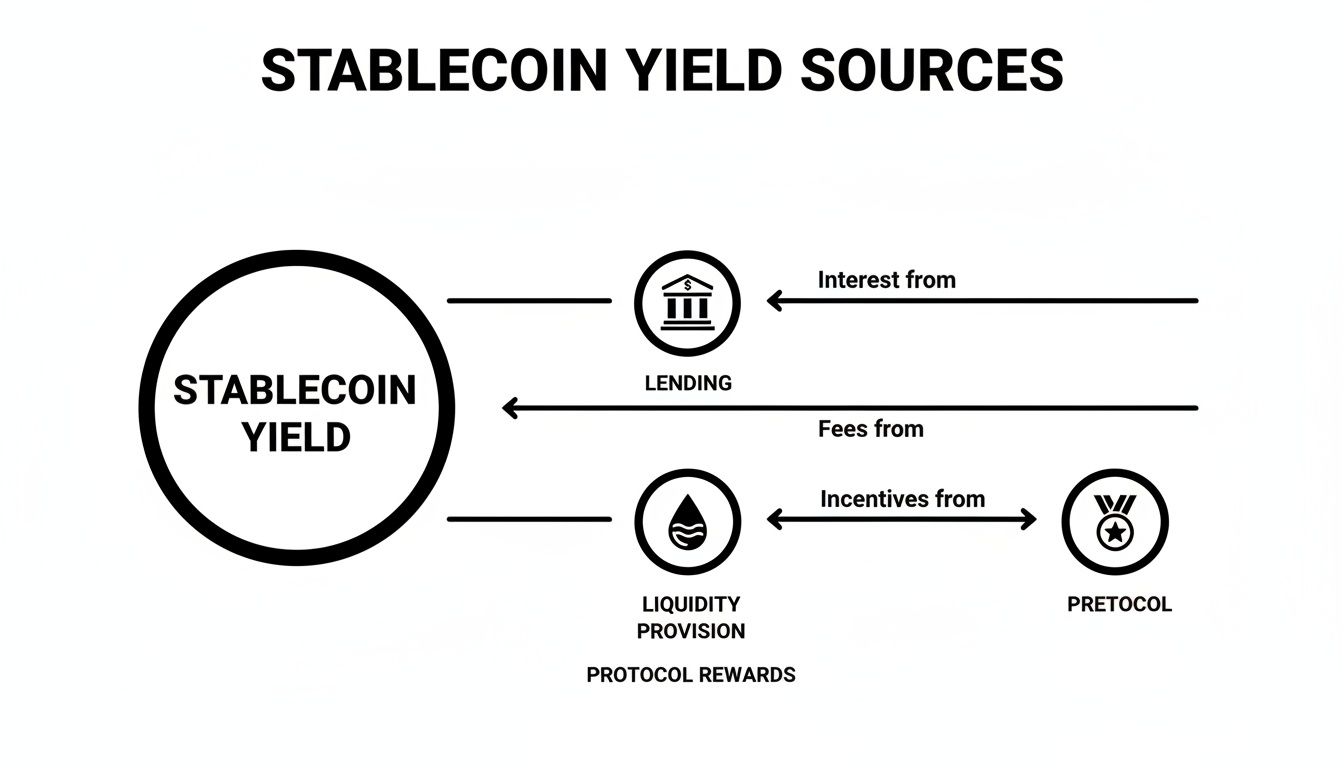
This diagram helps visualize how your deposited stablecoins are put to work. They aren't just sitting idle; they're actively participating in DeFi's financial engine, earning you a cut of the action.
Curve Finance: The Bedrock of Stablecoin Liquidity
When you talk about stablecoin yield farming, it’s almost impossible not to mention Curve Finance. Launched back in early 2020, Curve is a decentralized exchange built for one thing: swapping assets that should be worth the same, like USDC, DAI, and USDT. Its special math formula, known as an Automated Market Maker (AMM), is fine-tuned to handle massive trades with incredibly small price changes, or slippage.
This efficiency makes Curve the default destination for anyone needing to swap large amounts of stablecoins. All that trading volume generates fees, and as a liquidity provider, you get a piece of that pie. It’s a simple, powerful, and steady source of yield.
During the legendary "DeFi Summer" of 2020, Curve basically wrote the playbook for modern stablecoin farming. Early on, it was offering jaw-dropping APYs that could range from 300% to 500%. The protocol also pioneered the vote-locked token model (veCRV), which lets liquidity providers boost their rewards by up to 2.5 times. This genius move helped its Total Value Locked (TVL) soar past $10 billion, cementing its spot at the top.
Key Feature: Curve’s secret sauce is its low-slippage trading engine. This creates a capital-efficient powerhouse that attracts traders, which in turn generates more fees for liquidity providers.
Aave: A Giant in Decentralized Lending
If Curve is the undisputed king of stablecoin trading, then Aave is the titan of decentralized lending. Think of Aave as an automated money market where you can lend or borrow all sorts of digital assets. For anyone holding stablecoins, it’s one of the most straightforward ways to start earning.
You just deposit your stablecoins, and you start earning interest right away. It's that simple. The interest comes from borrowers on the other side who are putting up their own crypto as collateral to take out loans. The entire process is open, automated, and doesn't require anyone's permission.
Aave's V3 upgrade rolled out some game-changing features that made it even better for yield farmers:
- High-Efficiency Mode: Lets you borrow more against your stablecoin collateral, maximizing capital efficiency.
- Isolation Mode: Allows the platform to list newer, potentially riskier assets without putting the entire protocol at risk.
- Portal: A feature that lets you move your assets seamlessly between Aave markets on different blockchains like Ethereum, Polygon, and Arbitrum.
These innovations have made Aave a true cornerstone of the DeFi ecosystem. Its relentless focus on security and constant improvement makes it a go-to for anyone looking for reliable, low-fuss stablecoin yield. For a deeper dive into picking a platform, see our guide on the best stablecoin liquidity providers.
Pendle Finance: The Future of Yield Strategies
Ready to move beyond the basics? Pendle Finance is where things get really interesting. Pendle is a protocol that lets you tokenize and trade future yield. It cleverly splits a yield-bearing asset into two new tokens: a Principal Token (PT) and a Yield Token (YT).
This simple split unlocks a world of advanced strategies. You could, for instance, sell your future yield (the YT) today for cash upfront, effectively locking in a fixed rate on your principal. On the flip side, if you think yields are about to skyrocket, you could buy up YT to get amplified exposure to those future earnings without having to own the underlying asset.
Pendle has quickly become the place to be for farming yields on more complex assets like Liquid Staking Tokens (LSTs) and stablecoin derivatives. While it’s certainly more involved than just lending on Aave, it gives you a level of strategic control that you just can't find anywhere else. Its rapid growth proves that the market is maturing and demanding more sophisticated tools for managing capital.
Comparison of Top Stablecoin Yield Farming Platforms
To make sense of these different approaches, it helps to see them side-by-side. Each platform offers a unique balance of potential returns, complexity, and risk.
| Protocol | Primary Yield Source | Typical Stablecoin APY Range | Key Feature | Risk Profile |
|---|---|---|---|---|
| Curve Finance | Trading fees & CRV rewards | 2% - 15% | Low-slippage stablecoin AMM | Low |
| Aave | Lending interest & token incentives | 1% - 10% | Blue-chip decentralized lending | Very Low |
| Pendle Finance | Yield tokenization & trading | 5% - 30%+ | Trading future yield (PT/YT) | Moderate to High |
This table gives you a snapshot of what to expect. Curve and Aave are the established, lower-risk pillars of the space, offering steady, if modest, returns. Pendle, on the other hand, is for the more active farmer who wants to make strategic bets on where yields are headed.
Ultimately, there's no single "best" platform—it all comes down to your personal strategy. Are you looking for a simple "set and forget" yield, or are you willing to take on more complexity for a potentially higher reward? Your answer will point you toward the right protocol.
How to Start Your First Stablecoin Farm
Ready to jump in? Getting started with stablecoin yield farming feels a lot less intimidating when you walk through it step-by-step. Let's do just that.
For this example, we'll provide liquidity to a USDC/USDT pool. We're going to do this on a Layer 2 network like Arbitrum to keep our costs down. Gas fees there are usually just a few cents, a huge saving compared to the often-pricey Ethereum mainnet.
Getting Your Digital Wallet Ready
First things first: you need a non-custodial Web3 wallet. This is different from an account on a centralized exchange because you hold the keys. You're in complete control of your assets.
We'll use MetaMask for this walkthrough. It's one of the most popular wallets out there and works with just about everything. Think of it as your passport to the DeFi world.
- Download and Install: Head over to the official MetaMask website to get the browser extension. Always, always double-check you're on the real site to avoid phishing scams.
- Create Your Wallet: The setup process will guide you. Pay close attention when it gives you your 12-word secret recovery phrase. This is the master key to your funds. Write it down on paper, store it somewhere safe and offline, and never, ever share it.
- Add the Arbitrum Network: MetaMask starts on the Ethereum network by default. The easiest way to add Arbitrum is to visit a site like Chainlist, connect your wallet, find Arbitrum, and add it with one click.
Funding Your Wallet with Stablecoins
With your wallet set up, it's time to put some money in it. You'll need two things: the stablecoins you plan to farm with (USDC and USDT), and a little bit of Ether (ETH) on the Arbitrum network to cover transaction fees.
- Option 1: Send from an Exchange: This is usually the simplest path. Buy your ETH, USDC, and USDT on an exchange like Coinbase or Binance. When you go to withdraw, make sure you select the Arbitrum network as the destination and send them to your MetaMask wallet address.
- Option 2: Bridge from Ethereum: If you already have crypto on the Ethereum mainnet, you can use a tool like the Arbitrum Bridge to move your funds over to the Layer 2 network.
Once your funds arrive, you're ready to put them to work.
Finding a Decentralized Exchange (DEX)
We'll use Uniswap for our example, as it's one of the biggest and most intuitive DEXs around. The experience is pretty similar on other platforms like Sushiswap or Curve. Just head to the Uniswap app and click the button to connect your MetaMask wallet.
Here’s a look at the Uniswap interface for swapping tokens.
The layout is clean and simple. You just pick the tokens you want to trade, and it shows you the exchange rate and any fees before you commit.
Depositing into a Liquidity Pool
Okay, here's the main event. You're about to become a liquidity provider, or LP. This means you'll deposit an equal value of two tokens—in our case, USDC and USDT—into a shared pool. This pool allows other people to trade between those two assets, and you get to earn a small fee from every trade.
- Go to the 'Pool' Section: On Uniswap, you'll see a "Pool" tab. Click it.
- Create a New Position: Choose to add a "New Position" and select the USDC/USDT pair. Because these are both stablecoins pegged to the dollar, the price range is incredibly tight, which is great for minimizing a risk known as impermanent loss.
- Deposit Your Stablecoins: Decide how much you want to deposit. The protocol requires a 50/50 value split, so if you deposit $500 of USDC, you'll need to deposit $500 of USDT. You'll have to approve Uniswap to spend your tokens first—this is a standard, one-time security step.
- Confirm the Transaction: Once approved, you'll click to confirm the deposit. MetaMask will pop up, asking you to sign the transaction and pay the small gas fee in ETH.
Staking Your LP Token for Extra Rewards
After you've deposited your funds, Uniswap gives you back a special token that acts as a receipt for your share of the pool. It’s called an LP token.
The final step for many yield farms is to "stake" this LP token. By staking it, you can often earn additional reward tokens on top of the trading fees, which can really boost your overall Annual Percentage Yield (APY). Staking is a core part of earning the best returns, which you can learn more about in our guide on how to stake stablecoins for high APY.
Pro Tip: Keeping track of everything can get tricky. Use a portfolio tracker like DeBank or Zapper. These tools give you a single dashboard to see all your DeFi investments, track your earnings in real-time, and monitor the value of your LP positions across different protocols.
Understanding And Managing The Key Risks
Those high yields you see in stablecoin farming don't come out of thin air—they're your compensation for taking on some very real risks. While stablecoins are built to be, well, stable, the DeFi protocols and complex strategies used to generate that yield have their own hidden dangers. If you ignore them, you could be looking at a serious or even total loss of your funds.
A smart approach means getting familiar with each type of risk and having a game plan to protect your investment. To really get a handle on this, it's helpful to use established frameworks for thinking about risk, like learning how to conduct risk assessment in a structured way. Let's break down the four biggest hurdles you'll encounter.

Smart Contract Failures
Every single DeFi protocol is powered by smart contracts, which are just bits of code that run automatically on the blockchain. The thing is, this code is written by humans, and humans make mistakes. Bugs, logical errors, or other vulnerabilities can—and do—slip through. Hackers are always on the hunt for these flaws to drain a protocol dry.
This is probably the most common and devastating risk in all of DeFi. The history books are filled with horror stories of protocols losing tens or hundreds of millions of dollars from a single, tiny coding mistake. An exploit can happen in an instant, often leaving users with no way to get their money back.
To protect yourself, stick with platforms that are proven and have stood the test of time.
- Look for Audits: Reputable projects hire third-party security firms to pick their code apart. Always check for multiple, recent audits from well-known companies before you deposit a dime.
- Time in the Market: A protocol that has been running smoothly for years without a major incident is a much safer bet. Those brand-new, unaudited platforms dangling absurdly high APYs are usually the ones that blow up.
The Danger Of A Depeg Event
A stablecoin's entire purpose is to hold its value against a target asset, almost always $1. A depeg is what happens when the coin's market price breaks away from that dollar value. This can be triggered by a loss of confidence in the reserves backing the coin, a massive wave of selling, or a fundamental flaw in an algorithmic stablecoin's design.
Think about it: if the stablecoin you’re farming with depegs to $0.80, your principal investment has just lost 20% of its value. That kind of loss can wipe out years of accumulated yield in a single day. You can dive deeper into this topic by reading our detailed guide on stablecoin risks.
Key Takeaway: Not all stablecoins are created equal. You're much safer with ones backed by transparent, fully-audited, and liquid assets like cash and government bonds. They tend to hold up much better under pressure than their algorithmic or under-collateralized cousins.
Impermanent Loss In Stablecoin Pools
Impermanent Loss (IL) is a unique risk you take on when you become a liquidity provider in an automated market maker (AMM) pool. In simple terms, it’s the difference in value between holding two assets in your wallet versus depositing them into a liquidity pool.
A common myth is that you can't have impermanent loss in a stablecoin-stablecoin pair (like USDC/DAI). While the risk is dramatically lower because both coins should be worth $1, it’s not zero. That risk becomes terrifyingly real if one of those stablecoins depegs.
Let’s say you were in a USDC/UST pool. When UST collapsed and fell to $0.10, arbitrageurs rushed in. They swapped worthless UST for all the valuable USDC in the pool. The AMM’s automatic rebalancing meant your position quickly became almost 100% UST, and your investment was toast. The IL risk in stablecoin pairs is really just another form of depeg risk.
Platform And Regulatory Uncertainty
Finally, you have to think about the risks that have nothing to do with the code itself. Platform risk covers everything from a protocol's team making bad decisions to an outright "rug pull," where the founders disappear with everyone's money.
Regulatory risk is the elephant in the room for all of crypto. Governments are still figuring out the rules. A sudden policy change could make a protocol illegal where you live, force it to shut down, or target the specific stablecoins you're using. Spreading your capital across different, reputable protocols—and maybe even different blockchains—is a good way to avoid putting all your eggs in one fragile basket.
Got Questions? We've Got Answers
Diving into stablecoin yield farming can feel like learning a new language. It's totally normal to have a few questions. Here are some straight answers to the things people ask most often, designed to help you get your bearings.
Is Stablecoin Yield Farming Still Worth It?
Absolutely, yes. The wild, 1,000%+ APYs from the early DeFi "gold rush" days are mostly gone, and that's probably a good thing. What’s left is a much more mature and sustainable way to earn passive income.
The game has changed. Instead of chasing fleeting, high-inflation token rewards, smart farmers now focus on real, reliable yield from things like trading fees and lending interest on established platforms. It’s less of a lottery ticket and more of a solid income strategy, often beating traditional finance options by a wide margin.
What’s a Realistic APY I Can Actually Expect?
This is the big one, and the honest answer is: it depends entirely on how much risk you're comfortable with. There's a clear trade-off between safety and returns.
Here’s a practical look at what you can expect:
- Low-Risk (4-10% APY): Think of this as the bedrock of stablecoin farming. We're talking about lending on a household name like Aave or providing liquidity for major stablecoins on Curve. These are generally your safest bets.
- Medium-Risk (10-20% APY): Ready to step it up a notch? This is where you might explore newer platforms, use a yield aggregator to auto-compound for you, or venture onto a Layer 2 network. It requires a bit more homework but can double your returns.
- High-Risk (20%+ APY): To get these kinds of numbers, you're usually looking at more complex strategies like leveraged farming or jumping into brand-new protocols. The potential rewards are high, but so is the risk of things going wrong. Never put more than you can afford to lose here.
The key is to match your strategy to your own financial situation and sleep-at-night factor.
How Much Do I Need to Get Started?
You don't need a huge bankroll. One of the best things about DeFi is that you can get your feet wet with as little as $100. The biggest hurdle for small-time farmers used to be the crazy high transaction fees on Ethereum.
Pro Tip: Don't start on Ethereum mainnet. Head straight to a Layer 2 like Arbitrum, Optimism, or Base. Gas fees there are usually just pennies, so your starting capital isn't eaten up by costs.
Starting small is the perfect way to learn the ropes. You can test out different platforms and strategies without risking serious money, and then add more capital once you feel confident.
What About Taxes?
This is one area you can't afford to ignore. The tax rules around DeFi are still a bit of a maze and change depending on where you live.
Generally, in most countries, the yield you earn is taxed as ordinary income at its market value the moment you receive it. On top of that, things you wouldn't think twice about—like swapping one stablecoin for another or even adding funds to a liquidity pool—can be classified as taxable events.
Because the regulations are constantly shifting, I can't stress this enough: talk to a tax professional who knows crypto. Seriously. Using a crypto tax software tool can also be a lifesaver for keeping track of every transaction.
At Stablecoin Insider, we provide the latest news and in-depth analysis to help you navigate the dynamic world of digital finance. Explore our resources to stay ahead.