
Table of Contents
If you're new to crypto, think of a stablecoin wallet as your personal bank account for digital dollars. It’s a secure place to store, send, and receive cryptocurrencies like USDC or USDT that are pegged to a stable asset, usually the U.S. dollar. This simple feature helps you sidestep the wild price swings you see with other digital currencies. It's your safe harbor in the often-stormy seas of the crypto market.
Understanding Your Digital Dollar Account
At its heart, a stablecoin wallet is a piece of software that puts you in direct control of your digital cash. Before we get into the nuts and bolts, it helps to grasp the bigger picture of What Is Cryptocurrency and where stablecoins fit in. Unlike assets famous for their volatility, stablecoins are built for consistency.
This stability makes them incredibly practical for everyday financial tasks. Imagine sending money across the globe without the days-long wait for a bank transfer or the hefty fees. A stablecoin wallet makes that a reality, with transactions often clearing in minutes for a tiny fraction of the cost. In fact, some companies are now using them for recurring payments, with 20% of their payment volume reportedly shifting to stablecoins to take advantage of the speed and savings.
Why Stability Is a Game Changer
The main reason to use a stablecoin wallet is to protect your funds from market chaos. If your money is in a typical crypto wallet, a sudden market downturn could slash its value overnight. With stablecoins, $100 stays $100, giving you a reliable way to transact and save.
This reliability opens up some powerful new possibilities:
- Global Payments: You can zip funds to anyone, anywhere in the world. Transactions settle almost instantly with minimal fees, cutting out the traditional financial middlemen.
- DeFi Access: A stablecoin wallet is your ticket into the world of Decentralized Finance (DeFi). You can lend your stablecoins to earn interest, supply them to trading pools, or explore other financial services built on the blockchain.
- Wealth Preservation: When the market gets shaky, traders and investors often convert their holdings into stablecoins. It’s a smart way to protect their capital without having to cash out of the crypto ecosystem completely.
A stablecoin wallet isn't just a place to park your assets. It’s a gateway to a more efficient, accessible, and global financial system, blending the security of the blockchain with the predictability of fiat currency.
A Foundation for Digital Commerce
The consistency that a stablecoin wallet brings to the table creates a solid foundation for digital commerce and new online services. To get a better sense of their real-world applications, our guide on the benefits of stablecoins dives into their role in everything from international remittances to large-scale enterprise finance.
Ultimately, using a stablecoin wallet is about taking back control and bringing predictability to your digital finances. It’s a fundamental tool for anyone who wants to use blockchain for practical, everyday purposes, moving beyond speculation and into real-world utility.
How Stablecoin Wallets Actually Work
Let's demystify what a stablecoin wallet really is. At its heart, a wallet is built on two fundamental pieces: a public address and a private key. Understanding how these two work together is the first step to mastering your assets.
Think of your wallet’s public address like your email address. You can share it freely with anyone who wants to send you something—in this case, stablecoins like USDC or USDT. It’s a unique identifier that points to your spot on the blockchain, and it's perfectly safe to post publicly or give to a friend.
Your private key, on the other hand, is the password to that email account. It’s a top-secret piece of cryptographic code that proves you own the funds associated with your public address. You use it to sign, or authorize, any transaction you want to send. If someone gets your private key, they have total control over your funds. Guard it with your life.
The Magic Behind a Transaction
So, what happens when you hit "send"? Your wallet software isn't actually moving coins around like a bank. Instead, it’s using your private key to create a unique digital signature for that specific transaction. This is all done locally on your device, meaning your private key is never broadcast over the internet.
Once signed, this transaction request is sent out to the entire blockchain network. Miners or validators then check the signature to confirm you are the legitimate owner of the funds, and if everything lines up, they add your transaction to the permanent, public ledger.
Key Takeaway: Your wallet doesn't technically "store" your stablecoins. The coins themselves always live on the blockchain. Your wallet simply holds the keys that give you the power to access and move them.
Hot Wallets vs. Cold Wallets: The Fundamental Trade-Off
Not all wallets are created equal. They generally fall into two categories, each offering a different mix of convenience and security. Picking the right one depends entirely on how you plan to use your stablecoins.
Hot wallets are always connected to the internet, making them incredibly convenient for everyday use. They're typically software-based and come in a few common forms:
- Mobile Wallets: Smartphone apps perfect for quick payments or interacting with DeFi on the go.
- Desktop Wallets: Applications installed on your computer, often with more advanced features.
- Browser Extensions: Plug-ins that let your web browser talk directly to blockchain applications.
Because they’re online, hot wallets are more vulnerable to hacks, malware, and phishing scams. They’re great for small, active amounts, but not for your life savings.
Cold wallets are the complete opposite—they are kept offline. The most popular type is a hardware wallet, which is a small physical device that looks like a USB stick. It stores your private keys in a secure, isolated chip, completely disconnected from the internet. To approve a transaction, you have to physically plug in the device and press a button. This makes it virtually impossible for a remote hacker to steal your keys. For securing large sums, cold storage is the undisputed champion.
Why Token Standards Are Non-Negotiable
Stablecoins aren't a single entity; they are created on different blockchains, and each chain has its own set of rules, known as token standards. Think of these standards as being like different file formats—an MP3 is not a JPEG. For your wallet to recognize and manage a stablecoin, it must support that specific standard.
For example:
- ERC-20 is the dominant standard for tokens built on the Ethereum network.
- TRC-20 is the standard used for tokens on the TRON network.
A stablecoin like Tether (USDT) exists as an ERC-20 version, a TRC-20 version, and on many other chains. If you send your TRC-20 USDT to an Ethereum (ERC-20) wallet address, those funds will be lost forever. It’s like mailing a letter to an address that doesn’t exist.
This is precisely why choosing a multi-chain wallet that explicitly supports the standards you need is absolutely critical. To get a better handle on the underlying mechanics, our guide on how stablecoins work is a great next step. The complexity of building wallets that can handle these different standards is also why you see high demand for senior mobile developer roles for onchain wallets in the job market.
What Makes a Great Stablecoin Wallet?
Picking a stablecoin wallet isn't just about finding a digital pocket for your funds. It's about choosing the right tool for the job—a secure, flexible, and easy-to-use gateway to the world of digital dollars. Think of it as less of a wallet and more of a personal vault and financial command center, all in one.
But what separates the best from the rest? Let's break down the core features.
First, it helps to understand what's going on under the hood. A wallet doesn't actually "hold" your coins. Instead, it manages your keys, which give you the power to move your assets on the blockchain. Your public address is like your bank account number—it’s how you receive funds. Your private key is like the secret PIN and signature combined—it’s what proves you own the funds and lets you send them.
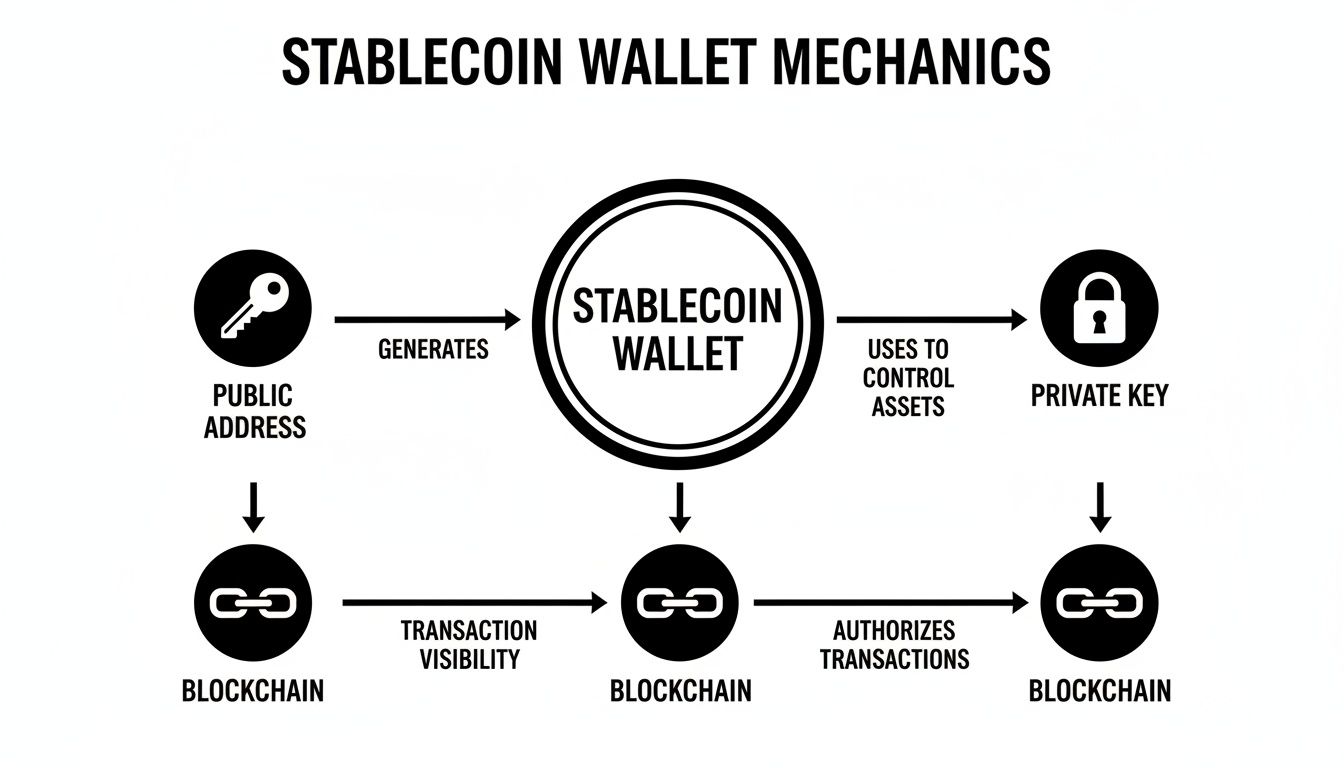
As the diagram shows, protecting that private key is everything.
Robust Security Protocols
Security is the absolute bedrock of a trustworthy wallet. If it's not secure, nothing else matters. While managing your private key is the fundamental part, a top-tier wallet adds extra layers of defense to protect you from bad actors.
Look for these non-negotiable security features:
- Two-Factor Authentication (2FA): This is a simple but powerful defense. It requires you to provide a second piece of information—usually a temporary code from an app like Google Authenticator—before you can access your wallet or approve a transaction. It's a digital deadbolt.
- Biometric Login: Using your fingerprint or face to unlock your wallet is not only convenient but also adds a solid layer of security, tying access directly to you.
- Hardware Wallet Compatibility: This is the gold standard for anyone serious about security. A great software wallet will let you connect a physical hardware device from brands like Ledger or Trezor. This keeps your private keys completely offline, meaning you approve transactions on the device itself, safe from any malware on your computer or phone.
A wallet's primary job is to keep your assets safe. Features like 2FA and hardware wallet support transform it from a simple container into a secure vault, giving you peace of mind that your stablecoins are protected against common digital threats.
Multi-Chain and Multi-Asset Support
Here’s a reality of the crypto world: stablecoins aren’t just on one network. Powerhouses like USDC and USDT live on a whole host of blockchains—Ethereum, Solana, BNB Chain, Polygon, and many more. If your wallet only supports one chain, you’re boxing yourself in.
This is why multi-chain support is so important. A good wallet lets you manage all your stablecoins and other crypto assets from a single, clean interface, regardless of which blockchain they live on. It prevents you from having to juggle a half-dozen different apps and, more importantly, reduces the risk of making a catastrophic mistake, like sending funds to the wrong network and losing them forever. Your wallet should be a central hub, not a silo.
Intuitive User Experience and DeFi Integrations
A wallet can be the most secure and versatile tool in the world, but if it’s a nightmare to use, you won't stick with it. A confusing interface is more than just an annoyance; it can lead to costly errors. In crypto, there’s often no undo button.
A fantastic user experience comes down to a few key things:
- Clean navigation so you can find what you need without a treasure map.
- A clear transaction history that actually makes sense.
- Helpful in-app guides or support to walk you through new features.
Beyond just holding and sending, many people want to put their stablecoins to work. This is where DeFi integrations come in. A truly great wallet doesn’t just store your assets; it connects you directly to the growing ecosystem of decentralized applications (dApps). This allows you to lend, borrow, stake, and earn yield on your stablecoins, all without ever leaving your wallet. It's the bridge from being a passive holder to an active participant.
Setting Up Your First Stablecoin Wallet Securely
Alright, let's get you set up. Stepping into the world of stablecoins means taking your first real step toward managing digital dollars, and it all starts with creating a wallet. We'll walk through this together, focusing on a self-custody wallet, which puts you squarely in the driver's seat. The goal is to build your confidence and make security second nature from day one.
We're specifically talking about wallets like MetaMask or Trust Wallet. Why? Because with a self-custody wallet, you hold the keys. No third party, no company, nobody else can access your funds. This is what financial sovereignty really means.
The need for this skill is growing faster than ever. The stablecoin market has seen explosive growth, ballooning from $205 billion to over $300 billion in just ten months. Just look at USDC—it's already being used in over 5.2 million active wallets. As more people turn to stablecoins, knowing how to secure your own wallet is no longer optional; it's essential. You can dig into the data behind this growth over at arkm.com.
Step 1: Download from the Official Source
This is your first, and arguably most important, security checkpoint. Scammers are experts at creating fake wallet apps and websites that look identical to the real thing, all designed to trick you into handing over your info and your funds.
To sidestep this trap, always go directly to the source. Download the software from the wallet's official website or its verified page on the Apple App Store or Google Play Store. Before you click download, double-check the URL. Triple-check the developer's name. Never, ever use download links from a random email, a social media ad, or a search engine promotion.
The screenshot above shows the official MetaMask website. This is exactly the kind of trusted source you should be looking for when downloading a browser extension or mobile app.
Step 2: Create Your New Wallet
Once the app is installed, it'll walk you through creating a new wallet. The first thing it asks for is a password. Think of this password as the lock on your front door—it protects the wallet on that specific device, whether it's your phone or your laptop.
It's crucial to understand what this password isn't. It's not the master key to your money. It just encrypts the private key data stored locally on your machine. If you forget this password, don't panic. You can still get back into your wallet using your secret recovery phrase, which brings us to the most vital step of all.
Step 3: Secure Your Secret Recovery Phrase
This is the moment of truth. During setup, the wallet will generate and show you a secret recovery phrase (you might also see it called a "seed phrase"). It’s a unique list of 12 or 24 random words.
Think of this phrase as the absolute master key to your entire digital asset vault. Anyone who has these words can access and control your funds from any device, anywhere in the world, bypassing your password completely.
Securing this phrase is non-negotiable. It's the bedrock of self-custody. Here's how you do it right:
- Write It Down: Grab a pen and paper. Write down every word, in the correct order. Make at least two physical copies.
- Store It Offline: Hide these paper copies in safe, separate, and private physical locations. Think of a fireproof safe at home or a bank's safe deposit box.
- Never Store It Digitally: This is a hard and fast rule. Do not take a screenshot of it. Don't save it in a text file, a notes app, a password manager, or email it to yourself. The second it's stored digitally, it becomes a target for hackers and malware.
If you lose this phrase and your device breaks or gets stolen, your funds are gone. Forever. There's no customer support to call, no "forgot password" link. You are the bank now, and this is your responsibility.
Step 4: Add Stablecoins and Fund Your Wallet
With your wallet set up and your recovery phrase secured, it's time to get it ready for stablecoins. By default, most wallets will only show the blockchain's native coin, like ETH on Ethereum. You’ll need to add your stablecoins, like USDC or USDT, yourself.
Look for a feature called "Import Token" or "Add Custom Token." You'll need to paste the stablecoin's official contract address into this field to make it appear in your wallet.
Once you can see your stablecoin balance (it will be zero, for now!), you're ready to add funds. Just copy your public wallet address—that long string of characters that acts like your bank account number—and use it as the destination when sending funds from an exchange or another wallet. For a more detailed look at these final steps, our guide to the imToken wallet offers a great practical example.
Matching Your Wallet to Your Needs
Picking the right stablecoin wallet isn't a one-size-fits-all affair. The best choice comes down to what you’re actually trying to do with your digital dollars. It’s a bit like choosing a vehicle—you wouldn't buy a heavy-duty truck for a daily city commute, and a race car driver isn’t picking up a family minivan.
By figuring out your main goal first, you can find a wallet that feels like a natural extension of your financial life. Let's walk through the ideal setups for three common types of users to make sure your choice boosts both your efficiency and your peace of mind.
For Everyday Users: Payments and Savings
If you're mainly looking to use stablecoins for straightforward transactions—sending money to family, paying for things, or just holding your savings in a stable asset—then simplicity is king. You need a wallet that just works, without making you jump through a bunch of technical hoops.
For this kind of use, a user-friendly mobile wallet is almost always the best bet. These apps are built for convenience and feel a lot like the modern banking or payment apps you already use. The focus is on clean, simple actions: send, receive, and check your balance.
Look for features that make life easier:
- Simple Interface: A clean layout where you can find what you need without getting lost.
- QR Code Support: This is non-negotiable. Scanning a QR code to send or receive money is essential for quick payments, both online and in person.
- Biometric Security: Using your fingerprint or face to open the app adds a serious layer of security that feels completely effortless.
The goal here is accessibility. You want something that makes handling digital dollars feel as easy as using Venmo or PayPal, but with all the benefits of the underlying blockchain technology.
For Active DeFi Traders: Yield Farming and dApp Interaction
Now, if you're jumping into the deep end of Decentralized Finance (DeFi), your needs are completely different. You aren't just holding stablecoins; you're putting them to work. You’re lending, borrowing, swapping, and providing liquidity across all sorts of platforms to earn yield. In this world, your wallet isn't just a place to store funds—it's your command center for the entire DeFi ecosystem.
For an active trader, a powerful browser-extension wallet like MetaMask or Phantom is the industry standard. These tools are designed to plug directly into decentralized applications (dApps) from your web browser, creating a seamless bridge between your assets and the protocols you want to use.
Key features for a DeFi wallet are:
- dApp Connector: This is the heart of it all. It’s what lets you connect to a DeFi site and approve transactions with a click.
- Multi-Chain Support: DeFi isn't just on Ethereum anymore. It’s on Solana, Polygon, Arbitrum, and dozens of other chains. A good wallet lets you manage assets across all these networks without having to switch apps constantly.
- Custom RPC and Token Imports: To get in on new or niche DeFi opportunities, you'll often need to manually add new blockchain networks and import token contracts. This flexibility is crucial.
For a DeFi user, the wallet is your mission control. It needs the versatility to navigate a multi-chain world and the power to interact with complex financial protocols, all while keeping your assets secure.
For Businesses and Institutions: Security and Compliance
When you're managing serious capital for a business, institution, or even as a high-net-worth individual, the game changes. Convenience takes a backseat to ironclad security and operational control. A simple wallet controlled by one person is a massive liability. You need a system built to enforce strict procedures and guard against threats from both inside and out. To better understand which assets are best suited for these purposes, take a look at our guide on the best stablecoins for various scenarios.
The go-to solution here is a multi-signature (multisig) wallet. Think of it as a digital safe that requires several keys to unlock. A transaction can only go through if a specific number of authorized people sign off on it—for example, requiring two out of three executives to approve any transfer.
This setup creates institutional-grade security by eliminating single points of failure. No one person can move funds on their own, which protects the company from rogue employees, external hacks, and simple human error.
Essential features at this level include:
- Configurable Approval Policies: The power to set custom rules, like requiring an M-of-N signature scheme (e.g., 2-of-3, 3-of-5).
- Role-Based Access Control: The ability to assign specific permissions to team members, limiting who can initiate, approve, or only view transactions.
- Audit Trails and Reporting: Having a detailed, unchangeable log of every single action is vital for accounting, compliance checks, and security forensics.
By matching your stablecoin wallet to your actual needs—whether for daily spending, active trading, or institutional treasury management—you’re setting yourself up with the right tool for the job.
Advanced Security Practices to Protect Your Stablecoins
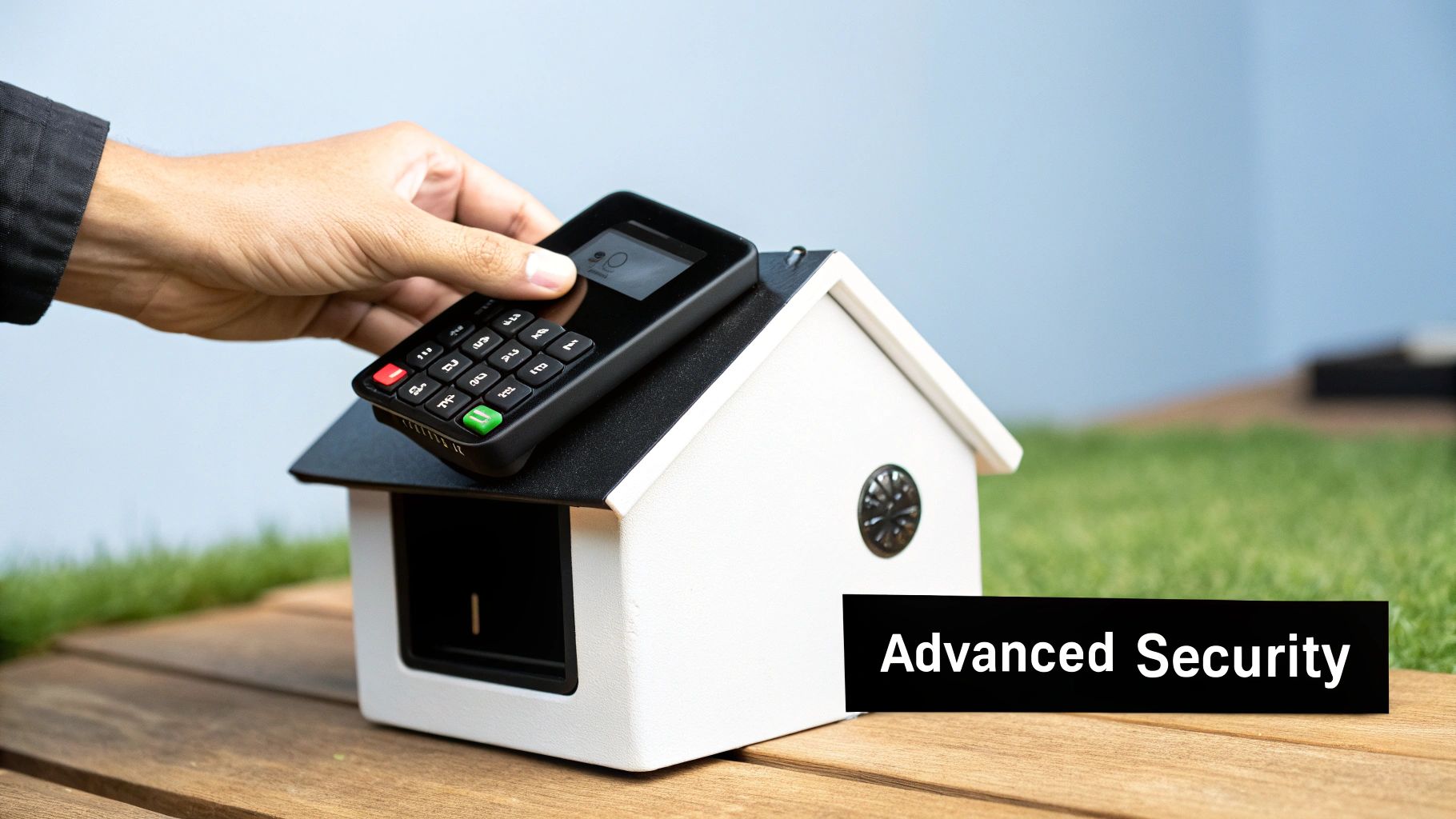
Once your stablecoin wallet is up and running, your job isn't done. The real mission begins: protecting your assets day in and day out. Basic precautions are a good starting point, but the crypto space demands a more serious security mindset. It’s time to move beyond simple passwords and adopt practices that can defend against some very clever threats.
The stakes couldn't be higher. Stablecoin wallets are the engine of a massive financial ecosystem. In the first half of this year alone, they facilitated over $8.9 trillion in on-chain transactions, and monthly volume just hit a record $1.25 trillion. This isn't just speculative noise; it's real-world utility, a trend you can dig into with these stablecoin statistics from 2025.
Embrace the Gold Standard of Cold Storage
If you're holding any significant amount of stablecoins, the single best security upgrade you can make is to move them into cold storage. This means getting a hardware wallet—a small physical device that keeps your private keys completely disconnected from the internet.
Think of it like moving your life savings from a shoebox under your bed to a high-security bank vault. Since the device is always offline, it’s virtually immune to online threats like malware or remote hacking. When you want to send funds, you physically connect the device and press a button to approve the transaction. This simple action can thwart nearly every common type of digital theft. For a more detailed walkthrough, our guide on storing stablecoins securely is a great resource.
Defend Against Phishing and Malicious dApps
Hackers often go after the weakest link: you. Highly convincing phishing scams are designed to fool you into visiting fake websites that are perfect clones of the real thing. Their goal is to trick you into entering your password or, even worse, your secret recovery phrase.
The golden rule of crypto security: Never, ever share your private keys or recovery phrase with anyone. Full stop. No legitimate company will ever ask for them.
Another huge risk comes from interacting with decentralized applications (dApps). When you connect your wallet to a dApp, you often give it permission—known as a "token approval"—to access and spend your stablecoins. While this is necessary for things like staking or swapping, it’s a permission that can be exploited if the dApp is compromised.
Here are a few proactive ways to stay safe:
- Bookmark Your Go-To Sites: Don't click on links from emails, DMs, or social media posts. Always navigate to exchanges and dApps using your own saved bookmarks.
- Audit Your Permissions: Periodically use a revocation tool like Revoke.cash to see which dApps have access to your funds. If you don't recognize or no longer use one, cancel its approval. This closes old backdoors to your wallet.
- Stay Skeptical: If an offer seems too good to be true, it probably is. Always vet a new dApp by checking for security audits and reading what the community is saying before you connect your wallet.
By making these practices a habit, you're building layers of defense around your stablecoins, turning your wallet into the secure financial hub it’s meant to be.
Common Questions About Stablecoin Wallets
Diving into stablecoins for the first time? It's natural to have questions. Think of this as your go-to guide for the most common things people wonder about as they get started. We'll cut through the jargon and give you straight answers.
One of the first things people ask is about juggling different types of stablecoins. Can you keep both USDT and DAI in the same wallet, for instance? Absolutely. Most modern wallets are built to be multi-chain and multi-asset, meaning they can handle a whole portfolio of different tokens from one place, as long as they run on a supported network (like Ethereum's ERC-20 standard).
What If I Lose My Wallet?
This is a big one, and it's a completely valid fear. What happens if your phone gets stolen or your laptop dies? Are your funds just... gone?
Thankfully, with a self-custody wallet, the answer is a firm no—as long as you’ve safely stored your secret recovery phrase. Your crypto isn't actually on your device; it's on the blockchain. Your recovery phrase is the master key that can unlock access to your funds from any new device, anywhere in the world.
This is why we can't stress this enough: writing down your 12 or 24-word recovery phrase and storing it offline, somewhere safe, is the single most important security step you will ever take. Lose the phrase, and you lose access. Keep it safe, and you can always get back in.
Are There Fees I Should Know About?
Another practical question is about cost. Does using a stablecoin wallet cost money? While the wallet software itself is almost always free, sending transactions isn't. You'll have to pay network fees, which are usually called "gas fees."
These fees don't go to the wallet company. They go to the people (validators or miners) who run the computers that process and secure your transaction on the blockchain. The amount can swing wildly depending on a few things:
- Network Traffic: Think of it like a highway at rush hour. The more congested the blockchain is, the more it costs to push your transaction through.
- Which Blockchain You're On: Sending stablecoins on a network like Polygon or Solana is often drastically cheaper than using Ethereum when it's busy.
- What You're Doing: A simple transfer is cheaper than a complex action, like interacting with a DeFi protocol.
How Is a Wallet Different From a Bank Account?
So, how does this all stack up against a regular bank account? They both hold value, but that's where the similarities end. A bank account is custodial—the bank holds your money for you, which means they ultimately have control over it.
A self-custody stablecoin wallet is the polar opposite. It puts you in complete, undisputed control. You are your own bank. No one can freeze your funds, block a transaction, or dip into your account without your private keys. This gives you incredible financial freedom, but it also means the responsibility for keeping it safe is entirely on you.
For more in-depth analysis and the latest news on digital assets, follow Stablecoin Insider at https://stablecoininsider.com.