

Table of Contents
At its core, stablecoin staking risk is the chance you could lose money when you lock up your stablecoins to earn a return. This isn't just one single threat; it's a collection of potential problems, like the stablecoin losing its dollar peg, a smart contract getting hacked, or the platform you're using going belly-up.
While many platforms market staking as a safe harbor from crypto's volatility, it's crucial to understand that it's not a risk-free savings account. It’s an investment with its own unique set of risks and rewards.
The Allure of High Yields and Their Hidden Costs

Let's be honest—the main draw of stablecoin staking is the yield. When you see platforms offering attractive Annual Percentage Yields (APYs), often dwarfing what traditional banks offer, it's hard not to be tempted. It feels like the perfect deal: the stability of the US dollar combined with the high-growth potential of crypto.
This promise of a steady, passive income stream without the wild price swings of Bitcoin or Ethereum is what pulls so many people in. But this is exactly where we need to pause and look closer. Those high returns don't just appear out of nowhere.
The Iceberg Analogy
Think of stablecoin staking like an iceberg. That impressive yield you see advertised? That's just the tip. It’s what’s visible above the water—solid, appealing, and easy to understand.
But beneath the surface, hidden from view, is the vast, dangerous mass of ice. This submerged part represents the complex web of risks that can easily wreck your portfolio if you aren't paying attention. These are the "hidden costs" that can turn a profitable venture into a painful loss.
The fundamental trade-off in DeFi is crystal clear: higher yields almost always come with higher, often less obvious, risks. The key is learning to see where those risks are hidden before you put your money on the line.
A First Look at the Hidden Dangers
To help you get your bearings, let's take a quick look at the major risks we'll be dissecting. Below is a simple table breaking down the key categories of stablecoin staking risk.
A Snapshot of Key Stablecoin Staking Risks
A quick overview of the primary risk categories this guide will break down for you.
| Risk Category | What It Means In Simple Terms | How It Can Affect Your Funds |
|---|---|---|
| Counterparty/Peg Risk | The stablecoin you're using fails to hold its 1:1 peg to the dollar. | Your $100 worth of stablecoins could suddenly be worth $50, or even $0. |
| Smart Contract Risk | A bug or flaw in the platform's code is exploited by a hacker. | Your staked funds could be drained directly from the protocol, resulting in a total loss. |
| Liquidity Risk | The platform doesn't have enough cash on hand to let everyone withdraw at once. | You might be unable to get your money out when you need it, especially during a panic. |
| Protocol Governance Risk | A vote by token holders or a decision by the team negatively impacts the protocol. | Changes to reward structures or security parameters could devalue your position. |
This table is just a starting point. Those high yields are, in effect, your compensation for taking on these specific risks. To get a better feel for how these returns are generated in the first place, it helps to understand the different factors that influence stablecoin interest rates across the market.
Now, let's dive deep into each of these risk categories so you can build a complete picture and learn how to protect your assets.
When Stablecoins Break: The De-Pegging Dilemma
The whole point of staking stablecoins is, well, their stability. You're parking your capital in something that’s supposed to be pegged one-to-one with the US dollar. That promise is the bedrock of the entire strategy. But what happens when that bedrock cracks?
This isn't just some abstract "what if." When a stablecoin "de-pegs," its market price breaks away from its intended value. Your digital dollar that was worth $1.00 suddenly trades for $0.95, then $0.80, or worse. For a staker, this is the nightmare scenario. Any yield you've been collecting is instantly wiped out if the principal value of your asset implodes.
To really get a handle on this risk, you first have to understand how these things are supposed to stay stable in the first place.
The Three Flavors of Stability—And Their Flaws
Stablecoins aren't a monolith. They come in a few different flavors, and the mechanics behind each one introduce their own unique weak points that can lead to a de-peg.
- Fiat-Backed: This is the most straightforward model. For every digital token out there, the issuer holds a real US dollar (or an equivalent safe asset) in a bank. Think of it like a digital coat check ticket; you should always be able to redeem your ticket for your coat.
- Crypto-Collateralized: These are backed not by dollars, but by other cryptocurrencies. To mint, say, $100 of this type of stablecoin, a user might have to lock up $150 worth of Ethereum. That extra collateral is meant to be a buffer against crypto's infamous price swings.
- Algorithmic: Here’s where things get complicated. These rely on complex algorithms and smart contracts—often with a second, volatile token in the mix—to automatically tweak supply and demand to hold the price at $1. They aren't backed by anything tangible.
Each of these designs has a potential breaking point. Fiat-backed coins are at the mercy of their banking partners. Crypto-collateralized coins can get wiped out in a severe market crash. And algorithmic designs? They can spiral out of control when fear takes over.
Anatomy of a Bank Run: The Cautionary Tale of UST
The most spectacular de-peg in history was the collapse of TerraUSD (UST). UST was an algorithmic stablecoin that got wildly popular by offering an eye-popping yield—around 20% APY—through its sister lending platform, Anchor Protocol.
This insane yield created a tsunami of demand, but it was completely unsustainable. Once market jitters set in, a few large players started pulling their money out. That was the spark. A full-blown panic ensued as everyone rushed for the exits, trying to sell their UST.
As the price slipped below $1, the algorithm kicked in as designed. It started minting more of its sister token, LUNA, to try and absorb the selling pressure.
This ignited a "death spiral." The more LUNA it printed, the more LUNA's price crashed. Seeing LUNA's value evaporate only intensified the panic among UST holders, who dumped their tokens even faster, forcing the algorithm to print even more LUNA. It was a self-fulfilling prophecy, a classic bank run playing out on the blockchain.
In just a few days, UST went from an $18 billion asset to completely worthless. Investors who had been happily staking their UST for that juicy yield lost everything. The UST fiasco is a brutal lesson in the extreme fragility of some stablecoin models and the seductive danger of yields that seem too good to be true.
Counterparty Risk: When "Safe" Isn't Safe
You might think that a fully fiat-backed stablecoin would be immune to this kind of chaos. But they have their own quiet, lurking threat: counterparty risk. Their entire stability rests on the traditional financial institutions holding their reserves. What happens if one of those banks goes under?
We saw this exact scenario unfold during the 2023 Silicon Valley Bank (SVB) crisis. The crisis was a wake-up call, showing just how real the custody risks are. Circle's USDC—one of the most trusted and widely staked stablecoins—depegged sharply to $0.87 on March 11, 2023. This event erased $3.3 billion in market cap and triggered a painful $1 billion in forced liquidations across DeFi.
The trigger? Circle had $3.3 billion, or about 8% of its reserves, parked in SVB. When the bank collapsed and regulators froze the funds, it shattered confidence overnight. Even the most reputable stablecoins were suddenly seen as vulnerable. You can explore further stablecoin statistics from 2025 to see the lasting market impact.
The SVB event proved that even with perfect transparency, your staked assets are only as secure as the banks holding the cash. A crisis in traditional finance can spill over into DeFi in a heartbeat, putting your staked capital directly in the line of fire.
The Invisible Threat of Smart Contract Flaws

Every stablecoin staking platform runs on smart contracts—automated bits of code that handle your funds without needing a human in the middle. Think of it like a digital vending machine: you put your stablecoins in, and it's programmed to dispense rewards and give back your deposit according to a fixed set of rules.
This automation is the engine of decentralized finance (DeFi), but it's also a critical point of failure. If there's a bug in that vending machine's programming, someone can figure out how to trick it into emptying its entire inventory. This is the essence of smart contract risk, a hidden but constant danger in the world of staking.
A single line of bad code can give a hacker the keys to the kingdom, allowing them to drain an entire staking pool. These digital heists are nothing like a bank robbery; they happen in seconds, are almost always irreversible, and can lead to a 100% loss for everyone involved.
Common Ways Hackers Exploit Code
You don't need to be a coding wizard to understand how these attacks happen. Most exploits fall into a handful of common patterns, each one targeting a specific type of logical mistake in the contract's design. Getting a feel for these will help you see the technical side of the risks you're taking.
Here are a few of the most common attack methods:
- Reentrancy Attacks: This is like tricking an ATM into spitting out cash over and over before it can update your account balance. An attacker starts a withdrawal, but before the transaction finalizes, their malicious contract "re-enters" the withdrawal function again and again, draining funds with each loop.
- Oracle Manipulation: DeFi protocols often rely on "oracles" to feed them real-world data, like the current price of a stablecoin. If an attacker can manipulate that data feed, they can trick the smart contract into thinking an asset is nearly worthless, letting them buy it for pennies on the dollar or trigger unfair liquidations. You can learn more about the different ways this happens in our guide to stablecoin oracle manipulation vectors.
- Simple Logic Errors: Sometimes, the vulnerability isn't some complex hack—it's just a simple mistake in the code. This could be anything from a miscalculation in how rewards are paid out to a slip-up in who's authorized to perform certain actions, accidentally creating a backdoor for a thief.
Even with multiple third-party audits, no code is ever guaranteed to be 100% bug-free. As staking protocols become more intricate—layering new features and connecting with other platforms—the surface area for potential attacks expands exponentially.
Real-World Consequences of Code Flaws
These theoretical risks hit home when you see the real-world damage they can cause. DeFi history is filled with stories of protocols that seemed perfectly safe until a clever hacker found a previously unknown vulnerability, leading to catastrophic losses for stakers.
The constant chase for higher yields has given rise to more complex systems like "restaking," where your assets are staked across several protocols at once to stack rewards. While it sounds great on paper, this complexity multiplies the risk.
A painful example is the EigenLayer restaking incident in April 2024. This event was a stark reminder that smart contract exploits are always a possibility. The hack drained $150 million from staked assets, including stablecoins derived from ETH. The protocol, which had already pulled in $12 billion by offering yields up to 15% APY, was compromised through a weakness in its slashing mechanics. This flaw let attackers liquidate cross-collateralized USDC positions, wiping out 12% of the pool's value. You can find more details in the comprehensive state of crypto report for 2025.
This incident teaches a vital lesson for anyone staking stablecoins: the code is the ultimate authority. It doesn't matter how reputable the team is or how high the yield seems; a single, hidden flaw can bring the whole system crashing down.
Understanding Liquidity and Market Contagion
Even with perfect code and a solid peg, your staked stablecoins aren't immune to the wild swings of the broader crypto market. Two of the most insidious risks you'll face are liquidity risk and market contagion. They often work in tandem, and they have the power to trap your funds and slash their value when you least expect it.
Think of it like trying to sell your house right after a massive market crash is announced. Your house is still a house, it hasn't changed, but all the buyers have disappeared. You can't turn its value into cash. You're stuck. That's liquidity risk in a nutshell.
In the world of stablecoin staking, this plays out as a classic "bank run." A wave of panic can cause everyone to rush for the exits at once, trying to unstake and sell their stablecoins. If the protocol can't meet that sudden demand, it seizes up. You might be unable to withdraw your funds, or your only option is to sell your stablecoins on the open market for pennies on the dollar because the pool has been drained dry.
The Domino Effect of Market Contagion
What usually triggers this kind of liquidity crunch? A much bigger beast called market contagion.
Picture the crypto ecosystem as a long line of dominoes. A major asset like Bitcoin or Ethereum is a huge domino at the front of the line. If it suddenly tumbles in price, it doesn't fall alone. It triggers a chain reaction that knocks over everything else down the line.
That's because so many DeFi protocols use these major assets as collateral. A steep price drop forces mass liquidations across the board, as platforms automatically sell collateral to cover loans.
This fire sale floods the market, cratering prices even further in a vicious cycle. The chaos inevitably spills over, shaking the foundations of the very platforms where your "safe" stablecoins are staked and leading directly to the liquidity crises we just discussed.
A juicy yield means nothing when the market tide goes out, dragging even the most secure-looking ships down with it.
A Case Study in Contagion and Liquidity Failure
We saw this happen in spectacular fashion with the collapse of TerraUSD (UST). This event wiped out over $40 billion in market value around May 12, 2022, and it remains a brutal lesson in how these risks become all too real.
UST was an algorithmic stablecoin that was supposed to hold its $1 peg through a connection to its sister token, LUNA. It attracted billions by offering yields above 20% on the Anchor protocol. But when market confidence cracked, it kicked off a death spiral.
As UST started to depeg, users stampeded to unstake and sell. The liquidity simply wasn't there to handle the onslaught, and UST’s value plummeted to as low as $0.03. The crisis in LUNA had created a contagion that caused a complete liquidity failure for UST, incinerating the funds of stakers who thought their capital was safe.
This is why understanding the fine points of stablecoin liquidity is non-negotiable. During a real market storm, even the strongest protocols get put to the ultimate test.
Your Framework for Assessing Staking Opportunities
Knowing the different types of stablecoin staking risks is one thing. Actually navigating them in the wild is another challenge entirely.
Think of what follows as your pre-flight checklist before you commit any capital. This is a practical framework designed to help you do your own homework on any staking opportunity that catches your eye. We'll break it down into three core areas: sizing up the stablecoin, vetting the staking platform, and—most importantly—understanding where the yield actually comes from.
By working through these steps, you can shift from being a passive yield-chaser to an informed investor. That simple change in mindset can dramatically cut your exposure to risks that are, frankly, completely avoidable.
Evaluating the Stablecoin Itself
Before you even think about a staking platform, you have to get comfortable with the asset you're staking. Not all stablecoins are built the same, and the quality of their backing is the bedrock of your entire strategy. Your goal here is simple: verify the "stable" in stablecoin.
Start by asking a few basic questions:
- How is it backed? Is it like USDC, with real-world cash and U.S. Treasuries held in a bank? Or is it like DAI, over-collateralized with other crypto assets locked in a smart contract? Or is it purely algorithmic? Historically, fiat-backed and over-collateralized models have proven far more durable than their algorithmic cousins.
- How transparent are the reserves? Good projects aren't afraid to show their work. Look for regular, third-party attestations or full audits of their reserves on their official websites. For crypto-backed coins, you should be able to see the collateral on-chain yourself. If you can't find proof, that's a huge red flag.
- What does its peg history look like? No stablecoin maintains a perfect $1.00 peg 24/7. Check its price chart. Has it wobbled or de-pegged during market-wide panic? How quickly did it recover? A track record of resilience under pressure is a very good sign.
Vetting the Staking Platform
Once you're confident in the stablecoin, it's time to put the staking platform under the microscope. This platform is your direct counterparty. Its security, reputation, and how it's run are just as important as the coin itself. A great stablecoin on a shoddy platform is still a recipe for disaster.
Here’s your checklist for the platform:
- Security Audits: Has the platform’s code been audited by well-known security firms like CertiK or Trail of Bits? Look for publicly available audit reports. Multiple audits are better than one, but don't forget that even audited code can hide bugs.
- Team Reputation: Who are the people behind the project? Do they have real names, faces, and a proven track record in crypto? Or are they anonymous? An anonymous team is a deal-breaker for many, as there’s zero accountability when things go wrong.
- Insurance Funds: Does the protocol have a "safety module" or an insurance fund? These are designed to cover user losses in case of a smart contract hack or other shortfall event. Having one shows the team is thinking ahead about protecting its users.
The flowchart below gives you a simplified way to think through these primary risk factors.
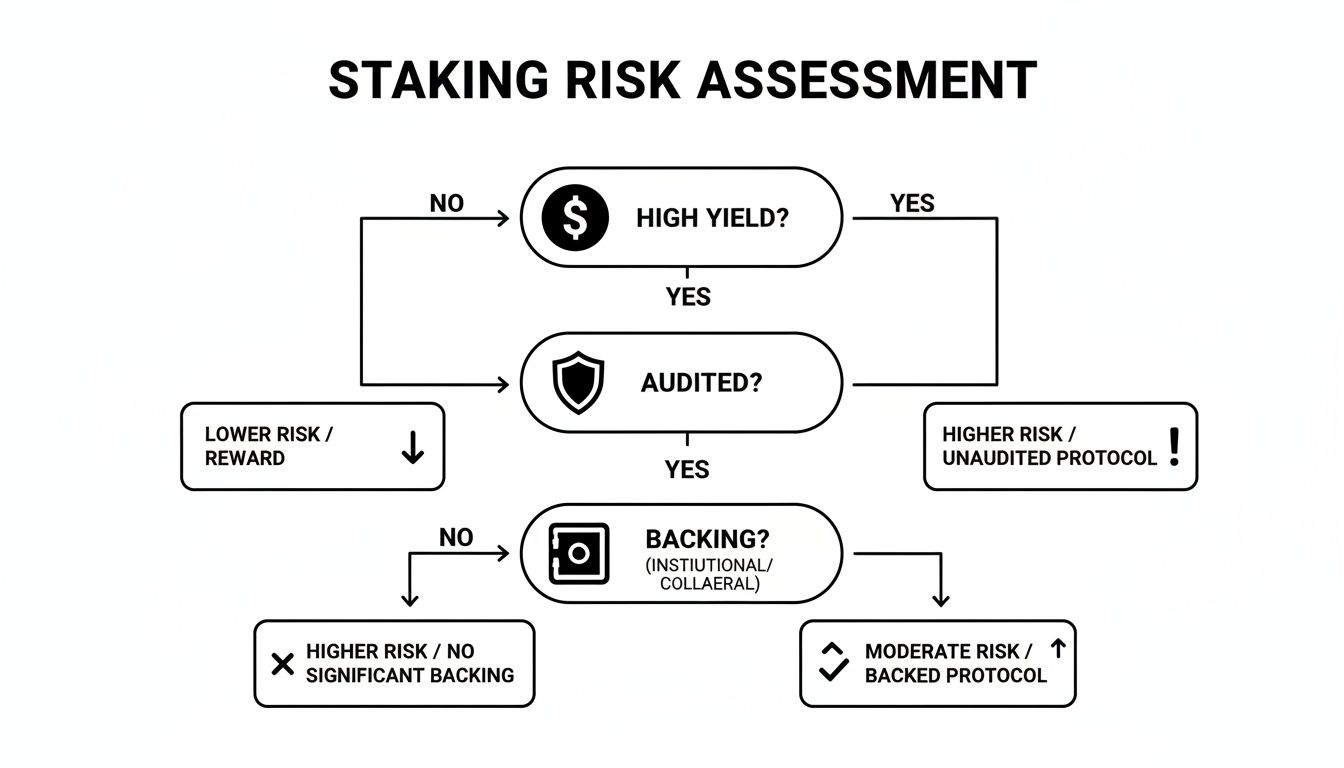
As the visual shows, the combination of sky-high yield, weak audits, and murky backing is a clear signal of unacceptable risk.
Questioning the Source of the Yield
This is the big one. You have to ask: where is this money really coming from? A juicy APY can easily distract you from an unsustainable economic model that's destined to fail. Healthy, long-term yield comes from real economic activity, not financial smoke and mirrors.
The most critical red flag in any staking opportunity is an impossibly high APY. If a platform offers returns that seem too good to be true, they almost certainly are. It’s often just a temporary subsidy paid out in inflationary farm tokens that will eventually crash to zero.
Is the yield generated from real borrowers paying lending fees? Or from trading fees on a busy decentralized exchange? That’s a sustainable model.
Or is the yield paid out by printing the platform’s own governance token out of thin air? That’s a far riskier game, one that completely depends on a constant flood of new money to keep prices from collapsing.
Tools like DeFiLlama are your best friend here. They offer transparent, raw data on hundreds of protocols. You can track everything from a stablecoin's market cap to its historical performance, all in one place.
With these principles in mind, you can start digging into specific strategies. To learn more, check out our guide on how to stake stablecoins for high APY.
Actionable Strategies to Minimize Your Risk

Spotting the dangers in stablecoin staking is one thing, but actively protecting yourself from them is what keeps your capital safe. Knowing about risk is passive. Managing it is an active defense. Let's get into the practical, concrete steps you can take to lower your exposure and stake with more confidence.
The most powerful tool in your arsenal is diversification. It’s the age-old wisdom of not putting all your eggs in one basket, applied directly to the world of DeFi. By spreading your funds out, you ensure that a single point of failure can't torpedo your entire position.
After all, a devastating smart contract bug or a platform collapsing overnight could mean a total loss. Diversification turns a potential catastrophe into a manageable bump in the road by containing the damage from any single event.
Building Your Defensive Portfolio
True diversification isn’t just about scattering your funds randomly. It’s about being deliberate and spreading your capital across different types of risk. A smart approach involves diversifying across a few key areas:
- Stablecoin Type: Don't go all-in on one model. Try allocating funds between a major fiat-backed stablecoin like USDC, a battle-tested crypto-collateralized one like DAI, and maybe even a small, speculative slice in an algorithmic design.
- Platform: Never commit everything to a single staking protocol, no matter how great its reputation. A healthy mix might include established DeFi giants like Aave or Compound alongside newer, well-audited platforms to balance security with potential yield.
- Blockchain: Staking across different networks (think Ethereum, Solana, Avalanche) insulates you from chain-specific problems. This could be anything from severe network congestion and high fees to a targeted hack on that particular ecosystem.
The goal of diversification isn't to magically erase all risk—that's impossible. It's to make sure that no single threat can land a knockout blow on your portfolio.
Leveraging DeFi Insurance and Setting Limits
For another powerful layer of security, look into DeFi insurance protocols. Services like Nexus Mutual or Insurace.io let you buy coverage for specific risks, especially smart contract failure. You pay a small premium for a policy that pays out if the staking platform you're using gets hacked and your funds are lost.
Think of it as a targeted safety net that directly addresses one of the most unpredictable threats out there. You can dig deeper into these kinds of security measures in our complete guide on stablecoin security.
Finally, you need to set your own rules. Before you even start, decide what percentage of your portfolio you're comfortable putting into higher-risk, higher-yield strategies, and stick to it. This personal limit prevents you from making emotional decisions when the market gets either too greedy or too fearful. Stay on top of protocol updates, keep an eye on governance discussions, and be aware of regulatory chatter. A proactive, disciplined approach is your best defense.
Frequently Asked Questions About Stablecoin Staking
Jumping into stablecoin staking always brings a few key questions to the surface. Getting solid, straight-up answers is the best way to feel confident and make better calls when it comes to managing your risk.
Here are the answers to some of the most common things people ask.
Is Staking Stablecoins Completely Safe?
Let’s be clear: no financial activity is ever 100% safe. Think of stablecoin staking as an investment, not a high-yield savings account. It comes with its own set of calculated risks, like the stablecoin losing its peg, smart contracts getting hacked, or the platform you're using going under.
Like any other financial move, it all comes down to understanding the inherent risks of investing. The goal isn't to find something with zero risk—that doesn't exist. It's about getting comfortable with the unique risk-reward balance of this specific opportunity.
How Can I Verify a Stablecoin's Reserves?
Checking what actually backs a stablecoin is probably the most important piece of homework you can do. How you do it really depends on the type of coin.
- For Fiat-Backed Coins (like USDC or USDT): Head to their official websites and look for the monthly attestation reports. These documents, which should come from well-known, independent accounting firms, are meant to confirm that the reserves line up with the supply of coins in circulation.
- For Crypto-Collateralized Coins (like DAI): You can check this yourself using on-chain tools and blockchain explorers. These give you a live, transparent look at exactly which crypto assets are locked up in smart contracts to back the coin.
The mark of a truly transparent and trustworthy stablecoin project is how easily you can verify its reserves. If you have to dig around for proof or the information is confusing, take that as a serious red flag.
What Is the Biggest Red Flag in a Staking Platform?
The single biggest warning sign is an Annual Percentage Yield (APY) that just looks too good to be true. It's tempting, but it almost always points to a dangerously shaky economic model.
Any yield that's consistently over 20% should make you pause, especially if it's being paid out in the platform's own token, which they can print more of at will. This kind of setup often needs a constant flood of new money just to stay afloat and can collapse without warning—just look at what happened with Anchor Protocol.
At Stablecoin Insider, we provide the in-depth analysis and timely news you need to navigate the complexities of digital assets. Stay informed and make smarter decisions by exploring our resources at https://stablecoininsider.com.