
Table of Contents
In 2025 regulation was clearly the primary catalyst behind stablecoin market maturation.
In 2026 that trend continues.
Across the United States, Europe, Asia, and emerging markets, policymakers moved decisively to replace ambiguity with structured oversight.
The result was a year in which stablecoins transitioned from speculative crypto instruments into regulated financial infrastructure supporting payments, settlement, treasury operations, and tokenized assets.
This shift reshaped issuer behavior, exchange liquidity, and institutional participation, while creating clear winners among operators capable of translating regulation into production-ready systems.
Firms such as Advix and Mezen sit squarely at this intersection where compliance, technology, and real-world deployment converge.
Europe: MiCA Forces Compliance and Liquidity Realignment
The European Union’s Markets in Crypto-Assets Regulation (MiCA) became the most consequential regional framework of the year.
By imposing uniform rules on issuance, reserves, disclosures, and redemption rights, MiCA materially reduced regulatory risk for institutions, while simultaneously raising the bar for issuers and exchanges.
The immediate effect was visible in exchange activity.
On February 3, 2025, Kraken announced the delisting of several non-compliant stablecoins in the European Economic Area, including USDT, PayPal USD, EURT, TrueUSD, and TerraClassicUSD.
The phased process margin restrictions, sell-only trading, and eventual forced conversion, culminated on March 31, 2025. Liquidity consolidated rapidly around MiCA-compliant instruments.
Institutional sentiment followed.
In a January 2025 research note, JPMorgan highlighted that MiCA strengthened euro-denominated stablecoins by concentrating trading pairs around compliant tokens such as Circle’s EURC, while non-compliant alternatives faced structural decline.
Compliance costs increased, but so did trust, participation, and balance-sheet usage.
United States: The GENIUS Act Establishes a Federal Baseline
In the United States, regulatory clarity arrived with scale. On July 18, 2025, President Donald J. Trump signed the GENIUS Act into law, establishing the country’s first federal stablecoin framework.
The legislation mandates 100% reserve backing with cash or short-term Treasuries, monthly public reserve disclosures, enhanced AML and sanctions compliance, and explicit holder protections in the event of issuer insolvency.
This clarity accelerated institutional usage.
On September 23, 2025, the Commodity Futures Trading Commission announced an initiative promoting stablecoins and tokenized collateral in derivatives markets, modernizing collateral management and improving capital efficiency.
Since the GENIUS Act, relative stablecoin growth has outpaced broader crypto assets, reinforcing the view that regulation is now an adoption driver rather than a constraint.
APAC: Divergence, Discipline, and Policy-Led Design
Asia-Pacific regulation evolved along sharply divergent paths.
In Hong Kong, the Hong Kong Monetary Authority implemented its stablecoin licensing regime on August 1, 2025, publishing detailed supervision and AML guidelines.
However, regulators repeatedly cautioned markets against speculative interpretations of preliminary applications, emphasizing that licensing remains stringent.
South Korea advanced toward a dedicated stablecoin law, with the Bank of Korea warning of depegging and digital bank-run risks while advocating bank-led issuance and strict reserve oversight.
Japan, meanwhile, prepared for the approval of JPYC’s yen-backed stablecoin, aligning issuance with existing money-transfer regulation.
China moved decisively in the opposite direction.
In December 2025, the People’s Bank of China reaffirmed its nationwide crypto ban, explicitly classifying all stablecoins as illegal virtual currencies while promoting the e-CNY as the sole permitted digital currency.
CIS Region: Controlled Scaling Over Speculation
Across the Commonwealth of Independent States, stablecoin policy reflects national economic strategy rather than ideological alignment.
Kazakhstan’s Astana International Financial Centre allows licensed issuance of fiat-backed stablecoins under full reserve and disclosure requirements.
Uzbekistan relies on supervised pilots and sandboxes to manage FX risk.
Armenia aligns closely with European standards, prioritizing large, well-capitalized issuers.
In this environment, execution matters as much as authorization.
According to Advix, stablecoin success in the CIS requires more than regulatory approval, it demands operational systems that integrate compliance, custody, issuance, and business logic.
Advix works directly with governments, financial institutions, and startups to convert policy frameworks into scalable, regulator-ready infrastructure that delivers measurable economic impact.
As CEO Irina Denezhkina notes, fragmentation is not a flaw, but an arbitrage opportunity for prepared participants.

Mezen echoes this view from the deployment side.
Based on its work in live, regulated enterprise stablecoin projects across Uzbekistan, Kazakhstan, Belarus, and Kyrgyzstan, Mezen expects a material acceleration in enterprise adoption over the next two to three years.
Usage is already scaling faster than many observers anticipated.
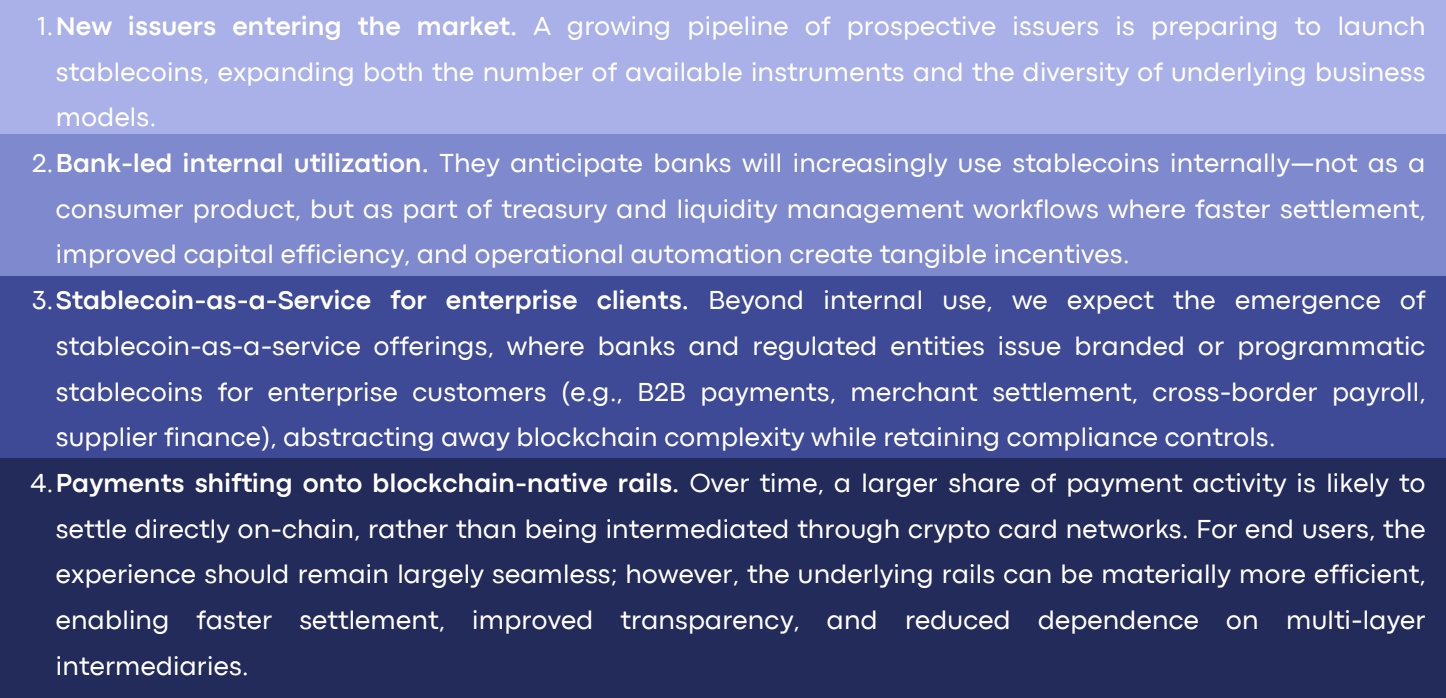
Mezen identifies four reinforcing drivers behind this growth:
- New issuers entering the market, expanding instrument diversity
- Bank-led internal usage for treasury and liquidity management
- Stablecoin-as-a-Service models for enterprise clients
- Payments migrating directly onto blockchain-native settlement rails
These trends position Mezen as a key participant in turning stablecoins from policy concepts into production financial tooling.
Middle East, Australia, and the UK: Infrastructure Thinking Takes Hold
In the UAE, the Central Bank of the UAE completed its transition to full enforcement of the Payment Token Services Regulation in June 2025.
This move supported regulated stablecoins alongside plans for a digital dirham, reinforcing the UAE’s role as a fintech hub.
Both Circle and Tether secured Money Services Provider permissions in Abu Dhabi.
Australia’s Australian Securities and Investments Commission granted class relief for stablecoin distributors and clarified that stablecoins and wallets qualify as financial products, providing a transitional runway through mid-2026.
In the UK, the Bank of England proposed a regime for systemic sterling stablecoins, including reserve requirements split between central bank deposits and government debt, holding limits, and potential liquidity backstops.
The Big Picture: Stablecoins as Systemic Infrastructure
By the end of 2025, global stablecoin regulation had clearly shifted from reactive oversight to strategic infrastructure policy.
In 2026 jurisdictions are no longer asking whether stablecoins should exist, but how they can be integrated safely into payments, capital markets, and treasury systems.
For issuers, exchanges, and enterprises, the implication is clear: compliance is now the cost of entry, not a competitive disadvantage.
Operators such as Mezen and Advix demonstrate that the real edge lies in execution, building systems that are not only compliant, but usable, scalable, and economically relevant.
Stablecoins are no longer a niche crypto product.
In 2025, they became regulated financial rails and the foundation for the next phase of on-chain finance and in 2026 that momentum continues.
FAQ
1. When did MiCA stablecoin rules take effect in the EU?
MiCA entered into force in stages between 2024 and 2025, with full stablecoin compliance enforced from December 30, 2024.
2. Why were stablecoins delisted in Europe in early 2025?
Exchanges such as Kraken delisted non-MiCA-compliant stablecoins beginning February 3, 2025, completing forced conversions by March 31, 2025.
3. When was the U.S. GENIUS Act signed into law?
The GENIUS Act was signed on July 18, 2025, creating the first federal U.S. stablecoin regulatory framework.
4. Which stablecoin activities are now regulated in the United States?
The GENIUS Act mandates 100% reserve backing, monthly disclosures, AML compliance, and insolvency protections for stablecoin holders.
5. What types of stablecoin use cases are scaling in regulated markets in 2026?
Regulated markets are seeing growth in enterprise payments, treasury management, cross-border settlement, and stablecoin-as-a-service models operating under MiCA, the GENIUS Act, and equivalent regional frameworks.