Table of Contents
SAN JOSE, Calif., March 17, 2026.
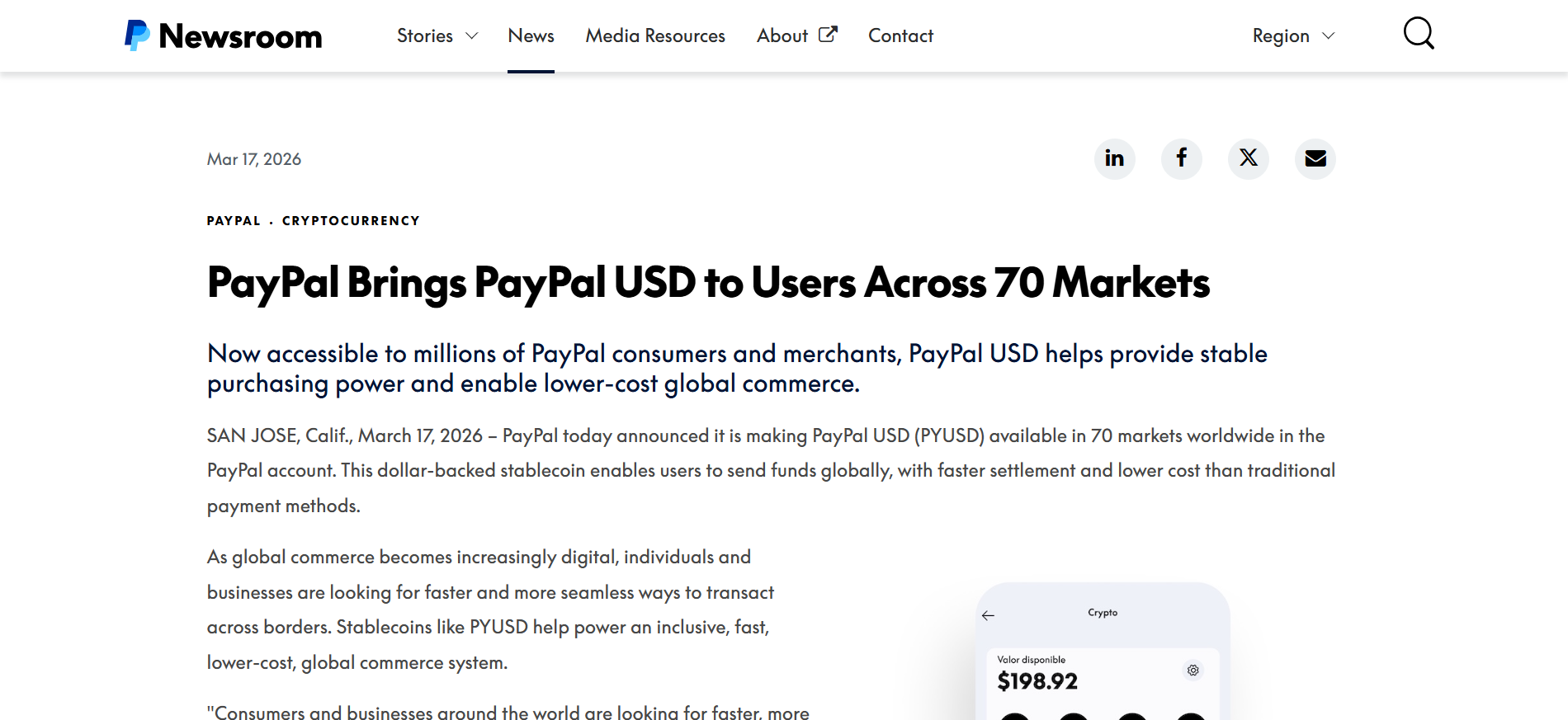
PayPal today announced a major expansion of its USD-backed stablecoin, PYUSD, making it accessible in users’ PayPal accounts across 70 markets worldwide.
The rollout transforms how millions of consumers and businesses handle global transactions, delivering faster settlements, significantly lower costs, and greater stability compared to traditional banking methods.
Key Takeaways
- 70-market rollout: PYUSD is now available in 70 countries and regions, a dramatic increase from its prior U.S. and U.K.-only footprint, covering key areas in Asia-Pacific, Europe, Latin America, and North America.
- Faster and cheaper transfers: Users benefit from instant settlements and reduced costs for sending money across borders without relying on legacy banking rails.
- Rewards for holders: Eligible users can earn competitive yields on PYUSD balances, adding passive income potential while keeping funds in stable USD value.
- Business-friendly features: Merchants gain quicker access to funds, better liquidity management, and lower FX fees for global trade.
- Regulatory backing: As a U.S. federally regulated stablecoin issued by Paxos, PYUSD offers transparency and 1:1 asset backing for trust and stability.
Launched in the United States in 2023 and previously limited to the U.S. and U.K., PYUSD is now rolling out across Asia-Pacific, Europe, Latin America, and North America. Examples of newly supported markets include Colombia, Costa Rica, Peru, Uganda, and Singapore (for business accounts only). Remaining markets will gain access in the coming weeks.
“Consumers and businesses around the world are looking for faster, more seamless ways to transact globally and the current system still charges too much, takes too long, and settles on timelines that were designed for a different era,” said May Zabaneh, Senior Vice President and General Manager of Crypto at PayPal. “Enabling PYUSD in users’ accounts across 70 markets gives people faster access to their funds, lower-cost ways to send money across borders, and a more direct path to participating in the global economy.”
PYUSD, issued by Paxos Trust Company and fully backed 1:1 by U.S. dollar deposits, Treasuries, and cash equivalents, maintains stable purchasing power. Users in supported markets can now buy, hold, send, and receive the stablecoin directly in their PayPal wallet.
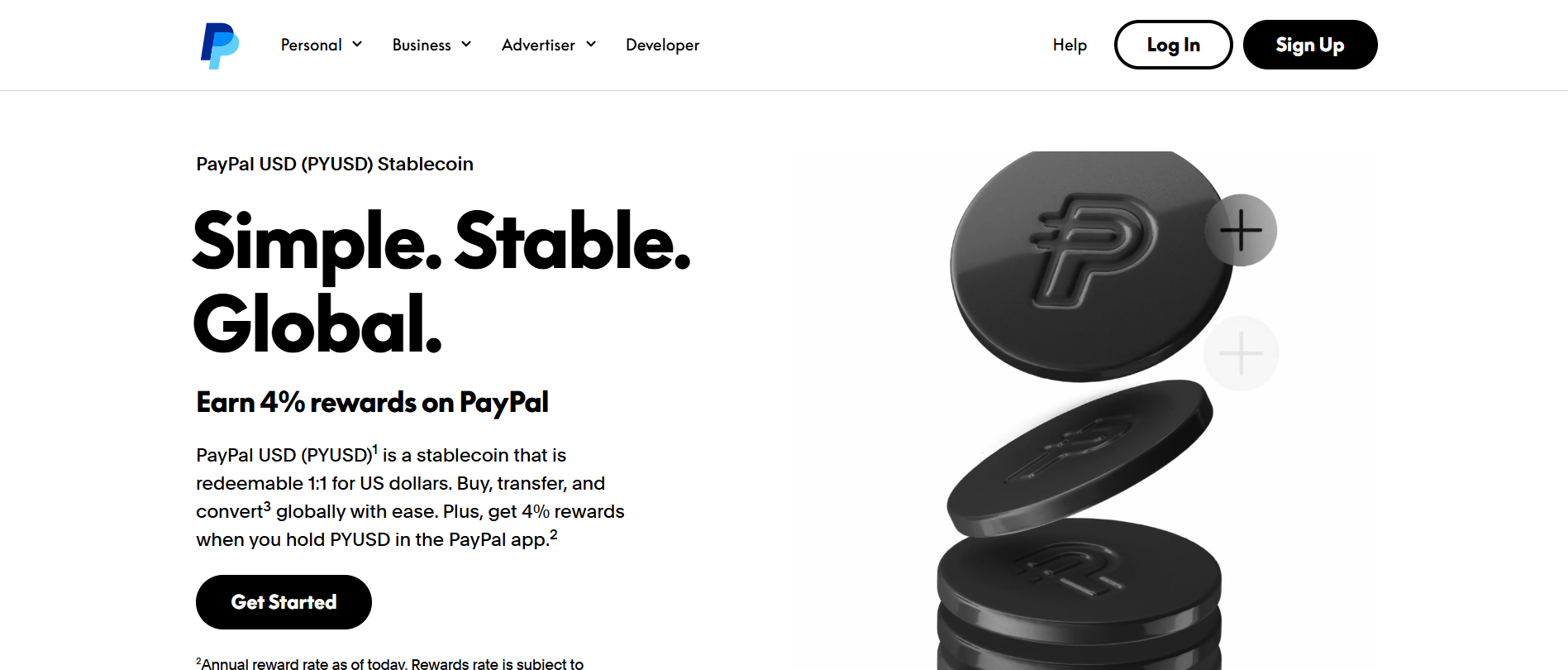
Eligible users can also earn rewards on their PYUSD holdings (rewards rates are set at PayPal’s discretion and vary by region; not available in Singapore or the U.K.). Funds transfer instantly to friends, family, or external digital wallets, and users can convert PYUSD to local currency for everyday spending.
For businesses, the advantages are immediate. Merchants accepting PYUSD receive proceeds in minutes rather than days or weeks, improving cash flow, reducing foreign exchange fees, and enabling smoother cross-border operations.
This expansion builds on PYUSD’s growing role in creating liquidity and utility for a more inclusive global commerce ecosystem. By bridging traditional finance with blockchain, PayPal aims to lower barriers for international payments that have long been plagued by high fees and slow processing.
Conclusion
PayPal’s expansion of PYUSD to 70 markets marks a pivotal step toward mainstream adoption of stablecoins for everyday global commerce.
By making dollar-pegged digital currency seamless and accessible via a familiar PayPal wallet, the company is delivering on its promise of faster, more affordable, and inclusive international payments.
As digital commerce continues to grow, PYUSD is positioned to play a central role in reshaping how money moves around the world, empowering both individuals and businesses to participate more fully in the global economy.
Read Next:
- 6 Best Stablecoin APIs For Businesses In 2026
- Ethena's USDe Q1 2026 Report
- Best Stablecoin Settlement Tools For Marketplaces in 2026
FAQs:
1. What is PayPal’s PYUSD stablecoin?
PYUSD is PayPal’s official USD-backed stablecoin, issued by Paxos and fully collateralized 1:1 with U.S. dollars, Treasuries, and cash equivalents. It maintains a steady $1 value and can be used for payments, transfers, and storage within PayPal accounts.
2. Which countries now have access to PYUSD after the expansion?
PYUSD is available in 70 global markets, including the United States, United Kingdom, Colombia, Peru, Costa Rica, Uganda, Singapore (business accounts), and many others across Asia-Pacific, Europe, Latin America, and North America. Full access is rolling out immediately in most places, with remaining markets following in the coming weeks.
3. How does the PYUSD expansion help with international transfers?
The expansion enables instant, low-cost cross-border sending of funds in stable USD value. Users avoid high traditional banking fees, slow settlement times, and currency conversion losses, making global payments faster and more affordable than ever.
4. Can users earn money on their PYUSD holdings?
Yes, eligible users in supported markets can earn rewards on their PYUSD balances (rates vary and are set by PayPal). This feature, already popular in the U.S. at around 4% annually, now extends to most of the 70 new markets.
5. Who benefits most from PayPal’s PYUSD availability in 70 markets?
Both consumers and businesses benefit. Individuals gain easier international sending and stable storage; merchants enjoy faster fund access, improved liquidity, and reduced fees for cross-border trade, ultimately driving more inclusive global commerce.
Disclaimer:
This content is provided for informational and educational purposes only and does not constitute financial, investment, legal, or tax advice; no material herein should be interpreted as a recommendation, endorsement, or solicitation to buy or sell any financial instrument, and readers should conduct their own independent research or consult a qualified professional.