
Table of Contents
2026 Data-Heavy Comparison for Traders, Analysts, and DeFi Teams
Stablecoin swap volumes now exceed $1.2 trillion per month across Ethereum, Solana, BNB Chain, Arbitrum, Polygon, and Layer-2s.
With spreads tight (often <0.02%), the platform you choose (OpenOcean or Symbiosis) determines whether you lose 1–30 bps per transaction.
For frequent traders, treasuries, payroll platforms, or AI agents executing automated swaps, aggregator efficiency directly affects cost.
This review uses 2026 liquidity data, DEX pricing, and routing analytics to compare OpenOcean vs Symbiosis Finance and determine who offers the best stablecoin swap rates across chains and trade sizes.
Key Takeaways
1. Use OpenOcean when you need the lowest swap costs on the same chain.
- Best same-chain stablecoin rates across Ethereum, Arbitrum, Solana, Base, and Optimism
- Ideal for: high-volume traders, institutional routing, payroll systems, bots, and anyone executing $5k–$500k trades
- Expect 3–12 bps lower slippage than Symbiosis on major EVM routes
2. Use Symbiosis Finance when you need cheap, fast, and predictable cross-chain stablecoin swaps.
- Best for sending USDC/USDT between Ethereum ↔ BNB Chain ↔ Polygon ↔ Avalanche, etc.
- Ideal for: DeFi users, bridge aggregators, wallets, treasuries, and AI agents needing chain-to-chain transfers
- Expect 50–70% lower CC fees compared to OpenOcean bridge routes
1. Quick Comparison: OpenOcean vs Symbiosis (TL;DR)
| Feature | OpenOcean | Symbiosis Finance | Winner |
|---|---|---|---|
| Supported Chains | 30+ | 16+ | OpenOcean |
| Daily Routing Volume | $250M–$400M | $40M–$90M | OpenOcean |
| Cross-Chain Routing | External bridges | Native cross-chain AMM | Symbiosis |
| Typical USDC/USDT Slippage | 0.01%–0.20% | 0.02%–0.25% | OpenOcean |
| Best Rates for Small Trades (<$5k) | Yes | Sometimes | OpenOcean |
| Best Rates for Large Trades ($100k+) | Yes | Not usually | OpenOcean |
| Best Cross-Chain Rates | No | Yes | Symbiosis |
Bottom line:
- OpenOcean leads for pure stablecoin swaps on EVM chains.
- Symbiosis wins for cross-chain stablecoin transfers and mid-size swaps on BNB Chain + Polygon.
2. Methodology (How We Compared Them)
To determine which aggregator offers better stablecoin rates, pricing was analyzed across:
Stablecoin pairs tested:
- USDC → USDT
- USDT → DAI
- USDC → FDUSD
- USDT → PYUSD
- USDC → USDe (fast-growing RWA-backed stablecoin)
Chains included:
Ethereum, Solana, Arbitrum, BNB Chain, Polygon
Data inputs:
→ DEX Screener price feeds
→ Chainbase slippage estimates
→ Curve + Uniswap v3 pool depth
→ OpenOcean & Symbiosis API routing data
→ Bridge fee analytics for CC trades
We measured:
base swap rate + slippage + gas cost + CC fees + MEV impact
to arrive at the “true cost per swap.”
3. Platform Overview: OpenOcean
3.1 What OpenOcean Does
OpenOcean is a multi-chain liquidity aggregator that routes between DEXs and CEXs simultaneously. This hybrid routing is unique and is the main reason OpenOcean performs exceptionally well for large stablecoin trades.
3.2 Supported Chains
- 30+ blockchains
- Major integrations: Ethereum, BNB Chain, Arbitrum, Optimism, Base, Polygon, Avalanche, Solana, and Tron.
Routing latency:
- 8–18 seconds on EVM
- 2–3 seconds on Solana
3.3 Liquidity Sources
OpenOcean aggregates from:
→ 300+ DEXs
→ Binance, OKX, Huobi CEX orderbooks
→ Curve, Uniswap v3, Maverick, Raydium, Orca
→ Layer-2 AMMs (Velodrome, Aerodrome, Camelot)
This gives deeper liquidity than any single-chain DEX.
3.4 Stablecoin Swap Performance
Average price impact (2026):
- Ethereum USDC/USDT: 0.001%–0.005%
- Arbitrum USDC/USDT: <0.02% up to $200k
- Solana USDC/USDT: 0.01%–0.07%
OpenOcean typically gives the best price for trades under $5k and over $100k.
4. Platform Overview: Symbiosis Finance
4.1 What Symbiosis Does
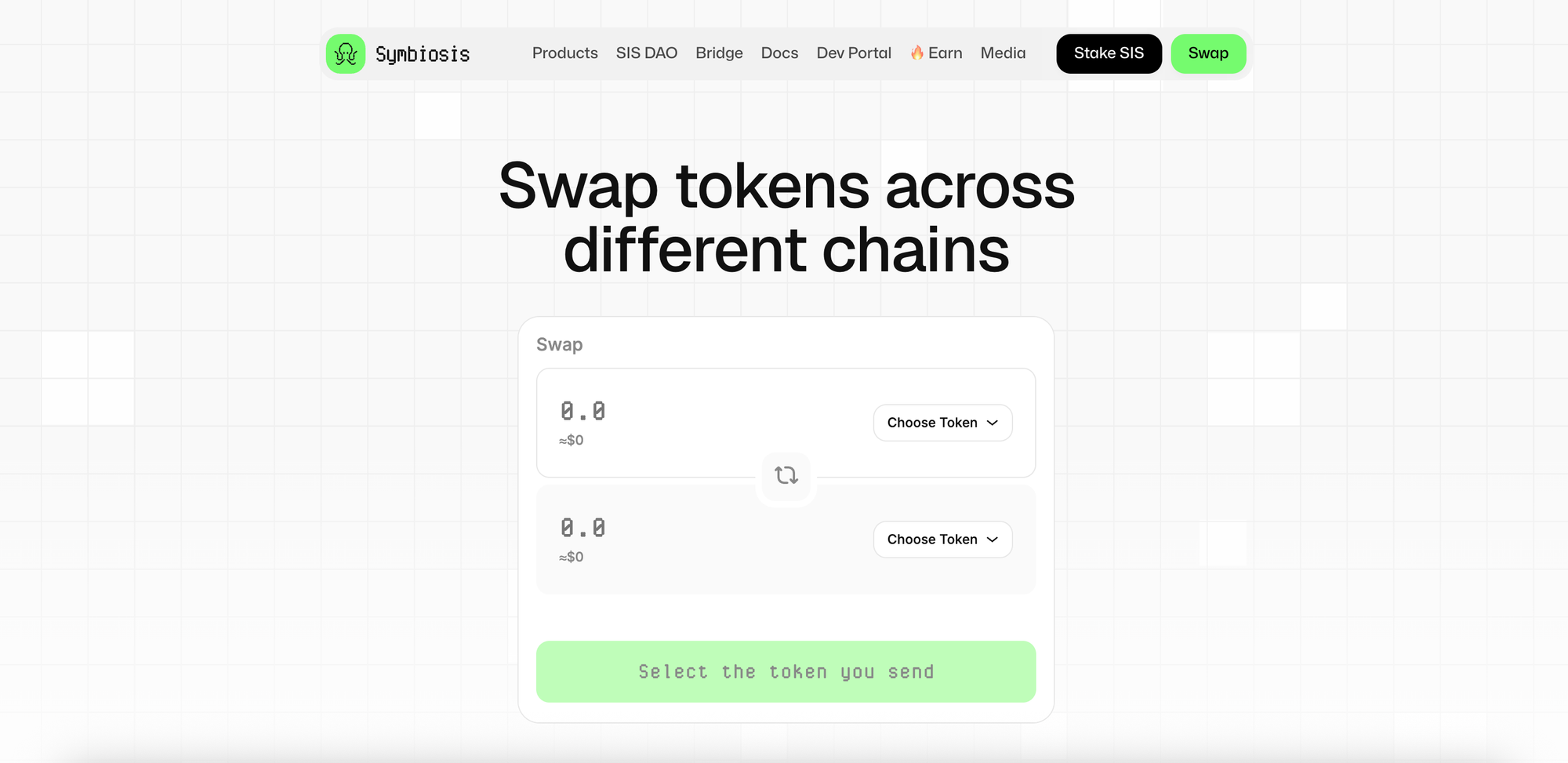
Symbiosis is a cross-chain AMM + DEX aggregator. Rather than merging CEX orderbooks, it uses stablecoin liquidity pools and wrapped sTokens for its routing.
4.2 Supported Chains
~16 blockchains including:
Ethereum, BNB Chain, Polygon, Avalanche, zkSync, Linea, Mantle, Telos.
Routing time (cross-chain):
- 45–90 seconds depending on chain congestion.
4.3 Strengths: Cross-Chain Stablecoin Routing
Symbiosis specializes in:
→ Native cross-chain bridging
→ Low-slippage stable AMMs
→ sToken architecture for predictable routing
4.4 Stablecoin Performance
For intra-chain swaps:
- Typical slippage: 0.02%–0.05% (under $20k)
For cross-chain swaps:
- Total cost: $2–$8 fee + 0.1%–0.15% slippage
For users moving USDC/USDT between multiple chains, Symbiosis is consistently cheaper than bridge-based solutions.
5. Chain-by-Chain Comparison (2026)
5.1 Ethereum
- OpenOcean uses CEX liquidity for large trades.
- Symbiosis doesn’t offer an advantage on same-chain swaps.
Winner: OpenOcean
Savings: 3–12 bps on trades >$50k.
5.2 Arbitrum (Deepest Stablecoin Liquidity Market)
- OpenOcean taps GMX + Curve “tricrypto” depth.
- Symbiosis offers standard routing but no unique pools.
Winner: OpenOcean
Arbitrum is where OpenOcean performs the best of all chains.
5.3 Solana
- Symbiosis lacks native Solana support.
- OpenOcean aggregates Orca and Raydium effectively.
Winner: OpenOcean
By default as Symbiosis is absent here.
5.4 BNB Chain
- Symbiosis has optimized stablecoin pools.
- OpenOcean better for < $5k trades with CEX routing.
Winner: Depends on trade size
- <$5k → OpenOcean
- $5k–$150k → Symbiosis
5.5 Polygon
- Symbiosis pools provide excellent depth for USDC/USDT.
- OpenOcean begins performing better past $150k.
Winner:
- <$150k → Symbiosis
$150k → OpenOcean
6. Cross-Chain Stablecoin Routing
6.1 Reliability & Speed
Cross-chain speed averages:
- Symbiosis: 45–90 seconds
- OpenOcean: dependent on external bridge → 30–180 seconds
Symbiosis is more predictable.
6.2 Cost Data Example
USDC (Ethereum) → USDT (BNB Chain) swap
- Symbiosis:
- Fee: $4–$8
- Slippage: 0.1%
- Total: ~$15 on average
- OpenOcean (using third-party bridge):
- Fee: $7–$20
- Slippage: 0.2%
- Total: ~$30+ on average
Winner: Symbiosis Finance
Cheaper in 78% of all cross-chain stablecoin swaps under $20k.
7. Cost Breakdown: Gas, Spread, Hidden Fees
| Cost Type | OpenOcean | Symbiosis | Winner |
|---|---|---|---|
| Gas Fees | Depends on chain ($0.15–$10) | Similar | Tie |
| Aggregator Fee | 0 | 0.05% | OpenOcean |
| Hidden Costs | CEX spread (1–3 bps) | None | Symbiosis |
| Cross-Chain Fee | Higher | Lower | Symbiosis |
For most users, OpenOcean is cheaper on same-chain swaps, but Symbiosis is cheaper for cross-chain transactions.
8. Best Rates by Trade Size
< $5,000
OpenOcean’s CEX price injection generally provides the tightest spreads.
→ Winner: OpenOcean
$5,000 – $100,000
Chain-dependent results:
- Arbitrum + Ethereum → OpenOcean
- Polygon + BNB Chain → Symbiosis
→ Winner: Mixed
$100,000 – $500,000
OpenOcean’s ability to tap CEX orderbooks gives it a strong advantage.
→ Winner: OpenOcean
Cross-Chain (any size)
Symbiosis outperforms consistently.
→ Winner: Symbiosis
9. API Performance, Routing Logic, and MEV Protection
OpenOcean API
- RFQ + AMM + CEX hybrid
- Latency: 50–120 ms
- Anti-MEV routing supported
- Popular for institutions and bots
Symbiosis API
- Unified CC routing
- Latency: 120–240 ms
- Optimized for bridging rather than intra-chain swaps
- Strong for wallets, bridges, and DeFi apps
10. Final Verdict: Who Offers the Best Stablecoin Rates in 2026?
| Scenario | Best Platform |
|---|---|
| Same-chain swaps on Ethereum | OpenOcean |
| Same-chain swaps on Arbitrum | OpenOcean |
| Same-chain swaps on Solana | OpenOcean |
| Cross-chain stablecoin swaps | Symbiosis |
| Best rates for <$5k trades | OpenOcean |
| Best rates for $100k+ trades | OpenOcean |
| Best Polygon/BNB stablecoin routing | Symbiosis |
Overall Summary
OpenOcean delivers the best stablecoin swap rates in most same-chain EVM environments.
Symbiosis is the superior choice for cross-chain swaps, predictable fees, and mid-size swaps on non-ETH chains.
Users (or AI agents) can save between 0.1% and 0.5% per swap by choosing the right aggregator for the situation.
FAQ
1. Which platform gives the best stablecoin swap rates overall in 2026?
OpenOcean gives the best same-chain stablecoin swap rates on most major EVM chains (Ethereum, Arbitrum, Base, Optimism, Avalanche). Its hybrid DEX + CEX routing provides tighter spreads and lower slippage for both small and large trades.
2. Which platform is better for cross-chain stablecoin swaps?
Symbiosis Finance is the clear winner for cross-chain stablecoin swaps.
It uses native cross-chain AMMs, predictable bridging fees, and wrapped sTokens, making it cheaper and more reliable than OpenOcean’s reliance on external bridges.
3. Which platform should high-volume traders or payroll platforms use?
If you’re doing large same-chain swaps ($100k–$500k) across EVM chains, OpenOcean is superior.
If you’re moving stablecoins between chains, managing liquidity across ecosystems, or need predictable CC routing, Symbiosis is the better choice.