
Table of Contents
The future of decentralized finance isn't just about tweaking the current system. It's about building a new one from the ground up—one that's more open, efficient, and interconnected than anything we've seen before. We're witnessing a move away from DeFi's niche, crypto-native roots and toward a direct challenge to the very foundations of traditional banking.
Welcome to the Next Financial Revolution
Decentralized finance, or DeFi, is far more than a passing trend. It's a fundamental reimagining of our global financial infrastructure. If you think about where DeFi is today, it feels a lot like the early days of the internet—a little clunky, maybe a bit complicated for newcomers, but absolutely buzzing with potential to change everything.
The reason this movement is catching fire is simple: it tackles the deep-seated problems of traditional finance head-on. For decades, we've put up with middlemen taking a cut, slow transaction settlements, and a system that often locks people out. DeFi flips that script entirely. By cutting out the centralized gatekeepers, it's paving the way for a more level and accessible financial playing field.
If you're new to the space, getting a handle on what is DeFi and how it works is the perfect starting point. That foundational knowledge is key to seeing just how big this shift could become.
The Pillars of DeFi's Future Growth
The explosive growth we've seen in DeFi didn't happen by accident. It's powered by a clear and compelling promise to fix problems that have plagued finance for years. As we look ahead, the next decade of DeFi's evolution will stand on four critical pillars:
- Breakthrough Scalability: DeFi needs to be fast and cheap enough for everyone. The goal is to overcome today's network congestion to handle millions of transactions per second, rivaling traditional payment giants.
- Seamless Interoperability: Right now, many blockchains are like walled gardens. The future is about tearing down those walls so different networks can communicate and share assets effortlessly, creating one unified financial ecosystem.
- An Intuitive User Experience: Let's be honest, using DeFi can be intimidating. The next wave of innovation will focus on designing apps that are as simple and intuitive as your favorite banking app, removing the technical hurdles for everyday users.
- The Centrality of Stablecoins: Stable digital currencies are becoming the bedrock of the entire system. They provide the price stability needed for everything from global payments to complex financial products. You can dive deeper and understand digital currency concepts to see why they're so crucial.
The DeFi market isn't just growing; it's undergoing a seismic expansion that signals a new era in global finance. This transformation is heavily fueled by the increasing role of stablecoins as the system's core settlement asset.
The numbers back up this incredible trajectory. The global DeFi market, valued at USD 87.11 billion in 2025, is projected to soar to an astonishing USD 954.59 billion by 2035. This isn't slow and steady growth; it's an explosion, driven by an expected compound annual growth rate (CAGR) of 27.02% between 2026 and 2035.
Think of this guide as your roadmap. We're here to unpack these powerful forces and give you a clear, practical view of what the next decade in finance really looks like.
The Technology Powering DeFi's Next Wave
For DeFi to ever truly compete with—and even integrate into—traditional finance, it has a few major hurdles to clear. It needs to get faster, a lot cheaper, and far more connected than it is today. Right now, using DeFi can sometimes feel like trying to navigate rush hour traffic on a single-lane road: painfully slow and surprisingly expensive.
Fortunately, a new wave of technology is being built from the ground up to solve these exact problems.
These aren't just minor tweaks; they represent a complete overhaul of DeFi's engine. The work is focused on three critical areas: making networks lightning-fast, getting different blockchains to actually talk to each other, and pooling capital so it can be used anywhere, anytime. Together, these upgrades are laying the groundwork for an ecosystem that’s both incredibly powerful and genuinely accessible.
This is all in service of DeFi's core promise: cutting out the dead weight from traditional finance, opening up access to a global audience, and unlocking a new era of innovation.
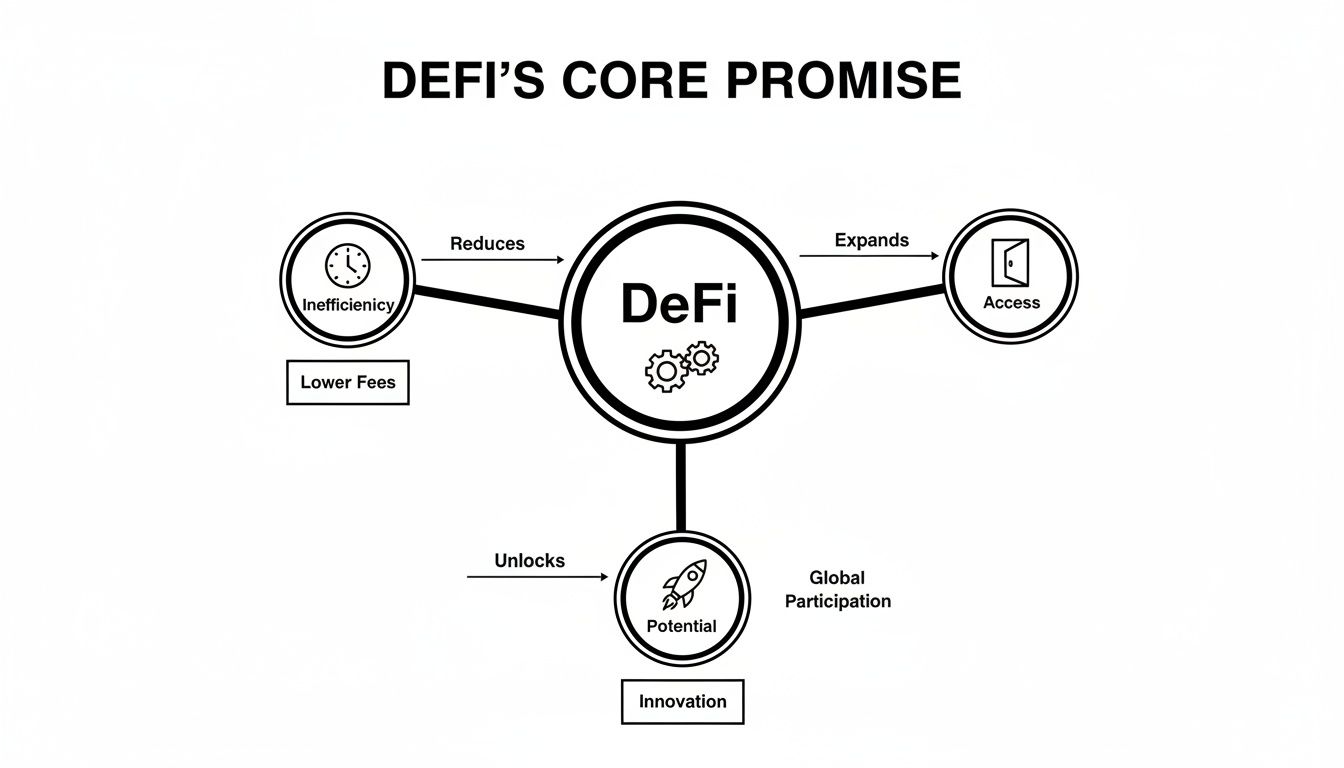
As you can see, these pillars don't exist in a vacuum. Each one reinforces the others, creating a much stronger and more user-focused financial system.
To better understand these shifts, the table below breaks down each major technological advancement, the problem it’s designed to fix, and what it actually means for you as a user.
Key Technological Shifts in DeFi
| Technological Shift | Core Problem It Solves | Real-World Analogy | Impact on Users |
|---|---|---|---|
| Layer 2 Scaling | High fees and slow transaction speeds on main blockchains. | Adding an express toll lane to a congested highway. | Near-instant transactions with fees that cost pennies, not dollars. |
| Cross-Chain Interoperability | Blockchains are isolated and can't communicate with each other. | A universal travel adapter that lets your electronics work in any country. | Seamlessly move assets between different blockchains without clunky, risky bridges. |
| Unified Liquidity Layers | Capital is trapped in thousands of separate apps and chains. | A city-wide water main instead of thousands of individual wells. | Better prices on trades, more available capital for loans, and a more efficient system overall. |
These advancements are moving from theory to reality, fundamentally changing what’s possible in decentralized finance. Let’s dive a little deeper into each one.
Unlocking Scalability with Layer 2 Solutions
The single biggest bottleneck holding DeFi back has always been scalability. Blockchains like Ethereum are incredibly secure, but they can only handle a handful of transactions per second. When too many people try to use them at once, the network clogs up and fees skyrocket. It's a huge barrier for any kind of mainstream adoption.
Enter Layer 2 solutions.
Think of a popular blockchain as a main highway that's constantly jammed with traffic. A Layer 2 is like an express lane built right alongside it. It scoops up thousands of transactions, processes them off the main chain almost instantly for next to nothing, and then submits a single, compressed summary back to the main highway for final security.
This approach gives users the best of both worlds: the blazing speed of a private database with the battle-tested security of a major decentralized network.
By offloading the heavy lifting to a secondary layer, DeFi apps can finally hit the performance numbers needed for real-world use. We're talking about handling thousands of transactions per second, not just 15.
This isn't a far-off dream; it's happening right now. Major Layer 2 networks are already processing millions of transactions every single day, making DeFi apps for trading, gaming, and payments dramatically more responsive and affordable.
Building Bridges with Cross-Chain Interoperability
Today, the blockchain world is a collection of digital islands. Moving your assets from Ethereum to another network like Solana or Avalanche often means trusting a clunky and sometimes insecure third-party "bridge." It’s like trying to plug a European appliance into an American socket without the right adapter—it just doesn't work.
Cross-chain interoperability protocols are that universal adapter.
They are creating a secure, standardized way for different blockchains to send messages and transfer value as if they were part of the same network. We're moving away from isolated ecosystems and toward a true "internet of blockchains," where your assets and data can flow freely and safely.
This is absolutely critical for DeFi's future. It opens up a world of possibilities. For instance, a user could:
- Hold a digital asset on one blockchain.
- Use that asset as collateral for a loan on an entirely different blockchain.
- Do all of this from a single wallet, without ever navigating away from their favorite app.
This kind of connectivity makes the entire DeFi landscape feel less like a cluster of disconnected towns and more like a single, unified market. To get a better handle on the mechanics, our detailed guide explores the fundamentals of cross-chain DeFi and its potential. This interconnectedness is the key to building sophisticated financial products that work across the entire digital asset space.
Creating Unified Liquidity Layers
Liquidity—the pool of available capital for trading, lending, and borrowing—is the lifeblood of any financial system. Right now in DeFi, that liquidity is spread thin, trapped within thousands of individual apps across dozens of blockchains. This makes capital incredibly inefficient.
The next big step is the rise of unified liquidity layers.
Imagine a single, massive reservoir of capital that any app, on any blockchain, can tap into whenever it needs it. Instead of every project digging its own little well for liquidity, they can all draw from a shared, bottomless ocean.
This model makes the whole system run better. It means traders get the best possible price, borrowers can always find capital, and new apps can launch without the massive challenge of attracting their own liquidity from scratch. While this technology will be mostly invisible to the end-user, it will power a far more fluid and responsive financial backend, securing DeFi's place in the future of finance.
How Stablecoins Became DeFi's Backbone

If blockchain is the railroad for a new financial system, stablecoins are the locomotives pulling the cargo. They tackle the single biggest hurdle that has plagued crypto since day one: its wild price swings. Without a stable unit of account, you simply can't build sophisticated financial products like loans, insurance, or derivatives.
Just imagine trying to get a mortgage where your monthly payment could jump by 20% overnight. It would be pure chaos. Stablecoins solve this by providing a reliable "digital dollar" on the blockchain, creating the predictable foundation DeFi needs to thrive.
They act as the essential bridge between the familiar world of fiat currency and the new frontier of digital assets. This stability is why they've become the default currency for almost everything that happens in DeFi, from simple token swaps to complex trading strategies.
The Evolution from Simple Pegs to Financial Instruments
The first stablecoins were easy enough to understand: digital tokens backed one-to-one by actual dollars sitting in a bank. This fiat-collateralized model was a straightforward and effective way to bring a much-needed anchor to a volatile market. To get a handle on the different mechanisms, you can dig into this excellent breakdown of how stablecoins work.
But the future of DeFi demands much more than a simple price peg. The market is quickly moving beyond these early designs, and we're now seeing the rise of more powerful stablecoin models that are becoming financial instruments in their own right.
These next-generation assets are heading in some fascinating directions:
- Yield-Bearing Stablecoins: These tokens automatically earn interest for you. They do this by putting their underlying collateral to work in secure, low-risk DeFi lending protocols. Instead of just sitting there, your digital dollars are constantly earning.
- RWA-Backed Variants: Real-World Asset (RWA) stablecoins are backed by tangible things like real estate, government bonds, or corporate debt. This is a game-changer, as it directly connects the on-chain economy to trillions of dollars in real-world value.
- Algorithmic and Crypto-Overcollateralized Models: These types use smart contracts and other crypto assets as collateral, offering a truly decentralized alternative to relying on traditional banks to hold the reserves.
By evolving from simple IOUs into productive, yield-generating assets, stablecoins are no longer just a tool for trading. They are becoming the core building block for a more dynamic and efficient on-chain economy.
This shift is a huge step toward making DeFi a real alternative to traditional finance. It’s a sign that we’re moving beyond just copying old-world products and are starting to create something fundamentally new.
The Gateway for Institutional Capital
For years, big financial institutions have watched DeFi from a distance—intrigued by the potential but scared off by the volatility and regulatory uncertainty. Regulated, transparent stablecoins are completely changing that equation. They are becoming the trusted on-ramp for serious institutional money.
When a major fund can hold a digital dollar that is fully backed, regularly audited, and compliant with financial rules, the perceived risk plummets. This newfound confidence is unlocking the door for trillions of dollars to flow from traditional finance into the DeFi ecosystem.
This wave of institutional capital is set to reshape the entire market. As these players come in, they bring not only money but also a demand for more robust infrastructure, deeper liquidity, and professional-grade financial products—all built on a stablecoin foundation.
Interacting with Central Bank Digital Currencies
Looking ahead, one of the most interesting developments will be how private stablecoins and government-issued Central Bank Digital Currencies (CBDCs) coexist. Rather than seeing them as rivals, it’s more useful to think of them as two sides of the same coin, each serving a different purpose.
- CBDCs will likely become the settlement layer for massive wholesale transactions between major financial institutions, offering unmatched security and the full backing of a central bank.
- Private Stablecoins will probably continue to dominate on the retail and innovation side of DeFi, offering greater flexibility, programmability, and integration with the fast-moving world of dApps.
This creates a complementary system. Government-backed digital currencies provide the ultimate layer of trust, while privately issued stablecoins fuel innovation and user-facing applications. The numbers already point to this future, with stablecoin transaction volumes projected to soar past $3 trillion by 2026 and the total value locked on Ethereum already climbing over $100 billion.
Making DeFi as Easy as Your Banking App

For all its potential, let's be honest: DeFi has an adoption problem. And it all comes down to complexity. For anyone outside the crypto-native bubble, using a DeFi app today feels like trying to navigate a computer with just a command line. It’s incredibly powerful if you know what you're doing, but a complete non-starter for everyone else.
This hurdle is the single biggest thing holding DeFi back from mainstream use. The future of decentralized finance, then, depends entirely on making this complexity vanish. We're on the cusp of a new wave of innovation focused on creating an "invisible" DeFi—one where you can tap into powerful financial tools without ever having to think about private keys, gas fees, or which blockchain you're on.
The destination is clear: an experience as smooth and simple as your mobile banking app. That's how we open the door for the next billion users.
The Rise of Account Abstraction
The technology paving the way for this revolution is called account abstraction. It sounds technical, but the core idea is simple: it separates your account from the single private key that traditionally controls it. This seemingly small shift unlocks a whole universe of user-friendly features people have come to expect from any modern app.
Think of a standard crypto wallet as a physical key to a single door. Lose the key, and you're locked out forever. Account abstraction turns that simple key into a programmable smart lock. You can program it to open with a fingerprint, grant temporary access to a friend, or have a backup plan if you get locked out.
Account abstraction is the engine that will power a user experience revolution in DeFi. It allows developers to build wallets and applications that feel familiar to a non-crypto audience, removing the steep learning curve that holds back growth.
This isn't just a minor tweak. It's a fundamental rewiring of how we interact with the blockchain.
What an Abstracted Future Looks Like
With account abstraction, a new generation of smart contract wallets can offer features that were once just a pipe dream. Because these wallets are controlled by code instead of a single key, they're far more flexible and secure.
Here are a few game-changing features this technology enables:
- Social Logins and Recovery: Forget frantically writing down a 12-word seed phrase on a piece of paper. Smart contract wallets let you create and access your account with things you already use, like a Google account or Face ID. Account recovery can be as simple as designating trusted friends or family to help restore access, finally killing the all-or-nothing risk of losing a private key.
- Sponsored and Automated Transactions: One of the most alien concepts for newcomers is having to pay "gas fees" for every little action. Account abstraction lets apps sponsor these fees for their users, making the experience feel free, just like a normal web app. It also paves the way for automated actions, like setting up recurring investments or paying for subscriptions directly from your wallet.
- Session Keys and Spending Limits: Imagine playing a blockchain game without having to approve every single micro-transaction. You could grant the game a temporary "session key" with permission to spend, say, up to $20 in an hour, keeping the rest of your funds totally secure. It's a massive improvement for usability.
These upgrades aren't just about convenience; they're about building a more secure and accessible financial system. For developers aiming to build user-friendly payment rails, our guide on choosing a crypto payment API explores how these new wallet technologies are being integrated.
By stripping away the technical jargon and replacing clunky processes with familiar interactions, we can finally make the future of decentralized finance welcoming for everyone, not just the experts.
Understanding the Global Regulatory Roadmap
Many people see regulation as the enemy of innovation. In the world of decentralized finance, it’s actually the opposite. Think of it less as a barrier and more as the guardrails on a bridge connecting DeFi’s wild, early days to the mainstream global economy.
As the industry grows up, it has to start talking to policymakers. This isn't about shutting DeFi down. It’s about answering the tough questions that will give institutional investors the confidence to bring trillions of dollars into the space. The real goal is to protect people and stop bad actors without killing the decentralized spirit that makes this technology so powerful.
Navigating Key Regulatory Questions
Regulators everywhere are wrestling with the same big problems. They're trying to apply laws written for a centralized world to a technology that is fundamentally decentralized. It’s a tricky balancing act that calls for a completely new way of thinking.
Here’s what they are focused on:
- Classifying Digital Assets: Is a token a security? A commodity? Or a brand new category? The answer changes everything about how it can be traded, taxed, and sold.
- Implementing KYC/AML Standards: How do you enforce Know Your Customer (KYC) and Anti-Money Laundering (AML) rules when there’s no central company to check IDs? This is a massive technical and philosophical challenge for DeFi.
- Defining Liability: If a smart contract gets hacked and money is lost, who’s on the hook? The developers? The DAO that governs it? The users? The law isn't clear yet.
The smartest regulators are starting to rally around a simple idea: "regulate the activity, not the technology." This means if a DeFi app acts like a lender, it gets treated like a lender. If it functions as an exchange, it gets regulated like one.
This approach is so important because it allows the underlying technology to keep evolving. It ensures a level playing field, where financial activities meet the same standards whether they happen at a bank or on a blockchain.
Global Frameworks Taking Shape
Different parts of the world are moving at their own pace, but a clearer picture is starting to emerge. Europe has jumped ahead with its Markets in Crypto-Assets (MiCA) regulation, creating one of the first comprehensive rulebooks for the industry. It brings much-needed clarity for stablecoin issuers and service providers. You can dive deeper into these worldwide efforts in our guide to stablecoin regulation and its global impact.
The United States is a bit more complicated, with various agencies claiming authority. But serious legislative work is happening, especially around stablecoins. At the same time, major financial hubs in Asia are setting up their own "sandboxes" to attract DeFi talent while keeping risks in check.
This global push for clear rules is precisely why so many people believe DeFi is the future. Traditional banks pull in $7.24 trillion a year, while DeFi's projected $110 billion market by 2026 is still just a tiny fraction of that. But with transaction volumes already topping $3 trillion—playing in the same league as giants like Visa—the potential is undeniable. Sensible regulation is the final piece of the puzzle needed to unlock it.
Your Guide to the Decentralized Future
So, where do we go from here? Whether you're an investor trying to find the next big thing, a developer building it, or a policymaker tasked with making sense of it all, you need a clear map. The road ahead is paved with the technological and regulatory bricks we've just discussed, and getting it right means balancing bold innovation with careful planning. This isn't just about chasing trends; it's about grasping the deep, fundamental shifts that are remaking finance as we know it.
My takeaway for you is one of optimistic realism. Yes, the hurdles are high—especially when it comes to user experience and navigating the regulatory maze. But the direction of travel is undeniable. Decentralized finance is on a path to fundamentally reshape our global economy.
A Roadmap for Key Players
Depending on who you are, your focus will need to shift. Knowing where to put your energy and capital is what separates the winners from the losers as this space grows up.
For Investors
Your game plan should be simple: follow the utility. Forget the hype cycles and look for projects that are actually solving real-world problems and have a great user experience.
Dig into the fundamentals:
- Is the tech solid? Pay close attention to how they're tackling scalability and cross-chain communication. These are the make-or-break issues.
- Who is using it? A project with a growing, active user base is always a better bet than one built purely on speculation. Lasting value comes from solving problems, not just from a hot token.
For Developers
The biggest wins will come from closing the gaps that still exist. Your mission is to make the complexity of DeFi completely invisible to the end user. Think about how you can use tools like account abstraction to make decentralized applications as easy to use as your favorite mobile app.
Focus your efforts on:
- Cross-chain innovation: Building the bridges that allow value to move seamlessly between different blockchains is a massive opportunity.
- Unified liquidity: Create applications that plug into shared liquidity layers. This is how we'll build the truly interconnected financial system of tomorrow.
The ultimate goal is an open financial system where value and data flow as freely and easily as information does on the internet today. You now have the map to help navigate and build that future.
Frequently Asked Questions About DeFi
As DeFi expands its reach, it's natural to wonder how it will reshape finance. These questions dig into the real-world impact, potential pitfalls, and what this means for your wallet.
The goal isn't just to unpack the tech; it's to see how everyday users, investors, and even banks stand to gain or lose.
Will DeFi Completely Replace Traditional Banks
Highly unlikely in the near term. More often, banks will weave DeFi tools into their own services to cut costs and roll out new products. Think of DeFi as the plumbing beneath the web, powering modern finance.
The single biggest obstacle to the future of decentralized finance is regulatory uncertainty. Without clear rules, mainstream adoption stalls.
If lawmakers strike the right balance, this synergy could make the global financial system stronger and more accessible.
What Is The Biggest Risk To The Future Of DeFi
Regulatory uncertainty sits at the top of the list. Beyond that, three threats deserve your attention:
- Smart Contract Vulnerabilities: Hackers target weak code, so ongoing audits and solid development practices are vital.
- Centralization Risks: When governance falls into too few hands, projects can stumble.
- Macroeconomic Shocks: Recessions, policy shifts, or market crashes can test DeFi’s resilience.
How Can I Safely Invest In The Future Of DeFi
Begin with known names and proven networks. Here are three starter steps:
- Invest In Major Blockchains: Look at tokens like Ethereum or established Layer 2s with solid track records.
- Use Reputable Platforms: Stick to exchanges and lending protocols that pass multiple security audits.
- Explore Stablecoin Yields: Stablecoin pairs can offer steadier returns compared to volatile assets.
Always do your research, understand each protocol’s nuances, and never risk more than you’re ready to lose.
At Stablecoin Insider, we break down complex topics so you can stay ahead of the curve. Discover our latest insights at Stablecoin Insider.