
Table of Contents
First Digital's FDUSD is one of the most unusual stablecoins in the market. With a current market cap of approximately $384 million and a 24-hour trading volume of $321 million, FDUSD routinely generates trading volume that approaches or exceeds its entire circulating supply in a single day.
That volume-to-market-cap ratio is unlike almost any other stablecoin in existence, and it tells you everything about what FDUSD actually is: not a savings instrument, not a cross-chain settlement layer, but a Binance trading vehicle, engineered for exchange-native activity and little else.
Introduced in June 2023, FDUSD is a reserve-backed stablecoin issued by FD121 Limited, a subsidiary of Hong Kong-headquartered financial firm First Digital Limited.
It arrived at precisely the right moment, as Binance needed to replace BUSD, and grew rapidly as a result. It has since contracted nearly as fast. Understanding FDUSD in Q1 2026 means understanding both the momentum that built it and the structural risks now eating into it.
Key Takeaways
- FDUSD's current market cap of ~$374M represents a collapse from its 2024 peak of ~$4.8B.
- Trading volume remains disproportionately high relative to supply, with 24h volume regularly approaching or exceeding the total market cap.
- FDUSD's Binance concentration is its defining structural risk: at its peak, 94% of all FDUSD in circulation was held or traded on Binance.
- The April 2025 depeg to $0.87–$0.91, triggered by Justin Sun's insolvency allegations, exposed how quickly sentiment can overwhelm a stablecoin.
- FDUSD's programmability narrative (smart contracts, escrow, automated financial contracts without intermediaries) remains its most differentiated long-term angle.
FDUSD Market Cap and Supply
FDUSD's market capitalization hit an all-time high of $2.44 billion in early 2024, driven by Binance's promotional zero-fee program. By March 2025, FDUSD had surpassed $4.8 billion in market cap, making it briefly the fourth-largest stablecoin in the world.
As of March 2026, that figure has contracted to approximately $374 million, a drawdown of over 90% from peak.
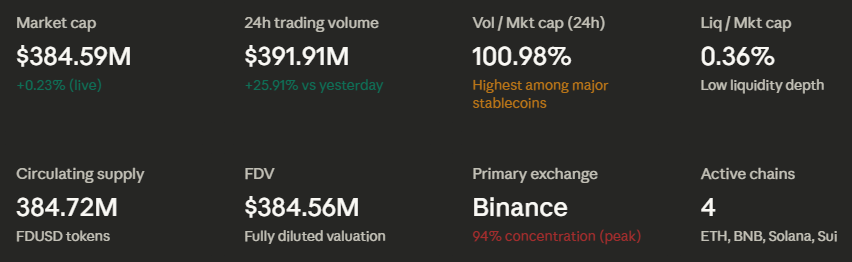
The current CoinMarketCap ranking is #93, with a live market cap of $384 million and a circulating supply of 384 million FDUSD coins.
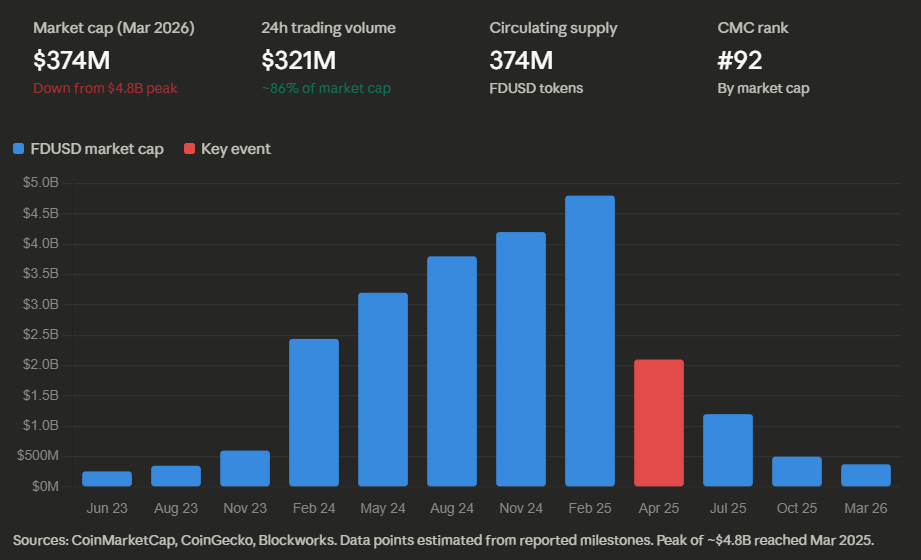
The red bar at April 2025 marks the Justin Sun depeg incident, after which supply contracted sharply and has not recovered.
This chart is the defining visual of FDUSD's story: built by a single exchange, dependent on a single exchange, and vulnerable to a single exchange's decisions.
Origin: Built to Replace BUSD
FDUSD's origin cannot be separated from Binance's regulatory crisis with BUSD. The BUSD phaseout completed a process that began in February 2023, when a NYDFS order halted further BUSD mints from then-partner and issuer Paxos.
BUSD's market cap had since fallen from a peak of $23 billion to merely $3 billion.
Following the discontinuation of support for Binance's native stablecoin BUSD, Binance encouraged users who hold BUSD stablecoin assets to transition to FDUSD in an official statement issued September 1, 2023.
From January 2, 2024, BUSD withdrawals were disabled and any remaining BUSD balances in users' Binance accounts were automatically converted to FDUSD at a 1:1 conversion rate.
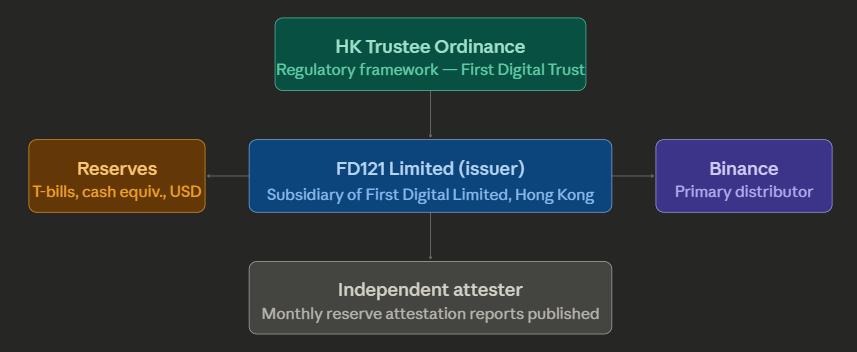
FDUSD is issued by First Digital Labs, a subsidiary of digital asset custodian First Digital Trust, regulated under the Hong Kong Trustee Ordinance. FDUSD is backed one-for-one with U.S. dollar reserves or highly liquid, high-quality assets held in regulated Asian financial institutions that cannot be commingled with other First Digital assets.
The timing of FDUSD's launch, June 1, 2023, was not coincidental. The launch coincided with the first day of retail cryptocurrency trading in Hong Kong under new regulatory guidelines, which had led to a rapid uptick of crypto-related activity in the region.
The Binance Dependency
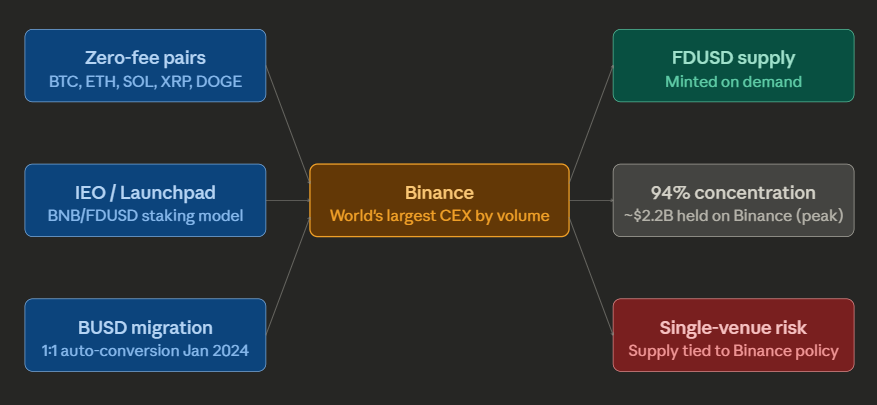
No stablecoin is more concentrated in a single venue than FDUSD. The zero-fee program is the mechanism that explains both its rise and its vulnerability.
Binance added BTC/FDUSD and ETH/FDUSD trading pairs in August 2023 and extended zero-fee Bitcoin trading to include the BTC/FDUSD pair, with users enjoying zero maker fees on the ETH/FDUSD pair until further notice.
In December 2023, Binance introduced zero-fee trading for BNB/FDUSD, DOGE/FDUSD, ETH/FDUSD, LINK/FDUSD, SOL/FDUSD and XRP/FDUSD spot and margin trading pairs.
The result was extraordinary volume. FDUSD's volume climbed 51.1% to $122 billion in January 2024, making it the second most popular trading pair after Tether's USDT. FDUSD trading pairs comprised 38%, an all-time high, of total spot trading volume on Binance as of February 12, 2024, a 42.6% increase compared to the prior month.
Binance also continues to offer zero-fee trading on select BTC and FDUSD spot pairs as of 2026, though promotional intensity has reduced significantly since the 2024 peak.
The April 2025 Depeg
The single most important event in FDUSD's history occurred on April 2, 2025. Tron founder Justin Sun blasted First Digital, the issuer of FDUSD, in a tweet alleging that the Hong Kong-based firm was "effectively insolvent and unable to fulfill client fund redemptions" for its stablecoin. FDUSD saw a significant depeg to $0.91, with a market cap loss of about $200 million.
First Digital responded: "The recent allegations by Justin Sun against First Digital Trust are completely false. This dispute is with TUSD and not with $FDUSD. First Digital is completely solvent. Every dollar backing $FDUSD is completely, secure, safe and accounted for with US backed T-Bills."
The root cause traced back to a $456M dispute between Techteryx, the issuer of TrueUSD, and First Digital over allegedly misused TUSD reserves, not FDUSD funds. The incident caused a $130 million drop in FDUSD's market cap.
Binance holds approximately $2.2 billion worth of FDUSD, the majority of which represent customer deposits. "BTC/FDUSD is historically the most traded pair on Binance, so this disruption is a big deal," Coinbase director Conor Grogan said.
Reserve Structure and Regulatory Standing
FDUSD reserve assets are custodied by First Digital Trust Limited, a licensed Trust or Company Service Provider under Hong Kong's Anti-Money Laundering and Counter-Terrorist Financing Ordinance, and a registered trust company under the Trustee Ordinance.
Reserve assets are fully segregated from the trust company's assets to isolate against bankruptcy.
FDUSD is 100% backed by cash and cash equivalents, guaranteeing 1:1 USD redemption. Monthly reserve reports and independent attestations are published. Reserves are held by First Digital Trust Ltd., a public trust company registered in Hong Kong, and at financial institutions in Switzerland, Australia, and Hong Kong.
FDUSD smart contracts implement the ERC-20 Token Standard and are audited by PeckShield and Quantstamp. FDUSD is currently issued on Ethereum, BNB Chain, Solana, and Sui.
Hong Kong's regulatory framework is not equivalent to U.S. OCC or EU MiCA oversight in terms of global institutional recognition. First Digital Labs is actively working to secure regulatory authorization for its stablecoin issuance activities from a recognized and reputable financial regulatory authority.
Hong Kong's continued development of its cryptocurrency regulatory framework positions FDUSD favorably for future growth.
FDUSD's Programmability
FDUSD was designed from launch with programmability as a core feature, and this remains its most compelling long-term angle, even if real-world adoption of these features has been limited.
The stablecoin is programmable and capable of enabling the execution of financial contracts, escrow services, and insurance without intermediaries.
FDUSD can be programmed to facilitate financial contracts, escrow services, and insurance without the need for intermediaries. This programmability opens up new possibilities for automating and streamlining various financial processes, making them more efficient and transparent.
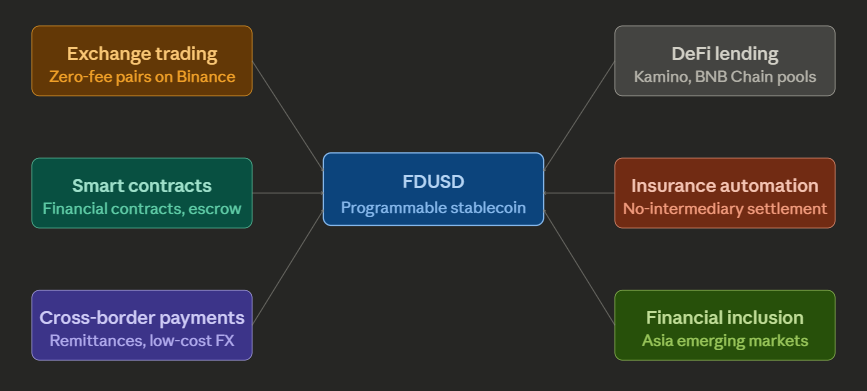
The programmability features have not yet driven meaningful adoption outside Binance's exchange environment.
The use cases, escrow, automated insurance, trustless financial contracts, are real and valuable, but require an ecosystem of builders choosing FDUSD as their stablecoin of choice. That ecosystem has not materialized at scale.
FDUSD vs. Other Stablecoins
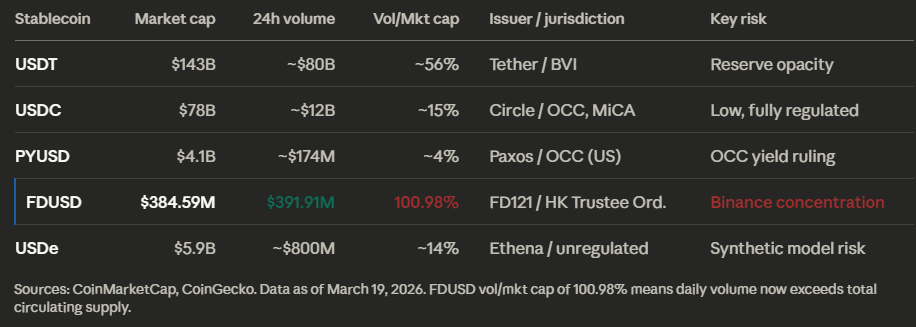
The most striking number in this table is FDUSD's 24h volume of $391.91 million against a market cap of $384.59 million, a vol/mkt cap ratio of 100.98%. That means daily trading volume has now exceeded the entire circulating supply. No major stablecoin approaches this.
- For USDC the ratio sits around 15%.
- For USDT it is around 56%.
FDUSD's ratio reflects its identity: it is not money people hold, it is money people trade, and every token in circulation is turning over more than once a day, almost entirely on Binance.
FDUSD Summary Scorecard
Conclusion
FDUSD in Q1 2026 is a stablecoin in search of a second act. Its first act was clearly defined: replace BUSD, dominate Binance trading pairs, ride zero-fee promotions to a multi-billion market cap. That act ended in April 2025 when a reputational attack compressed supply and shook institutional confidence, and Binance's reduced promotional intensity failed to arrest the decline.
The programmability narrative is the most credible path forward. Smart contract-native escrow, automated financial contracts, and insurance settlement without intermediaries are genuinely useful applications, and FDUSD is built for them from the ground up. But building that ecosystem requires competing with USDC and USDT in DeFi contexts where they have years of liquidity depth and developer familiarity.
FDUSD's fate in 2026 is binary: either Binance re-intensifies promotional support and supply rebounds, or it stabilizes at sub-$500M as a niche Binance-native stablecoin while programmability use cases develop slowly in the background.
A third outcome, genuine breakout independent of Binance, would require the kind of institutional DeFi partnerships or enterprise adoption that has not yet materialized.
Read Next:
FAQs:
1. What is FDUSD and who issues it?
FDUSD is a 1:1 USD-backed stablecoin issued by FD121 Limited, a subsidiary of Hong Kong-based First Digital Limited. It launched in June 2023, is regulated under the Hong Kong Trustee Ordinance, and holds reserves in segregated accounts with monthly independent attestations.
2. How does FDUSD differ from USDC and USDT?
FDUSD differs from USDC and USDT in jurisdiction, distribution, and design. USDC operates under U.S. OCC oversight, USDT under Tether's BVI structure, both distributed across hundreds of venues. FDUSD operates under Hong Kong's Trustee Ordinance and is almost entirely a Binance product.
3. Why did FDUSD's market cap collapse from $4.8B to $374M?
FDUSD's market cap collapsed from $4.8B to $374M due to two factors: Binance reduced the intensity of its zero-fee promotional program, and the April 2025 Justin Sun depeg incident caused a 9% peg deviation and $130M in immediate market cap losses.
4. What was the Justin Sun depeg incident?
The Justin Sun depeg incident occurred on April 2, 2025, when Sun publicly alleged First Digital Trust was insolvent. FDUSD dropped to $0.87–$0.91 on Binance. First Digital denied the allegations, confirmed reserves were fully backed by U.S. T-bills, and announced legal action against Sun. The peg recovered within 24 hours, but supply contraction accelerated.
5. What blockchains does FDUSD operate on?
FDUSD operates on four blockchains: Ethereum, BNB Chain, Solana, and Sui. BNB Chain dominates by activity, reflecting its Binance-native identity. Smart contracts on all chains are audited by PeckShield and Quantstamp.
Disclaimer:
This content is provided for informational and educational purposes only and does not constitute financial, investment, legal, or tax advice; no material herein should be interpreted as a recommendation, endorsement, or solicitation to buy or sell any financial instrument, and readers should conduct their own independent research or consult a qualified professional.