
Table of Contents
Digital asset compliance is simply the set of rules and internal processes that allow cryptocurrencies and other tokens to play by the same rules as the rest of the financial world. It’s all about following regulations built to prevent financial crime, protect consumers, and keep the market fair.
Think of it as the bridge connecting the innovative, fast-paced world of digital assets with the established standards of global finance.
What Digital Asset Compliance Really Means

At its heart, compliance isn’t about slowing things down. It’s about building the trust needed for crypto to go mainstream. Without any rules, the digital marketplace would be the Wild West—chaotic, risky, and a complete non-starter for serious investors. Compliance brings the order and predictability that institutions and everyday users need to feel confident.
This whole framework really stands on three core pillars. If one is weak, the entire structure is shaky.
The Three Pillars of Compliance
First up is Anti-Money Laundering (AML). These are the procedures that stop bad actors from using crypto to wash dirty money. It means actively monitoring transactions for suspicious activity and reporting it to the authorities, which helps throw a wrench in criminal operations.
Next, you have Know Your Customer (KYC). You can't have a real AML program without it. KYC is the process of verifying that your customers are who they claim to be. This simple step is a powerful defense against fraud, identity theft, and criminals trying to open anonymous accounts.
The third pillar involves market integrity rules. These regulations exist to create a level playing field for trading. They outlaw shady practices like wash trading or insider trading, which protects investors and builds genuine confidence in an asset’s true value.
A strong compliance framework is the engine for institutional investment. It transforms digital assets from a speculative niche into a legitimate asset class, paving the way for products like ETFs and integration with traditional banking.
Why Compliance Is a Superpower for Stablecoins
This foundation is non-negotiable for stablecoins, which are designed to be a dependable digital dollar. For a stablecoin to be trusted as a medium of exchange, users and regulators have to be certain it isn't a tool for illegal activity. A rock-solid compliance program is a signal of security and legitimacy.
It’s what makes a stablecoin attractive for everything from global payments to DeFi. If you want to get into the nuts and bolts of how these assets work, feel free to check out our detailed guide on what digital currency is.
In the end, digital asset compliance provides the guardrails the industry needs to grow up. It's the essential step that turns a disruptive idea into a reliable piece of the global economy.
Navigating the Global Regulatory Maze
Stepping into digital asset compliance feels like opening a world atlas where every country has drawn its own borders, often with overlapping and conflicting lines. This isn't just a map-reading exercise; it's the bedrock for any project that wants to operate globally and build lasting trust.
You don’t need to memorize every single law. The key is to spot the major trends and the big, influential frameworks that are setting the tone for everyone else. Think of it as learning the main highways before you start exploring the side streets—it gives you a much better view of where the industry is actually heading.
The EU Drops the Hammer with MiCA
For years, the crypto world felt like the Wild West. Then the European Union stepped in with its Markets in Crypto-Assets (MiCA) regulation, and everything changed. This wasn't just another rule; it was the first time a major economic power created a single, comprehensive rulebook for digital assets.
MiCA put an end to the guesswork for all 27 member states, creating clear definitions and strict operational rules for issuers and service providers. It was a clear signal to the rest of the world that the era of regulatory ambiguity was coming to an end.
This framework is a huge deal for stablecoins in particular. MiCA lays down non-negotiable rules for issuers, forcing them to hold proper reserves, operate with transparent governance, and guarantee redemption rights for users. Our deep dive into https://stablecoininsider.org/stablecoin-regulations/ explores these nuances and what they mean for the future of digital money.
The United States: A Patchwork in Progress
While the EU built a single highway, the United States is still paving a network of local roads. The U.S. approach is fragmented, with rules coming from a handful of powerful agencies—the Securities and Exchange Commission (SEC), the Commodity Futures Trading Commission (CFTC), and the Treasury are the main players.
For a long time, U.S. regulation has been defined by enforcement actions, where agencies essentially apply old financial laws to new crypto cases. It's a "regulate by lawsuit" model. But the tide is turning, and there's a real push to create clear, proactive legislation. It’s a slower process, but it reflects the challenge of fitting a new asset class into one of the world's most intricate financial systems. The lesson here? In the U.S., you have to keep one eye on the agencies and the other on Congress.
Navigating this global scene means understanding the inherent complexities, like the challenges of cross-border Bitcoin compliance. Businesses have to stay on top of how different jurisdictions handle everything from custody to transaction reporting.
The Global Baseline: FATF's Travel Rule
Even as nations figure out their own rules, one global body is setting the ground floor for fighting financial crime. The Financial Action Task Force (FATF) doesn't write laws itself, but its recommendations carry immense weight, and member countries are expected to adopt them.
One of its biggest impacts on crypto comes from the "Travel Rule."
In simple terms, the Travel Rule forces Virtual Asset Service Providers (VASPs)—think exchanges and custodial wallets—to collect and share customer information for transactions over a certain amount. It’s the crypto version of the information-sharing rules that have been standard in banking for decades.
This rule is designed to strip away the anonymity that makes crypto attractive for money laundering. It ensures that a clear data trail "travels" with every transaction, giving authorities a way to follow the money. Implementing it has been a massive headache for the industry, but it's a non-negotiable part of becoming a legitimate financial player.
To help put these different approaches into perspective, here's a quick side-by-side comparison.
Key Global Regulatory Frameworks at a Glance
This table offers a snapshot of the major regulatory frameworks, highlighting what they focus on and how they specifically impact stablecoin projects.
| Regulatory Framework | Jurisdiction | Primary Focus | Key Impact on Stablecoins |
|---|---|---|---|
| MiCA | European Union (27 member states) | Creating a single, harmonized market for crypto-assets with clear licensing and operational rules. | Establishes strict reserve, governance, and redemption requirements for all stablecoin issuers. |
| U.S. Agency-Led | United States | Applying existing securities, commodities, and banking laws through agency guidance and enforcement. | Regulation is evolving, with a focus on defining stablecoins as securities or payment systems. |
| FATF Standards | Global (Member Countries) | Setting international standards for Anti-Money Laundering (AML) and Counter-Terrorist Financing (CFT). | Mandates the "Travel Rule," requiring VASPs to share originator and beneficiary data for transactions. |
Ultimately, finding your way through this maze requires being nimble and proactive. As the rules get clearer, the line between a compliant, trustworthy project and a risky, unregulated one is becoming impossible to ignore—and it directly impacts everything from market access to investor confidence.
Building a Bulletproof Compliance Program
Knowing the rules of the road is one thing; actually building a vehicle that can navigate them safely is another entirely. That’s the difference between understanding digital asset regulations and implementing a truly robust compliance program. This isn't about a dusty binder on a shelf—it's about creating a living, breathing system that becomes part of your company's DNA. It's your blueprint for building trust and ensuring you're still in business years from now.
So, how do you move from theory to practice? Every solid compliance program rests on four critical pillars: strong governance, a sharp risk assessment, practical internal controls, and ongoing independent testing. Get these right, and you’ll have a formidable defense against financial crime and regulatory heat.
The regulatory landscape itself is a patchwork quilt, with major economies stitching together their own approaches. This map gives you a sense of why a universal, principles-based compliance structure is so important.
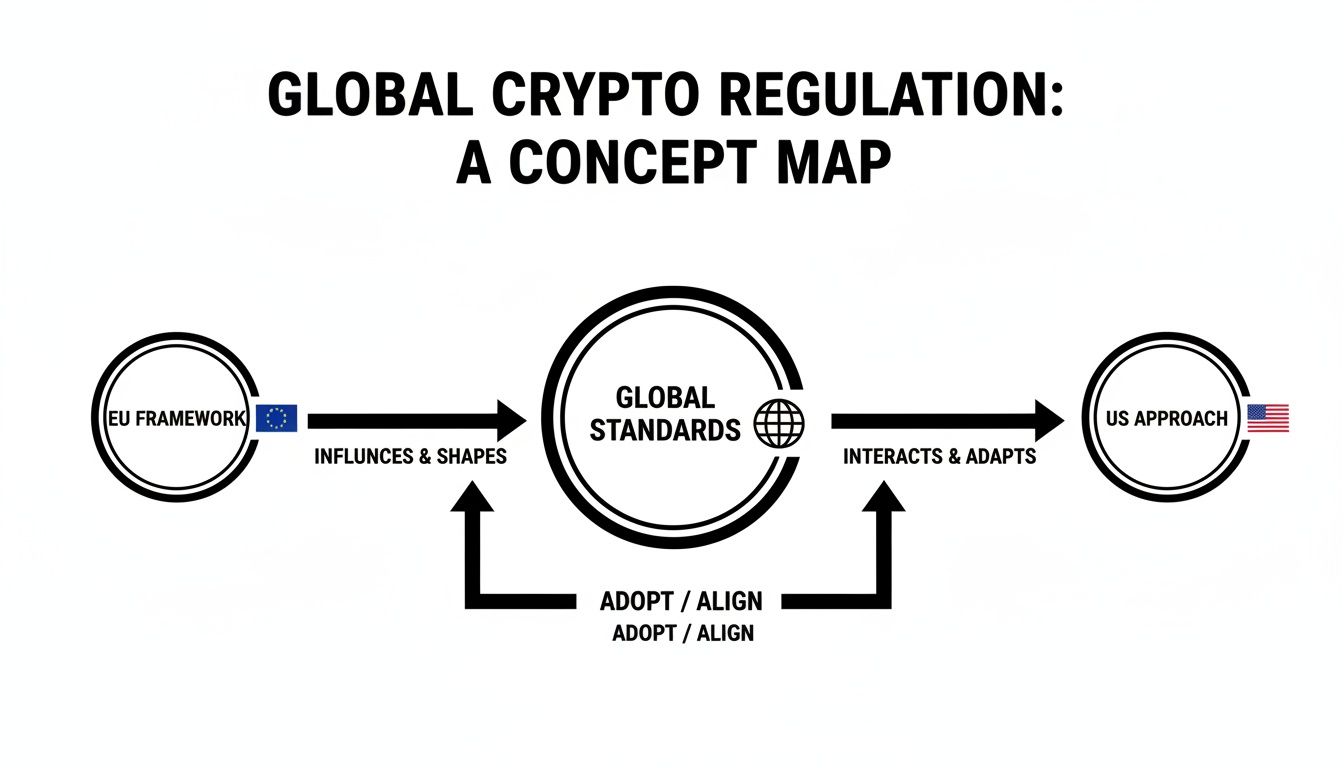
As you can see, regions like the EU and the US are forging distinct paths, but they’re all influenced by overarching global standards from bodies like the Financial Action Task Force (FATF).
Establishing Strong Governance
Compliance always starts at the top. Without buy-in from the board and senior leadership, any program is doomed to fail. Strong governance means fostering a culture of compliance where every single person, from the CEO down, understands their role in protecting the business.
This isn't just about hiring a Chief Compliance Officer. It's about tangible, documented commitment.
- Clear Policies: You need board-approved, written policies for everything from AML and KYC to sanctions screening.
- Defined Roles: Who is responsible for what? Spell it out. Ambiguity is the enemy of compliance.
- Ongoing Training: The threats and rules are always changing, so your team's education can't be a one-and-done event.
When leadership champions compliance, it becomes a shared responsibility, not just one department's problem.
Conducting a Thorough Risk Assessment
You can't defend against threats you haven't identified. A risk assessment is your process for systematically finding, measuring, and understanding the specific illicit finance risks your business is exposed to. This is a continuous exercise, not a one-time checklist. Every new product, new market, or new type of customer demands a fresh look. For a deeper dive, it helps to understand foundational risk management principles.
Your assessment needs to dig into the specifics of your operations:
- Customers: Are you onboarding high-risk clients like Politically Exposed Persons (PEPs)?
- Products: Do any of your offerings have features that could attract bad actors, like privacy coins or high-speed cross-border transfers?
- Geography: Are you operating in or touching jurisdictions known for money laundering or sanctions evasion?
The output of this process is a detailed risk profile that tells you exactly where to focus your resources.
Think of a risk assessment as a heat map for your business. It illuminates the hot spots, allowing you to deploy your defenses where they're needed most instead of just guessing.
Implementing Essential Internal Controls
If policies are the "what," then internal controls are the "how." These are the day-to-day procedures and technology you put in place to manage the risks you just identified. They are the engine of your compliance program.
At a minimum, your controls must cover these core areas:
- Customer Identification Program (CIP): This is the foundation of KYC. You need a rock-solid process for verifying who your customers are, using reliable, independent documents and data.
- Transaction Monitoring: You need a system—often using blockchain analytics tools—to spot weird or suspicious patterns that could signal money laundering. Think sudden, large transfers or a web of transactions designed to obscure the source of funds.
- Sanctions Screening: Your customer lists and all transactions must be continuously checked against global blacklists, like the OFAC Specially Designated Nationals (SDN) list.
- Reporting and Recordkeeping: You need a clear, efficient process for filing Suspicious Activity Reports (SARs) with the proper authorities and keeping detailed records for at least five years.
These controls have to be customized for your business, especially around the unique challenge of safeguarding digital assets. To get a better handle on this, check out our guide on the different digital asset custody solutions available.
Finally, no program is truly bulletproof without a regular check-up. Independent audits, conducted by a qualified third party, are non-negotiable. They stress-test your controls, find the weak spots you might have missed, and ensure your program is keeping up with the ever-changing rules. It's the ultimate proof to regulators, partners, and investors that you take compliance seriously.
The Technology Powering Modern Compliance

Smart compliance in digital assets isn’t just about having the right policies on paper; it's about having the right technology to actually enforce them. In an industry that moves at the speed of the blockchain, trying to keep up manually is a losing game. This is where Regulatory Technology, or RegTech, comes into play.
Think of RegTech as the central nervous system for your compliance program. It’s the engine that monitors, detects, and reports on risks as they happen, turning abstract rules into concrete actions. Without a solid tech stack, even the most carefully written compliance manual is just gathering dust.
The Rise of Blockchain Analytics
At the heart of any digital asset compliance setup, you'll find blockchain analytics. These incredibly powerful platforms are the industry's answer to transaction monitoring, giving us a window into the flow of funds that was unimaginable a decade ago.
Tools from companies like Chainalysis or TRM Labs are like financial detectives for the on-chain world. They sift through billions of data points on public ledgers, tracing the path of assets from one wallet to the next and automatically flagging anything that looks suspicious.
Here’s how it works in practice:
- Real-Time Screening: Every single transaction gets instantly checked against massive databases of illicit addresses, such as those tied to sanctions, terrorist financing, or darknet markets.
- Wallet Risk Scoring: The systems assign a risk score to wallets based on their entire transaction history, helping compliance teams focus on the most urgent alerts first.
- Source of Funds Tracing: They can help you figure out if incoming funds are coming from a legitimate, regulated exchange or from a high-risk, unhosted wallet.
This kind of technology is absolutely essential for meeting your AML obligations and giving regulators the crystal-clear audit trails they now expect.
Secure Record-Keeping and Attestations
Beyond just watching transactions, technology is crucial for maintaining the integrity of records and reserves—a major focus for regulators everywhere. Digital asset firms have to prove they are who they say they are and, more importantly, that they actually hold the assets they claim to.
This is especially true for stablecoin issuers and custodians. You need secure, tamper-proof systems to document every customer interaction and transaction. It's like a digital vault that needs to be impenetrable to both hackers and regulatory auditors. For a deeper dive, our overview of different approaches to stablecoin security unpacks these challenges further.
The final piece of the puzzle is third-party attestations. These are independent verifications, often done by major accounting firms, that use technology to confirm a company’s financial statements or reserve holdings are accurate. For a stablecoin, this means providing cryptographic proof that every token out there is backed by a real-world asset.
Connecting Tech to Regulatory Mandates
Ultimately, the goal of all this tech is to satisfy specific regulatory demands. A perfect example is the direct line between proof-of-reserves monitoring and the strict rules in the EU's MiCA regulation. MiCA doesn't just ask stablecoin issuers to claim they have reserves; it forces them to prove it with data that can be independently verified.
This isn't just a European trend; it's happening globally. The United States, for instance, has climbed to sixth in global digital asset regulation, partly because of big moves like creating a Strategic Bitcoin Reserve and U.S. Digital Asset Stockpile. This initiative centralized over 207,000 BTC (worth about $17 billion) and other assets. You can find more on this global shift in crypto asset risk on Coincub.
At the end of the day, this technology isn’t just about avoiding fines. It’s about building a foundation of trust with your users and with regulators, proving that the digital asset economy can be both innovative and responsible.
What Compliance Means for Your Role
Digital asset compliance isn't a one-size-fits-all problem. It’s a completely different puzzle depending on where you sit at the table. A developer architecting a new protocol has a vastly different set of concerns than an investor sizing up its potential or a FinTech leader figuring out how to plug it into their regulated platform.
The key to navigating this space without getting burned is understanding your specific slice of the responsibility pie. Abstract rules and regulations suddenly become clear, actionable steps when you look at them through the lens of your unique role.
Let’s break down what this actually means for the key players on the ground.
Guidance for Investors
For an investor, thinking about compliance isn't just about ticking a legal box—it’s one of the most powerful risk management tools you have. A project that’s cavalier about its regulatory duties is screaming that it doesn't care about stability or protecting its users. Those are massive red flags.
Your due diligence has to go way beyond tokenomics and the slickness of the tech. You need to get your hands dirty and really dig into the project's regulatory risk profile.
- Look for a Real KYC/AML Policy: Do they have a clear, public, and well-documented process for identifying users and watching out for shady transactions? If they can't clearly explain their anti-money laundering strategy, walk away.
- Find Their Legal Home: Where is the project legally based? An entity registered in a place with clear, robust rules (like the EU under MiCA) is a much safer bet than one operating out of a known tax haven with toothless oversight.
- Demand Independent Audits: Serious projects voluntarily bring in third-party firms to audit their code and their books. A total lack of independent audits should set off alarm bells.
A project’s stance on compliance tells you everything about its maturity. The serious players see regulation as the bridge to mainstream adoption. The fly-by-night operations treat it like an annoying obstacle to get around.
Think about it this way: you wouldn't sink your money into a traditional company that refused to produce financial statements or explain its corporate governance. The exact same logic applies here. A commitment to compliance is really a commitment to transparency and building something that lasts.
Guidance for Developers
If you’re a developer, you are the first line of defense. The code you write can either become a compliance nightmare down the road or solve problems from the very beginning. This idea is what we call “compliance-by-design.”
It’s the difference between building a product and then trying to duct-tape compliance features on later, versus embedding those safeguards right into the core architecture. This proactive approach saves an incredible amount of time, money, and headaches from costly rebuilds.
Your goal should be to build systems that are not just functional, but also completely auditable.
- Integrate Identity From Day One: Build the hooks for KYC solutions right into your platform from the start. This could be as simple as integrating with an identity verification API or designing smart contracts that can read identity-based tokens.
- Lock Down Your Data: Create secure, unchangeable logs of all transaction and user data. Regulators demand meticulous records, often for at least five years. Your system has to be able to pull those records without fail.
- Automate Sanctions Screening: Hard-code automated checks against official sanctions lists (like OFAC's SDN list) directly into your transaction flow. This blocks bad actors from ever touching your platform.
Building with compliance in mind isn't about killing creativity. It's about future-proofing your work and making sure it can safely plug into the wider financial world.
Guidance for FinTech Leaders
For established FinTechs and banks, jumping into digital assets is a huge opportunity, but it brings a whole new world of complex risks. Your main job is to stretch your existing, battle-tested compliance framework to cover the weird and wonderful attributes of this new asset class.
Your regulators aren't going to give you a pass. They will expect you to apply the same level of discipline to crypto as you do to stocks or wire transfers. This means you have to tailor your current programs to handle crypto-specific threats, from managing cryptographic keys to the tricky business of tracing funds from unhosted wallets.
Here are a few key strategies:
- Double Down on Vendor Due Diligence: If you’re partnering with a crypto sub-custodian or a liquidity provider, your due diligence has to be absolutely exhaustive. When they mess up, you're the one on the hook.
- Update Your Risk Assessments: Your old models won’t cut it. You need to update them to account for things like smart contract exploits, blockchain forks, and the risk of dealing with anonymous wallets.
- Train Your Team and Your Board: Make sure your leadership and your compliance staff actually understand this technology. Safe and sound operations are impossible if your people don't know what they're managing.
By treating digital assets as just another new product within your existing risk culture, you can innovate with confidence and grab the upside without jeopardizing your hard-won regulatory standing.
What's Next for Digital Asset Compliance?
The digital asset world doesn't stand still, and neither does compliance. If you're not looking ahead, you're already behind. Thinking about what's coming next isn't just about dodging fines; it’s about making smart, strategic decisions that ensure your project survives and thrives. As the crypto industry grows up, we're moving past reactive, patch-it-later fixes and toward building compliance in from the ground up.
Several powerful trends are shaping the future of digital asset compliance. These aren't just hypotheticals—they are real-world challenges and opportunities that teams are tackling today. Getting a handle on them is the only way to build a compliance program that won't break when the next regulatory wave hits.
The DeFi Compliance Puzzle
For a long time, decentralized finance (DeFi) operated in a kind of regulatory Wild West. Well, that era is officially over. Regulators are now determined to apply time-tested financial rules, like AML and KYC, to DeFi protocols. This creates a massive headache: how do you verify identities on a system that's designed to be open and permissionless for anyone?
Thankfully, some genuinely clever solutions are starting to gain traction. We're seeing the rise of:
- On-chain identity solutions: Think of these as digital passports for your wallet. They use things like verifiable credentials or non-transferable "soulbound" tokens to link a wallet to a real-world identity without handing your data over to a central company.
- Permissioned liquidity pools: Many protocols are creating separate, walled-off pools for institutions and verified users. This gives big players a compliant space to operate while connecting them safely to the broader world of DeFi.
- Zero-knowledge proofs: This is some next-level cryptography. It lets you prove something is true—for instance, that you aren't on a sanctions list—without actually revealing the sensitive personal data behind that fact.
These tools are crucial for building a bridge between the core ideals of decentralization and the practical demands of global financial regulation.
Smarter Enforcement and Global Teamwork
Regulators are getting much, much better at using technology to monitor the crypto ecosystem. The days of thinking on-chain activity was a mysterious black box are long gone. Global enforcement agencies now deploy sophisticated blockchain analytics tools that can trace illicit funds across different chains and countries with stunning accuracy.
This tech-up is happening alongside much tighter international cooperation. Agencies like the FBI in the U.S. and Europol in the EU are sharing intelligence and running coordinated operations to take down criminal organizations that exploit crypto.
The message from regulators is crystal clear: compliance isn't optional, and the blockchain is not a hiding place. Every transaction is a permanent record, and they're getting better at reading the story it tells every single day.
The Next Regulatory Frontiers
With foundational issues like money laundering and market integrity getting more attention, regulators are now shifting their focus to the next set of challenges. The conversations happening right now will set the rules of the game for years to come.
Here are the key areas to keep a close eye on:
- Self-Custodial Wallets: How to handle unhosted or "self-custody" wallets is still a major point of debate. Finding the right balance between a user's right to privacy and the need to stop illicit finance is a tough nut to crack, and the rules will keep changing.
- Privacy-Enhancing Technologies: Tools that obscure transactions, like crypto mixers and privacy coins, are under a microscope. Regulators are trying to figure out how to allow for legitimate privacy use cases while cracking down on their use for money laundering.
- Stablecoin Oversight: The stability and transparency of stablecoins are a top concern for financial watchdogs globally. As these assets become more woven into our financial system, expect even stricter demands for proof of reserves and operational safeguards. For a deep dive into what's on the horizon, check out our analysis of the future of stablecoins.
At the end of the day, digital asset compliance isn't a one-and-done checklist. It's a journey. The projects that will last are the ones that learn to adapt, innovate, and weave regulatory awareness into their DNA from day one.
Frequently Asked Questions
What’s the Difference Between AML and KYC?
It's helpful to think of KYC (Know Your Customer) as one of the most important tools in your AML (Anti-Money Laundering) toolkit. KYC is the hands-on process of actually verifying who your customers are—checking their ID, making sure they're not on a watchlist, and getting a sense of the risk they might pose.
AML, on the other hand, is the entire strategy. It’s the whole playbook of policies, internal controls, and technologies a firm puts in place to fight financial crime. So, KYC answers the question, "Who is this person?" while AML is the complete system that stops bad actors from using your platform for illegal purposes.
Does Digital Asset Compliance Apply to DeFi?
Absolutely, and more so every day. Regulators around the world are making it clear that if a DeFi protocol acts like a traditional financial service—say, a lending platform or an exchange—then it needs to play by similar rules.
This shift is why we're seeing the rise of "Regulated DeFi," where protocols might require identity verification before you can jump into certain high-value liquidity pools. The core idea is simple: the compliance obligation follows the financial activity, regardless of the underlying technology.
This is a tricky area, for sure, but it's a necessary step for DeFi to mature and connect with the global financial system. By blending decentralized innovation with time-tested principles of market integrity, we're paving the way for serious institutional investment.
What Is the Crypto Travel Rule?
The Travel Rule is a global standard from the Financial Action Task Force (FATF) that’s designed to bring more transparency to crypto transactions. It requires virtual asset service providers (like exchanges) to collect and share originator and beneficiary information for transactions that cross a certain value threshold.
Think of it as the crypto equivalent of the information sharing that’s been required for bank wires for decades. It's all about creating a clear audit trail to prevent funds from being moved around anonymously for money laundering or terrorist financing.